Blessed

Christ Pantocrator (Lord of Creation) icon

by Jim Forest

In English the first verses of the Sermon on the Mount are called “the beatitudes.” The traditional Russian phrase is “the commandments of blessedness.” The first word of each beatitude isn’t an everyday word. We have to ask ourselves before going further what blessed and beatitude mean.

Beatitude comes from the Latin word beatus, meaning happy, fortunate, blissful. In the context of the gods in Elysium, it meant supremely happy, in a state of pure bliss. In the late fourth century, beatus was the word Saint Jerome opted for in his translation of the “blessed are” verses.

“I would expect that, like so many other Latin writers, Jerome was assuming that the meaning would enlarge within its textual context,” Latin scholar Harold Isbell tells me. “However don’t overlook the possibility that because Greek is a more nuanced language, it conveys degrees of meaning which the hard-headed Roman would not suspect. Then there is ‘beatific,’ as in ‘beatific vision,’ which in the Christian tradition of the west refers specifically to the vision of God, an entirely appropriate but quite unmerited fruit of God’s creative act.”

While most English Bibles use “blessed,” some modern translations prefer “happy”: “How happy are the poor of spirit . . .”

“‘Happy’ isn’t good enough,” Rabbi Steven Schwarzschild once told me. “The biblical translator who uses such a word should change jobs, maybe write TV comedies with nice, tidy, happy endings. The problem is that, if you decide you don’t like ‘blessed,’ there isn’t a single English word which can take its place. You might use a phrase like ‘on the right track’ or ‘going in the right direction.’ Sin means being off the track, missing the target. Being ‘blessed’ means you aren’t lost — you’re on the path the Creator intends you to be on. But what you recognize as a blessing may look like an affliction to an outsider. Exchanging ‘blessed’ for ‘happy’ trivializes the biblical word. You might as well sum up the Bible with a slogan like, ‘Have a nice day .’”

“Happy” in some respects makes for an unhappy translation. Its root is hap, the Middle English word for “luck.” The word happen is a daughter word. A happenstance approach to life is to let things happen as they will, to depend on the roll of the dice. To act in a haphazard manner is to do things by chance. To be hapless is to be unlucky, but to have good luck is to be a winner. The lucky person, the happy person, has things going his way. We say certain people were born under a lucky star — they seem to get all the breaks, everything from good looks to money in the bank.

The founding fathers of the United States, in declaring independence from Britain, recognized “life, liberty and the pursuit of happiness” as inalienable rights. For them, the pursuit of happiness meant each person had the right to seek his own good fortune and not simply be the servant of another. In our era, in which happiness is somewhere between a human right and a social duty, many people feel guilty for failing to be continually happy.

But what about the word “blessed”? This was the word chosen by the translators of the Authorized Version in the seventeenth century. Blessed meant something consecrated to or belonging to God.

All the Gospels were first written in Greek. In those passages where “blessed” is a verb, the Greek is eulogeo (“to bless”) — an action associated with praise, thanksgiving and consecration, and therefore used in liturgical contexts. For example: “And as they ate, Jesus took bread and blessed and broke it and gave it to them, saying, ‘Take, eat, this is my body’.” (Mark 14:22)

Where “blessed” is used as an adjective, it is a translation of makarios. It is makarios which is used throughout the beatitudes. We also hear it also in such texts as, “Blessed are your eyes for they see, and your ears for they hear” and, “Blessed are you, Simon Bar-Jona, for flesh and blood has not revealed this to you, but my Father in heaven.” (Mt 13:16, 16:17)

In classical Greek makar was associated with the immortal gods. Kari means fate or death, but with the negative prefix “ma” the word means being deathless, no longer subject to fate, a condition both inaccessible and longed for by mortals. It was because of their immortality that the gods, the hoi Makarioi, were the blessed ones.

“The interesting thing about ashre [the Hebrew word for blessed] is that it is never, so far as I know, applied to God,” Archimandrite Ephrem Lash points out. “On the other hand the Greek makar starts life as precisely something which the gods are, though the related adjective makarios is more commonly applied to humans.”

In Christian use, makarios came increasingly to mean sharing in the life of God, the ultimate joy, a happiness without the fault lines of happenstance running through it. There is no higher gift. We are not simply capable of an abstract awareness that God exists or of studying God as an astronomer might study the night sky all the while knowing the stars are unbridgeable distances away, that their light may be centuries old by the time it reaches our eyes and that the objects which produced the light may no longer exist. The blessing extended to us is participation in the communion of the Holy Trinity, sharing in God’s immortality, and being blessed with qualities which seem humanly impossible.

So what does “blessed” mean? It means those who are already, in this life, risen from the dead, people whose choices are not driven by fear and death. “Risen from the dead are the poor in spirit… Risen from the dead are they who mourn…”

* * *

[This is a slightly shortened extract from The Ladder of the Beatitudes by Jim Forest, published by Orbis Books, 1999; not to be published without the author’s permission]

* * *

Resurrecting Easter

by Jim Forest

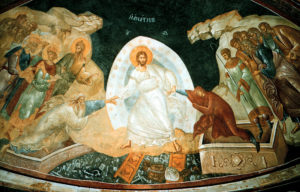
Anastasis (Chora Church in Istanbul)

In his book Orthodoxy, G.K. Chesterton describes a British explorer setting off to discover a new island in the South Seas but by miscalculation landing instead at the Pavilion at Brighton — a pagan temple, he assumes, used by the local cannibals.

The explorer who merely discovers his own back yard may look like a blockhead to the detached observer, Chesterton comments, but his mistake is really an enviable one. For “what could be more delightful than to have in the same few minutes all the fascinating terrors of going abroad combined with all the humane security of coming home again?”

Chesterton’s point was that it is time for Christians to rediscover their own religion, at the very center of which is Christ risen from the dead.

Easter is, of course, as familiar to us as the Brighton Pavilion is to the English. Pascha (from the Hebrew word for Passover) is celebrated in every church whatever its theological and liturgical tendency. In even the most holiday-resistant Quaker Meeting, at least one voice will be raised out of the silence on Easter Sunday to take note of the resurrection.

But within Christianity today, the great guardians and celebrators of Easter are the Orthodox.

It is striking that in the western Church the preeminent holiday is Christmas, though this wasn’t always the case. In fact there was no celebration of the nativity of Jesus in the early Church.

Perhaps the reason we in the west have especially taken to Christmas is because of the Age of Reason and all that led up to it and has been stamped by it. The birth of Jesus is something the most reasonable person can accept effortlessly — if Jesus lived, surely he was born. Whether we think he was God Incarnate or simply an itinerant rabbi who unintentionally created a movement we call Christianity, still we can celebrate his birthday. But nothing is more at odds with reason than believing a murdered man rose from the dead. Therefore Easter is an embarrassment to many, something best explained allegorically: “The disciples had an inner experience of Christ after he was dead and buried…”

Meanwhile, down through the centuries the Orthodox have centered their religious lives on the most ancient and central of Christian feasts. Go to any Orthodox Church for the last hour or two of Lent and you will find it so packed that, as they say in Russia, “an apple cannot fall.”

My first experience of such an Easter occurred in 1987 at a parish church on the outskirts of Kiev. I was staying with one of the parish priests and therefore arrived somewhat early — 10 pm — but already a steady stream of people was walking up the dark hillside. By the time the service began these must have been 2,000 people jammed inside and again as many around the church.

My host, Father Boris, thought it best to put me on the altar side of the iconostasis where there was space and even a few ancient chairs. I was, at first, disappointed. A true Orthodox Easter is spent standing in the crowd. But at that time I was new to the Orthodox tradition of standing prayer and perhaps wouldn’t have been able to take a full five hours on my feet at a time when normally I would be asleep.

Through the central doors of the iconostasis, I had a view of a table heaped with Easter bread — kulich — and beyond it a sea of faces illumined by candle light.

Among those who stood out from my vantage point was a group of teen-agers who seemed never to have been in church before. Unlike those around them, they didn’t engage in the body language of Orthodox prayer: didn’t cross themselves, didn’t bow. The girls were without scarves. The tallest, a young woman, had short blond hair cut in punkish style and blue-shadowed eyes. What alert eyes! — round as saucers, watching everything with wonder. Now and then she pointed out to the boy next to her something that had caught her attention. There was great excitement in her face. I wondered if someday I might return and discover her wearing a scarf and crossing herself.

Four priests and a deacon were gathered around the altar. The dean of the church, Father Nicholas, was a handsome man with a moustache and goatee. Across from him was an older priest, an especially joyous character, despite a stroke that gave him little use of his left arm and leg. With his right hand, the old man directed the clerics in their singing, offering many gestures of encouragement and appreciation.

At times it seemed like anarchy at the altar, with whispers and sign language about what to do next. One of the priests would start singing something and another would cut him off with an urgent whisper, “Not yet, not yet!” Then someone else would take the lead. The scene at times was wild and disordered but always amiable.

Lent ran its final hour in a somber tone yet charged with expectancy. We were like people standing outside the tomb containing Christ’s dead body, at the same time awaiting a flash of lightning that would shatter death itself.

Easter itself began with a procession, three slow turns around the church. Those already outside parted to make way for the procession. In every hand was a candle. Then came a sung reading of the resurrection story from the Gospel. After incensing the icon of Christ standing on the broken gates of hell while raising Adam and Eve from their tombs, the dean sang out the announcement, “Christos voskresye!” Christ is risen! To this everyone responded in one voice, “Veyeestino voskresye!” Truly he is risen! The procession made its way back into the church, everyone singing again and again the Easter hymn:

“Christ is risen from the dead, trampling down death
by death, and upon those in the tomb bestowing life.”

During the procession there was an explosion of bell-ringing. Russian bells sing their own Easter hymn in a particular pattern of sound that rejoices in the victory of life over death.

It is impossible to put on paper how this mixture of singing and bell-ringing sounds in the dead of night amidst many hundreds of candles and clouds of incense. The sound was like a deep shudder in the earth.

Back inside the church there was hardly air to breathe. The priests arranged themselves in front of the iconostasis and sang the opening five verses of the Gospel According to St. John: “In the beginning was the Word, and the Word was with God, and the Word was God …. The light shines in the darkness and the darkness has not overcome it.” This was done first in Church Slavonic, then in Ukrainian, Russian, Greek, Latin, English, French and German. “The more languages we use in singing the Easter Gospel,” a friend from Moscow explained, “the better we like it. I was in a church once where they sang the Gospel text in twelve languages. It made the whole world present.”

Later came the traditional reading of the Easter sermon of St. John Chrysostom: “Enter then, all of you into the joy of our Lord. First and last, receive alike your reward. Rich and poor, dance together. You who have fasted and you who have not fasted, rejoice today. The table is fully laden: let all enjoy it…[and] let none go away hungry. Let none lament his poverty; for the universal Kingdom is revealed. Let none bewail his transgressions; for the light of forgiveness has risen from the tomb. Let none fear death; for the death of the Savior has set us free….”

After the five-hour service — vespers, Easter proclamation, morning prayer, Eucharist — the crowd outside parted to form a pathway about two yards wide which was lined with baskets full of food, each basket feebly lit by a candle struggling against the wind. A priest lavishly dowsed every basket with water blessed at the Easter service, at the same time showering everything and everyone. So many people were there to have their baskets blessed that the circles kept reforming. It took more than an hour for the four priests, working in turns, to bless every basket.

Even then the night was far from over. While the congregation walked back to Easter morning meals in their own apartments, the staff went into the parish house, an old one-storey wooden building that clung precariously to the edge of the hill, where a heavily laden table awaited us: brightly painted Easter eggs, high loaves of kulich, a pyramid-like mound of pascha (in this case referring to a treat made from butter, icing sugar, cream cheese and a bit of congnac), home-made sausage, sliced meat, wine and vodka. We remained together until after dawn.

That night in Kiev in 1987 was far from my first Easter, and yet (here I am like Chesterton’s explorer) it was. My exhaustion, my entrapment in the ordinary, my preoccupations, ambitions and worries — all had vanished into joy.

If the main gift I have received again and again from the Orthodox Church has been nothing less than Easter, this is something that has become inseparable from the austere richness of Great Lent. I have come to understand that Orthodoxy guards the treasure of the resurrection by preserving the disciplines of spiritual life that make us more capable of experiencing Easter.

In Orthodoxy, Lent doesn’t begin abruptly but takes root gradually over several weeks. The Sunday of the Publican and the Pharisee is followed by the Sunday of the Prodigal Son, both of which point to the season of repentance the Church will soon enter upon. Next comes “Meat-fare Sunday” after which abstention from meat begins. And then “Cheese-fare Sunday,” after which the fast excludes dairy products and eggs. This day marks the final border crossing into Great Lent.

In my own mind, the real entry into Lent is Cheese-fare Sunday, also known as Forgiveness Sunday. On this day, directly after the Liturgy or later in the day at vespers time, each person is called upon to seek forgiveness from everyone else in the parish, and to offer forgiveness to them. “Let us call brothers even those who hate us,” declares one of the Easter verses sung in Orthodox churches, “and forgive all by the Resurrection.”

This annual face-to-face asking for forgiveness is a ritual as yet hardly known outside of Orthodoxy, though perhaps in time it will become part of ecumenical life. It is certainly not a ritual anyone could dismiss as empty. In my parish this year, before the whole congregation, one of our priests begged his wife to forgive him for his neglect and frequent times away. Each of us has something quite burdensome to confess to at least one other person in the church. There are many tears and much embracing.

Orthodox see mutual forgiveness as an essential precondition to our individual and corporal passage through Lent toward Easter. Fast by all means, for we live our spiritual life in body as well as soul, but even more important, repent and forgive.

One of the most striking characteristics of Orthodox spiritual life is the way in which the spiritual and physical are always connected — just as the spiritual life is seen as connecting us to those around us and requiring our physical as well as spiritual response to their urgent needs. (As I heard it put in an Easter sermon in Kiev that year of my first Russian Easter: “Bread for myself is a material question. Bread for my neighbor is a spiritual question.”)

Christ was raised from the dead in body and soul. Easter underlines the oneness of body and soul. This is why Orthodox pray not only in soul but in body, inner activity finding its outer “clothing” in various gestures, from making the sign of the cross to occasionally prostrating oneself on the floor. We bow toward the Gospel as it is carried through the church, for Christ is present in his Word. We kiss the icons and the cross: these are signs of connection to the communion of saints and the instruments of salvation. We light candles: the flame of prayer struck within us becomes one with the main source of light in the church. Again and again, inner action is reinforced by outer action, and vice versa. There is something of Easter in all these linkages.

Similarly there are also specific physical actions associated with each liturgical season. In a season especially set aside for repentance and forgiveness, the meatless Lenten diet is a proclamation of peace with the animal kingdom. At least for the 50 days or so leading up to Easter, we eat the fare of Adam and Eve.

If one is used to eating meat, it is something of a jolt to ban it from one’s table. We live in a secular age that tends to regard religious belief as more or less odd, and religious ritual as even worse, while fasting (unless justified for reasons of health) is a word that seems to belong to another century. But once the step is made, and not only meat but wine and beer and other treats disappear from the table, the freshness of mind that one experiences reveals unarguably the wisdom contained in liturgical tradition and its associated disciplines. Dietary restrictions entered upon for penitential reasons prove not to be hairshirts after all. Thus one begins not only to look forward to Easter but to Great Lent as well.

And the reason is simple: What makes us ready for the resurrection is itself illuminated by the resurrection.

* * *

ELEVENTH HOUR JOY

the Easter sermon by St. John Chrysostom traditionally read during the all-night Easter service in Orthodox churches

If any be a devout lover of God, let him partake with gladness from this fair and radiant feast. If any be a faithful servant, let him enter rejoicing into the joy of his Lord. If any have wearied himself with fasting, let him now enjoy his reward. If any have labored from the first hour, let him receive today his rightful due. If any have come after the third, let him celebrate the feast with thankfulness. If any have arrived after the sixth, let him not be in doubt, for he will suffer no loss. If any have delayed until the ninth, let him not hesitate but draw near. If any have arrived only at the eleventh, let him not be afraid because he comes so late. For the Master is generous and accepts the last even as the first. He gives rest to him who comes at the eleventh hour in the same way as to him who has labored from the first. He accepts the deed, and commends the intention.

Enter then, all of you into the joy of our Lord. First and last, receive alike your reward. Rich and poor, dance together. You who have fasted and you who have not fasted, rejoice today. The table is fully laden: let all enjoy it. The calf is fatted: let none go away hungry. Let none lament his poverty; for the universal Kingdom is revealed. Let none bewail his transgressions; for the light of forgiveness has risen from the tomb. Let none fear death; for the death of the Savior has set us free.

He has destroyed death by undergoing death. He has despoiled hell by descending into hell. Hell was filled with bitterness when it met thee face to face below: filled with bitterness, for it was brought to nothing; filled with bitterness, for it was mocked; filled with bitterness, for it was overthrown; filled with bitterness, for it was put in chains. It received a body, and encountered God. It received earth, and confronted heaven. O death where is thy sting?

O hell, where is thy victory? Christ is risen, and thou art cast down. Christ is risen and the demons are fallen. Christ is risen, and the angels rejoice. Christ is risen, and life reigns in freedom. Christ is risen, and there is none left dead in the tomb. For Christ, being raised from the dead, has become the first-fruits of those that slept. To him be glory and dominion to the ages of ages.

Bright Week in Kiev: Seeing Repentance

scene from the film “Repentance”

This is an extract from Pilgrim to the Russian Church, originally published in 1988 by Crossroads Books, New York

Kiev, 22 April 1987: In the afternoon Fr. Boris, Lydia, Volodya and I went to see Pokayaniye (“Repentance”). Last February, in Moscow, I tried to get a ticket to see the film. It was showing in seventeen cinemas around the city but tickets were completely sold out. It was easier to see the Bolshoi Ballet. Tickets were unavailable in Leningrad as well — instead Fr. Boris and I went to the opera. But here Fr. Boris finally succeeded in getting tickets. Even then there were only a few vacant seats in the theater despite the early hour and the fact that it was a weekday. “It’s said that Gorbachev ordered enough copies of the film to be made so that everyone will see it,” Volodya told me. If the rumor is true, Gorbachev must be pleased.

The film, directed by Tengiz Abuladze, was made in 1984 in Georgia, the Soviet Republic where Stalin was born. It ended up on ice with all but a few prints destroyed. That even one print survived is credited mainly to Eduard Shevardnadze, who backed Abuladze in making the movie. At the time Shevardnadze was First Secretary of the Communist Party in Georgia. Now he is Foreign Minister of the USSR and one of those most identified with Gorbachev. Following Gorbachev’s election and the subsequent overthrow of the Brezhnev-era old guard in the film-makers’ union, Goskino, the film was finally released.

Ostensibly about the mayor of a Georgian city, Repentance is really about Stalin. The dictator is a parable-like figure named Varlam who not only resembles Stalin but Hitler, Mussolini and Napoleon. Varlam is one of those people who, even after death, have a continuing awful presence among the living, becoming objects of veneration to those who are dazzled by cruelty and raw power. Their death is a kind of nap. In one scene we see Varlam/Stalin waking up in a lidless coffin, grinning dangerously at the camera, then rolling over to make himself more comfortable.

After Varlam’s burial his body, black boots and all, keeps re-appearing, propped up in the garden of the family villa. Death seems unable to contain this man responsible for the deaths of millions. The family, who thought they had seen the last of the Great Man, become increasingly distressed and call in the police to put an end to all these undesirable resurrections. A night watch in the cemetery reveals that there is nothing magical about Varlam’s post-mortem mobility. The daughter of two of his victims has been digging up the corpse and is using it to haunt Varlam’s slick, modern, high-living descendants.

The story centers on the parents of the grave-digger. We meet them earlier in their lives, when their daughter was eight or nine. They are a young couple, both artists. In our first glimpse of the couple their faces are lined with apprehension as they watch Varlam give a speech from a balcony facing their home. On a gallows in the background a vulture sits complacently on the cross beam. In the sky, Varlam’s portrait is suspended from a balloon. (In fact there were similar pictures of Stalin decorating the Soviet sky fifty years ago.)

The man has a Christ-like face, the woman looks like Mary and wears a cross. In a prophetic dream suffered by the mother she sees herself and her husband buried in the earth. Only their faces are uncovered, their eyes open and alive.

The couple are trying to save a local church that has been turned into a scientific laboratory — Fr. Boris guessed it was meant to represent the huge Savior Cathedral that once stood across the Moscow River from the Kremlin, now the site of an outdoor swimming pool. The camera slowly explores the peeling frescoes of biblical scenes before it discovers the shining apparatus of high technology that has taken the place of worshippers.

Varlam, flowers in hand, visits the artists’ home and seeks to win their support with an excess of charisma. In fact Stalin occasionally sent flowers to those whom he had added to his death list. Varlam pretends sympathy with their desire to save old buildings, but after his departure, the church is burned and the two artists — first the husband, then the wife — are swallowed up in the gulag. We see the man again when he is dying under torture. As the camera closes in on his suffering face, one realizes that it is also the face of Christ dying on the cross.

There is a heart-rending scene of his wife, warned that she is about to be arrested, trying to escape with her daughter in the dead of night, but grabbed as she steps out the door of their dingy flat.

The couple’s daughter survives. By the time of Varlam’s death, she is devoted to baking cakes modeled as churches, each steeple crowned with a golden baptismal cross such as her mother wore. One of Varlam’s admirers in the film is a curiously stunted man wearing an old soldiers’ uniform who, paying more attention to the newspaper than what he is doing, takes the steeple from one of her edible churches and, cross and all, stuffs it in his mouth. His eyes are held by the headline announcing Varlam’s death.

The film’s images have the brilliant clarity of dreams. In one scene people are waiting in line at a prison gate to deliver letters to relatives. If a letter is accepted, relief floods the face of the person who brought it. But for many the voice behind the gate refuses the letter, saying only, “Left, no forwarding address.” Those who wait know the awful meaning of the words. This is no film-maker’s visualization of nightmares but simply how it was.

In another scene several women are in a muddy timber yard searching the ends of the logs. One fortunate woman finds her husband’s name and, weeping, caresses the rough wood as if it were her husband’s face. Over supper I asked Fr. Boris if this was a dream scene. “It was no dream,” Fr. Boris said. “It was common for people to search among logs for names. Prisoners working in the forests carved their names and dates as a sign that, at least until the date on the log, they were still alive. What you saw happened many times.”

Repentance spans three generations. So little of the terrible truth has reached the third generation that Varlam’s privileged grandson has no idea of the horrors that are buried in the family past. His discovery of them leads him to accuse his father, a powerful man living elegantly in his mansion. “You don’t understand,” the father angrily tells the son, “you don’t know how it was! We did our best!” The boy barricades himself in his room and shoots himself.

His death drives the father to repentance. He goes into the cellar of the house where paintings that had belonged to the murdered young artists are stored. The room is now a kind of chapel illumined by vigil candles. In this setting the paintings resemble icons. Varlam’s son gazes at himself in a cracked mirror and watches his own image dissolve into the face of Varlam leering at him, laughing satanically. The image fades. In the darkness near the mirror a half-visible figure silently raises a fish to his shadowed face — the face of Christ — and eats it. In the darkness, in repentance, there is eucharist and forgiveness.

More than anything else, this is a religious film. In the final scene we see an old lady asking the woman who makes church-like cakes, “Does this street go to the church?” “No, it is Varlam Street — a street named after Varlam can’t lead to a church.” “What good,” asks the old lady, “is a street that doesn’t lead you to a church?” The film ends as we watch this babushka hobbling down the barren street.

Repentance is destined to be seen in many countries but only in the Soviet Union can one see not only the film but the stunned faces of the audience as it files silently out of the theater.

* * *

And Cleanse Us From Every Impurity

by Jim Forest

(lecture for the 1999 Sourozh diocesan conference, 29-31 May, Oxford, England0

The prayer, “Cleanse us from all impurity,” reminds me of something that happened several years ago while a guest of the parish of Saints Cosmos and Damien in central Moscow. I was sitting at a desk just outside Father Alexander Borisov’s office making notes for a talk I was to give that night. I had been at work only a short time when two icon restorers arrived with a large icon so dark one could only guess it was Saint Nicholas peering out of the gloom. The heavy panel — one restorer estimated it was 300 years old — was placed on a table. As the decades had passed and thousands upon thousands of candles burned before it, the image had become increasingly hidden under the smoke-absorbing varnish until it was almost black. Using a clear liquid — perhaps it was alcohol — and balls of cotton, the two worked side by side. Gradually their painstaking efforts began to reveal sharp lines and vivid colors. After an hour’s work, part of the face of Saint Nicholas had been brought back to life. I found myself the fortunate witness of a small resurrection.

It was a minor act of repair that would soon grace this recently reopened place of worship which had for many years housed a printing plant. It was also a gesture containing in microcosm the great housecleaning that the church was undergoing throughout Russia after so many years of destruction, vandalism, neglect and great suffering.

But icon-cleaning has still wider implications.

As a writer, nearly each day I am reminded of how damaged language is. So much of our vocabulary has been blackened by the smoke of politics, economics, our culture of consumption and entertainment, the “new-aging” of old words.

As someone who has been especially concerned about war and peace, I have long been aware of how difficult it is to use the word “peace.” In the Soviet era, “peace” was incessantly enlisted by those who ruled as the word summing up all they were doing or intended to do on the name of Marx and Lenin. Not only Russians were the victims of such bizarre Newspeak, but anyone in earshot of Soviet propaganda. It was a much-battered word in the west as well. Peace was as much the goal of America’s ever-smiling politicians as of those grim men in thick overcoats supervising military parades from atop Lenin’s tomb. I can recall as a child growing up in New Jersey, watching on our small black-and-white television screen the explosion of nuclear weapons on the Nevada desert, an amazing act of political theater in those relatively innocent days when no one worried about radioactive fallout. In that era the same government was canceling postage stamps with the message, “Pray for peace.” The slogan of the Strategic Air Command, the wing of the Air Force in constant readiness to fight nuclear war, was “Peace is our profession.” Peace could be assured, we were told, only by the threat of “mutually assured destruction” — a much-used phrase at the time which for some reason we no longer hear though the military structures produced by this doctrine remain intact. The acronym, appropriately, is MAD.

There was on the other hand the sentimental, absolutely otherworldly use of the word “peace” in churchly contexts, where it was reduced to an emotional or spiritual condition which had no connection at all with the world we live in or the nature of the Christian’s social responsibilities, certainly not as a word which might make one take exception to the direction America and NATO allies were taking.

When a word becomes its own antonym, one cannot use it without first attempting to repair the word. One of the best ways to restore the word “peace” is to pay close attention to its various uses within scripture and the Liturgy, but that must be the subject of another lecture.

It is not only our understanding of “peace” which cries out for restoration. The list of damaged words would fill a dictionary.

Now why am I talking about blackened icons and damaged words? Because their impurity becomes part of our impurity. When primary images and words are damaged, eye, ear and tongue are damaged. The heart and soul are damaged. We are damaged.

The restoration of icons provides a metaphor of the spiritual life, the ascetic struggle to be cleansed of all impurity, the paschal struggle to trample down death by death in our own lives.

The prayer “cleanse us from all impurity” is linked with the beatitude, “Blessed are the pure in heart.” To be cleansed from all impurity is to be given a pure heart.

First, think about the word “pure” — clean, spotless, stainless; intact, unbroken, perfect; free from admixture or adulteration; unmixed, unalloyed; free of anything that defiles, corrupts, impairs; without taint. The Greek word is katharos. It can be applied to anything without blemish or impurity: a wine which has not been watered down, gold without alloy, fresh spring water, bread made of the best ingredients; it can also refer to language unpolluted by lies, half-truths or slogans, or signify a person without vices — an official who would never take a bribe or a person who is perfectly truthful and straightforward.

Then consider the word “heart.” The brain has come up in the world while the heart has been demoted. The heart used to be widely recognized as the locus of God’s activity within us, the hub of human identity and conscience, linked with our capacity to love, the core not only of physical but spiritual life, not only of consciousness but of the unconscious, not only of the soul but the spirit, not only of the spirit but the body, not only of the comprehensible but the incomprehensible — in a word, the absolute ground zero of the human soul. Unfortunately, lately the heart has been reduced to machinery: a blood-circulating pump, part of our physical “hardware,” unrelated to the “software” of the mind.

In our brain-centered society, we ought to be scandalized that Christ didn’t say, “Blessed are the pure in mind,” or better yet, “Blessed are the brilliant in mind.” We are, after all, a people who tend to regard not the heart but the brain as the core of self. It’s high praise to be described as bright. No one aspires to be labeled “slow” or “dense.” Those recognized as clever have a shot at joining the aristocracy of the intelligent and may find themselves hugely rewarded. It is a sign of the poverty of our culture that “stupid” is nearly a curse word and at times even a license to kill. A pregnant woman who knows she is bearing a child with Downs Syndrome will almost certainly be urged to have an abortion.

What then is a pure heart? A heart free of possessiveness, a heart capable of mourning, a heart which thirsts for what is right, a merciful heart, a loving heart, a heart not ruled by passions, an undivided heart, a heart aware of the image of God in others, a heart aware of God’s presence in creation. “A person is truly pure of heart when he considers all human beings as good and no created thing appears impure or defiled to him,” wrote Saint Isaac of Syria.

Purification of the heart is the lifelong struggle of seeking a more God-centered life, a heart illuminated with the presence of the Holy Trinity. Purification of the heart is the moment-to-moment prayerful discipline of seeking to be so aware of God’s presence that no space is left in the heart for hatred, greed, lust or vengeance. Purification of the heart is the striving to place the mind under the rule of the heart, the mind representing the analytic and organizational aspect of consciousness. “Always keep your mind collected in your heart,” instructed the great teacher of prayer, Saint Theofan the Recluse. The Jesus Prayer — the Prayer of the Heart — is part of a tradition of spiritual life which helps move the center of consciousness from the mind to the heart.

A pure heart is a heart through which the mercy of God flows toward others, as is related in a story from the Egyptian desert which dates from the fourth or early fifth century.

A young brother went to an elder and confessed he was constantly enduring sexual fantasies. The older monk, who himself had been spared such temptations, told his visitor that he was not fit for monastic life. Agreeing that he was unworthy, the young man set out to return to the world. In God’s providence Abbot Apollo was coming toward him, saw his despair, and questioned him about its cause. “Think it no strange thing, my son, and do not despair, for I too, even at my age and in this way of life, am hard pressed by just such thoughts as these,” Abbot Apollo confessed. “Therefore do not give up when tested in this way. The remedy is not in our anxious thoughts but in God’s compassion.” The young monk took heart and returned to monastic life.

But the story goes further. Abbot Apollo walked directly to the cell of the monk who had been so lacking in compassion, so complacent about his own strengths, and stood silently outside his dwelling, praying that the elder would be visited by the same temptations the young man had suffered. In minutes the elder hurried from his cell, staggering as if he were drunk, going down the same road the young man had taken, convinced he could no longer be a monk. But Abbot Apollo stopped him, saying, “Go back to your cell, recognize your weakness, and look to yourself, for either the devil had forgotten you until now or was contemptuous of you, not finding in you someone worthy of battle. Did I say battle? But you could not even withstand attack for a single day. But all this has befallen you because when the young man came to you for help against our common adversary, instead of anointing him with words of comfort, you sent him away in desperation.”

A pure heart is a heart without contempt, a source of hope and patience and compassion. Those with a pure heart are a source of encouragement to others.

The more pure the heart, taught Saint Isaac of Nineveh, the Syrian, the more aware one becomes of the Creator in creation. He laid great stress on ascetic struggle — prayer, fasting, voluntary poverty, generosity to the poor — as the way to purify the heart. A warrior against passions of the world, this seventh-century bishop was passionate in his love of creation, not only the human being made in God’s image but everything which God has graced with life.

“What is purity?” Saint Isaac asked. “It is a heart full of compassion for the whole of created nature . . . And what is a compassionate heart? . . . . It is a heart which burns for all creation, for the birds, for the beasts, for the devils, for every creature. When he thinks about them, when he looks at them, his eyes fill with tears. So strong, so violent is his compassion . . . that his heart breaks when he sees the pain and suffering of the humblest creature. That is why he prays with tears at every moment . . . for all the enemies of truth and for all who cause him harm, that they may be protected and forgiven. He prays even for serpents in the boundless compassion that wells up in his heart after God’s likeness.”

I realize that for many of us, such words seem intended for others far more elevated in the spiritual life, not our ordinary selves. Few of us are praying for dumb beasts nor, by the way, do we find in the Gospel any imperative to do so. What we do find is the solemn commandment to love our enemies, to do good to them, and to pray for them. We also find the commandment to forgive. About this there is no ambiguity nor is such teaching only for those seeking a place on the calendar of saints. Christian life without love, forgiveness and mercy is no longer Christian. These things are basic. We are reminded of them with every Liturgy and each time we read the New Testament. Yet it we find it extraordinarily difficult to put these commandments into practice. Why?

Our difficulties give some indication of how far we are from purity of heart.

It is helpful to consider specific influences and impurities which make it difficult to love or care for others, especially strangers and those whom we regard as enemies. I would like to comment on three of these: tribalism, fear, and living in a hurry. (I limit myself to three on the advice of Bishop Kallistos.)

Tribalism

One aspect of our fallen human nature, bringing with it the illusion of separateness, is a strong tribal tendency. While the life of anyone in this room could be saved by blood donations given by a Latin American Aztec, an Alaskan Inuit or an African Zulu, we prefer to recognize ourselves as chiefly linked with those who share our nationality, language and primary stories, or — when tribalism has a religious character — with those who share a similar ritual life. Within our tribal boundaries, we are willing to make notable sacrifices, even to give our lives if there is no honorable alternative. Yet the tribe excludes more than includes. We see ourselves as radically and everlastingly separate from the vast majority, though in reality they are our brothers and sisters, equally descended with us from Adam and Eve, and equally the object of God’s love and mercy. There is a rabbinic commentary that says the reason there was only one Adam and one Eve was that so no one could regard himself as being of higher descent than another.

“The essence of sin is the fear of the Other, which is part of the rejection of God,” writes Metropolitan John Zizioulas of Pergamon. “Once the affirmation of the ‘self’ is realized through the rejection and not the acceptance of the Other — this is what Adam in his freedom chose to do — it is only natural and inevitable for the other to become an enemy and a threat. Reconciliation with God is a necessary precondition for reconciliation with any ‘other’.”

Fear

Then let us consider fear, fear being the greatest force restraining us from acts of love. If we would sum up the angelic message in a few words, it would be this: “Be not afraid.”

In his essay “The Root of War is Fear,” written nearly half a century ago, the Trappist monk Thomas Merton noted that it is not so much the fear people have of each other “as the fear they have of everything. It is not merely that they do not trust one another; they do not even trust themselves. . . . Only love — which means humility — can exorcize the fear that is at the root of war.”

This was an essay which I mailed to my father, a Marxist, who soon after responded with appreciation but said he could not agree. “The root of war,” he said, “is bad economics.” Years passed without either of us mentioning Merton’s essay. I only discovered he had continued thinking about it when I received a letter in which he told me, “I still think about what Father Merton said and want you to know that I have come to realize that the root of bad economics is fear.”

Not only war and social injustice but any failure in moral life, private or collective, often has its deepest roots in fear. Fear of rejection by our peers, with all its potentially dire consequences, is an extraordinarily powerful force in life, far more potent for most of us than the word of Christ or the witness of the saints.

Christ tramples down death by death; similarly the cure of fear is fear — not fear of others but fear of God. Fear of God gives the strength to swim against the tides of hatred, enmity, propaganda, and socially-organized murder in which we are made complicit even if others do the actual killing. Let me add that fear of God is not similar to the terror someone might feel if he had to stand before Hitler or Stalin’s desk, but something vastly different — a condition of absolute awe and adoration which must overwhelm any person aware he stands before the Holy Trinity.

The fear of a tyrant cannot open the gateway of love — only the fear of God does this. To love another — that is to be willing to lay down one’s life for another — is never one’s own achievement but only God’s gift, specifically a gift of the Holy Spirit who purifies the heart. Even love of one’s wife or husband, one’s children or parents, is God’s gift. It is impossible to love without God’s grace, yet only that love is perfect which sees and responds to God’s image in those whom we have no familial or social obligation to love. “The soul that has not known the Holy Spirit,” taught Saint Silouan of the Holy Mountain, “does not understand how one can love one’s enemies, and does not accept it.” As a young man, this Russian monk once nearly killed a neighbor. Later in life he goes so far as to say, “He who does not love his enemies, does not have God’s grace.”

Living in a Hurry

Finally, let me mention one other obstacle to the purification of the heart — the problem of being too busy, too caught up in the structural demands of daily life, finding ourselves prisoners of rush-hour traffic. While busy-ness was a problem familiar to our ancestors, few of them could imagine a culture living at such high speed as our own.

I recall an experience I had during the late sixties when I was accompanying Thich Nhat Hanh, a Vietnamese Buddhist monk who was visiting the United States. He was about to give a lecture at the University of Michigan on the war in Vietnam. Waiting for the elevator doors to open, I noticed my brown-robed companion gazing at the electric clock above the elevator doors. Then he said, “You know, Jim, a few hundred years ago it would not have been a clock, it would have been a crucifix.”

He was right. The clock is a religious object in our world, one so powerful that it can depose another.

I also recall a story related in the journal of Daniel Wheeler, a Quaker engineer who had come to Russia from Britain at the time of Tsar Alexander I to take charge of draining swampland in the Ochta region south of St. Petersburg. Several peasants had been sent to his house with an urgent message. They knocked on the door, got no response, and went inside hoping to find the engineer. First things first, however. As Orthodox Christians, they first looked for the icon corner in order to say a prayer. In an austere Quaker house, this proved difficult. There was no vigil lamp and nothing looked like an icon. The peasants knew things were different in other countries. What would a British icon look like? The settled on the mantelpiece clock. Standing before it, they crossed themselves, bowed, and were reciting a prayer when Daniel Wheeler walked in the door.

Were the peasants mistaken? The ticking icon on the mantle or the quartz watch on the wrist may not often be kissed but surely it is devoutly venerated by “advanced” people in our post-Christian world.

I think too of an experiment in the sixties at a Protestant theological school in America. A number of students were asked to prepare sermons on the Parable of the Good Samaritan. These were to be taped for grading by a professor of homiletics. It seemed an ordinary assignment, but those responsible for the project were interested in more than what the aspiring pastors would say about the parable. Without their knowledge, the students had been divided into three groups. Some were to be called on a certain morning and told that they could come to the taping room any time in the day; others were to be told that they had to be there within the next few hours; and the rest were to be told that an error had been made — they should have been called with their appoiment time the day before and they had to come without delay.

The testers had arranged that, as each student arrived at the building where the sermons were being recorded, they would find someone lying on the ground by a bench near the entrance, seemingly unconscious and in need.

What were the results? Among all those preaching sermons on the Parable of the Good Samaritan, barely a third took the time to stop and do anything for the person lying on the ground. Those who did stop, it was discovered, were mainly the ones who had been told they could come any time that day. They felt they had time, and that sense of having time gave them time to be merciful. They weren’t overwhelmed with deadlines and over-crowded schedules — the constant problem of many people, not least clergy and lawyers, which perhaps is why Jesus cast a priest and Levite in those unfortunate parts in his parable.

In reality everyone has time, indeed nothing has been given us so equally, but people walking side by side on the same street can have a very different sense of time, so that one of them is so preoccupied by a demanding schedule, or worry or fear or plans for the future, that he hardly notices what is immediately at hand, while the next person, though living a life full of obligations, is very attentive. Each person has freedom — to pause, to listen, to pray, to be late for an appointment, to change direction. The purification of the heart makes us freer, more capable of hearing and seeing those around us and responding to their needs.

It can be hard work learning how to get off the speedway inside our heads. Our own Metropolitan Anthony suggests as a basic exercise of spirituial life sitting down and saying to yourself:

“I am seated, I am doing nothing, I will be doing nothing for five minutes,” and then relax, and continually throughout this time (one or two minutes is the most you will be able to endure to begin with) realize, “I am here in the presence of God, in my own presence and in the presence of all the furniture that is around me, just still, moving nowhere.”

There is of course one more thing you must do: you must decide that within these two minutes, five minutes, which you have assigned to learning that the present exists, you will not be pulled out of it by the telephone, by a knock on the door, or by a sudden upsurge of energy that prompts you to do at once what you have left undone for the past ten years.

So you settle down and say, “Here I am,” and you are. If you learn to do this at lost moments in your life when you have learned not to fidget inwardly, but to be completely calm and happy, stable and serene, then extend the few minutes to a longer time and then to a little longer still.

[The Essence of Prayer (London: Darton, Longman & Todd, 1989); pp 181-182. This section of the book was also published separately as School for Prayer.]

The more engaged we are in the world, the more troubled by the destruction of the environment or the murderous violence or war, of injustice and cruelty, of abortion and other forms of killing, of the decay of civil life occurring in so many places, the more we need to take to heart such subversive advice as given by Metropolitan Anthony. Whatever we do stands on the foundation of prayer and stillness before God. Neglect these foundations and the most well-intentioned efforts are likely to go badly off course. Our work will be as impure as our hearts.

Let me finish with another story from the Desert Fathers. Perhaps you will remember it long after you forget everything else you heard in this lecture:

Abba Joseph came to Abba Lot and said to him: “Father, according to my strength I keep a moderate rule of prayer and fasting, quiet and meditation, and as far as I can I control my imagination; what more must I do?” And the old man rose and held his hands toward the sky so that his fingers became like flames of fire and he said: “If you will, you shall become all flame.”

Brothers and sisters, let us seek the blessing of the Holy Spirit, asking God to help us become all flame.

Following Christ in a Violent World

Talk for the Orthodox Student Association of Finland conference, Kaunisniemi Camp, January 31-February 2, 2003

by Jim Forest

Our Orthodox Christian belief is that Jesus was not simply a great rabbi whose brilliant teaching and short but praiseworthy life inspired a legend of resurrection and the creation of a new religion. We know him as the Son of God, the Second Person of the Holy Trinity, who became incarnate for our sake, entered history purposefully, rose from the dead and is constantly giving himself for the life of the world.

Consider the circumstances of his birth as a human being. Do we think it was an accident that he was born as the son of Mary in a certain Jewish village two thousand years ago? Not at all. He was born at a chosen moment in a chosen place.

What sort of place and moment? Not the star-lit dream Bethlehem of the modern Christmas card, but a humiliated, over-taxed land kept within the Roman Empire by brutal, bitterly-resented occupation troops — in many ways very like the actual Bethlehem we have today. Jesus Christ, Son of God, Savior, was born, lived, crucified and resurrected in a land of extreme enmity — a land in many respects resembling countries that were suffering German occupation 60 years ago.

He whom we try to follow was not born in ideal times nor did he possess the traits of the usual sort of hero. Think of the primary characteristics of Christ’s life recorded by the Gospel authors. He told stories in which the major themes are forgiveness and mercy. We healed many people who were chronically ill or were possessed by demons. On several occasions he raised the dead. He also raised a voiced of protest, condemning those who pile burdens on others they do would never carry themselves. Using a whip, he chased money changers from the Temple. He was not socially indifferent. He wasn’t simply doing good deeds while keeping silent about a corrupt and violent social order. It was not for his healing miracles or for the parables he told that the religious and political authorities of those times ordered his execution.

Yet we must also reckon with the fact that, despite his opposition to oppression, he never became part of the Zealot movement of violent opposition to the Roman presence nor did he bless anyone to join such the nationalist groups which was using violent methods to seek recovery of national independence.

We notice that Jesus neither assisted the Romans nor threatened their lives. We see in him following a third way, a way which is neither violent nor passive but centers on conversion, for it is only through conversion that we can live in what he calls “the kingdom of God.”

One of the most remarkable things about the Jesus we meet in the Gospels is that he treats no one as an enemy. Consider his encounter with the Roman centurion who came seeking his help — an officer who was part of the occupation army. Jesus not only responded positively to the appeal for help made to him but openly admired the centurion’s faith, describing it as being greater than those of his own countrymen. You can imagine how some of those who heard Jesus’s express respect for an enemy’s faith must have spat on the ground and muttered to themselves, “Traitor! These Romans are filth.” But we can also wonder whether, following his encounter with Jesus, if the centurion’s life afterward didn’t take a turn. It seems more than likely that he was one of the first Romans to place himself under the rule of Christ rather the Caesar.

Not once in the Gospels do we find a deadly weapon in Christ’s hand. His most violent action was to use a whip of chords to chase money changers out of the Temple because their activities were profaning a place of worship. It was a fierce action but one that endangered no one’s life but his own. We can imagine that it was after this event that those religious leaders who profited from the trade inside the Temple decided that this troublemaker from Galilee, the so-called Messiah, must die.

Again and again we see Christ healing people. Think about the last miracle before his crucifixion. Do you remember what it was? It is the most surprising healing miracle recorded in the Gospel, even more surprising than bring Lazarus back to life after four days in the tomb. Jesus healed the wound of one of the men who came to arrest him in the garden of Gethsemani. It was an injury caused by the Apostle Peter who was only trying to defend his Lord. Consider what Jesus said to Peter at that frightful moment: “Put away your sword, for whoever lives by the sword will perish by the sword.”

“Put away your sword!” These words of Jesus were taken deeply to heart in the early Church. In the early centuries of the Church we find many indications of Christians refusing to shed the blood of others, including converted soldiers involved in war. Even after the age of Constantine, the Church imposed severe penalties on those who killed even if they did so in war.

In a criticism of Christians written in 173 AD by the pagan scholar Celsus, Christians were sharply condemned for their refusal to serve in the army. “If all men were to do as you [Christians] do,” wrote Celsus, “there would be nothing to prevent the Emperor from being left in utter solitude, and with the desertion of his forces, the Empire would fall into the hands of the most lawless barbarians.”

One of the responses to this criticism that comes down to us was written by the North African Christian apologist, Origen: “Christians have been taught not to defend themselves against their enemies,” he said, “and because they have kept the laws that command gentleness and love of man, they have received from God that which they would not have achieved if they were permitted to make war, though they might have been quite able to do so.” The Christian refusal of military service, he went on, did not indicate indifference to social responsibility, but response at the level of spiritual combat: “The more devout the individual, the more effective he is in helping the Emperor, more so than the soldiers who go into the lines and kill all the enemy troops they can…. The greatest warfare, in other words, is not with human enemies but with those spiritual forces which make men into enemies.”

In the same century, St. Justin the Hieromartyr wrote along similar lines: “We who were filled with war and mutual slaughter and every wickedness have each of us in all the world changed our weapons of war … swords into plows and spears into pruning hooks.” Elsewhere he writes, “We who formerly murdered one another now not only do not make war upon our enemies but, that we may not lie or deceive our judges, we gladly die confessing Christ.”

Late in the second century we find another North African, Clement of Alexandria, calling on those not yet brought to the Christ’s Church to enlist “in an army without weapons, without war, without bloodshed, without wrath, without stain — pious old men, orphans dear to God, widows armed with gentleness, men adorned with love. Obtain with your wealth as guardians of body and soul such as these whose commander is God.” “If you enroll as one of God’s people, heaven is your country and God your lawgiver. And what are His laws? You shall not kill, you shall love your neighbor as yourself. To him that strikes you on the one cheek, turn to him the other also.”

At the heart of these and similar writings from the early Church is the conviction that we are, through baptism, people under the rule of God, obeying the rulers of this world only insofar as their regulations are not in conflict with God’s law. As St. Euphemia, a martyr of the early fourth century, declared, “The Emperor’s commands and [those of anyone in authority] must be obeyed if they are not contrary to the God of heaven. If they are, they must not only not be obeyed; they must be resisted.”

In the Church in Asia Minor in the early fourth century, it was declared: “Let a catechumen … if he desire to be a soldier, either cease from his intention, or if not, let him be rejected. For he has despised God by his thought and, leaving the things of the Spirit, he has perfected himself in the flesh, and has treated the faith with contempt.” One finds similar declarations in other parts of the Church throughout the Empire in the pre-Constantinian era.

Yet we know that the Church was seeking converts throughout society, including in the army. There was no profession, high or low, respected or detested, which were seen as excluded from the Gospel message. Soldiers, prostitutes, tax collectors, criminals — these and every sort of people were seen as potential converts.

Beginning at the end of the second century, we find burial stones indicating soldiers who had been baptized. The oldest known Christian grave marking indicating the deceased had been in the army dates from 197. Keep in mind that the army was not something you served in for a few years and left — you were a soldier from youth until retirement due to old age. Often times you were born into the military — if you were a healthy male and your father was a soldier, so were you. Nor was there provision for special discharge because you had been converted to a religion opposed killing.

What about those who came to baptism faith while in the army? They were told they must never take anyone’s life. “Anyone who has received the power to kill. . . in no case let them kill, even if they have received the order to kill,” stated the Canons of Hippolytus of the Church in Egypt in the mid-fourth century. This is similar to St. John the Baptist’s instructions to soldiers: “Do violence to no one, accuse no one falsely, and be content with your pay.”

Anyone guilty of actually killing another person was subject to grave penances and prolonged exclusion from the Eucharist. The Canons of Hippolytus stated: “If anyone has shed blood, let him not take part in the [eucharistic] mysteries, unless he has been purified by penance, by tears and groans.” We notice that even today canons survive from the Ecumenical Councils which require that priests and iconographers be persons who have never shed human blood.

Records survive of Christians being martyred for their refusal to accept military service in a period when other Christians were willing to accept conscription. For example in 295, a young Christian, St. Maximilian, was brought before the Roman Proconsul, Dion, in North Africa. His testimony is recorded in the ancient Acts of the Saints.

“I will not be a soldier of this world,” Maximilian said, “for I am a soldier of Christ.” “But there are Christians serving in the army,” the Proconsul replied. “That is their business,” said Maximilian. “I too am a Christian, and cannot serve.” Condemned to death, he proclaimed, “God lives!”

A generation later, in 336, we find St. Martin of Tours, an army officer who later became a missionary bishop, applying for discharge. “I am a soldier of Christ,” he declared. “It is not lawful for me to fight.” As his request was made on the eve of a battle, Martin was accused of cowardice. He responded by volunteering to face the enemy and to advance unarmed against their ranks. Julian Caesar instead ordered Martin imprisoned, but soon after St. Martin was permitted to resign from the army.

Late in the fourth century, St. John Chrysostom compared the violent with wolves: “It is certainly a finer and more wonderful thing to change the mind of enemies and bring them to another way of thinking than to kill them, especially when we recall that [the disciples] were only twelve and the whole world was full of wolves…. We ought then to be ashamed of ourselves, we who act so very differently and rush like wolves upon our foes. So long as we are sheep we have the victory; but if we are like wolves we are beaten, for then the help of the shepherd is withdrawn from us, for he feeds sheep not wolves…. This mystery [of the Eucharist] requires that we should be innocent not only of violence but of all enmity, however slight, for it is the mystery of peace.”

How strange all these texts seem even to us in the Orthodox Church. We are famous for our careful preservation of the ancient Liturgy and for maintaining many other traditions of the early Church. We are rightly scandalized and saddened when we notice new distortions of the faith in other sections of Christianity. Yet there is much from the Church’s first centuries that we have forgotten as completely as everyone else.

When did the change begin? Perhaps the crucial years was 313, when the Emperor Constantine ended the persecution against the Church by issuing the Edict of Milan. No longer the object of suppressive actions by the state, Christianity soon became the most favored religion of the empire — in a matter of a few generations, the only legal religion. Those who wanted to advance in the world had first to accept the Emperor’s religion and quickly lined up for baptism — though it is striking to notice that Constantine delayed his own baptism until he lay on his deathbed.

The relationship between the Church and state was drastically changed. Before Constantine, Christians had, in effect, been either barred from the army or permitted to serve in areas where their work was what today is done by police and firemen. Within a century of Constantine’s death, all non-Christians were excluded from the army. As St. Jerome wrote from his cave in Bethlehem late in the fourth century, “When the Church came to the princes of the world, she grew in power and wealth but diminished in virtue.”

Within the Orthodox Church for the past fifteen centuries, only monks, priests and iconographers are seen as having a vocation which, of its nature, bars them from bloodshed. They are required to live by a standard that had once been normal for all followers of Christ.

Late in the fourth century the foundations of the “Just War Theory,” as it is called in the Western Church, were laid by St. Ambrose of Milan and Blessed Augustine of Hippo. While both maintained the traditional view that the individual Christian was barred from deadly violence in self defense, they proposed that armed defense of one’s community was a different matter. Yet even for the soldier, they maintained that Christ’s command to love one’s enemies remained in full force.

In the course of centuries the just war theory gradually evolved, obtaining the main elements in its development by the thirteenth century. According to this doctrine a war could be considered just only if declared as a last resort by the state, fought for a just cause, with the burden of guilt clearly on one side, undertaken with a just intention, employing just means, and respecting the lives of the innocent and of noncombatants.

Has the just war doctrine had any influence on the actual conduct of war or prevented certain wars that might have been? We can fairly say that whatever influence it may have had was long ago. What is most striking about modern war is how completely all restraints are ignored. In the past 150 years, there has been an ever-growing percentage of noncombatant victims in war. Today the person most likely to survive a war is the soldier while the typical casualty is a non-combatant. Modern war relies on methods which inevitably result in massive numbers of noncombatant deaths. We now have the hellish term “collateral damage” in our working vocabulary — Newspeak for killing innocent people.

Development of the just war doctrine occurred chiefly in the west, gradually becoming a well-established doctrine if one without the authority of dogmatic teaching. While we can early find examples of Orthodox hierarchs fervently supporting war, it is noteworthy that in the Orthodox Church the just theory never acquired dogmatic status. In researching patristic sources, Byzantine military manuals, and a wide range of Orthodox declarations about war, the respected Orthodox theologian Father Stanley Harakas was startled to discover “an amazing consistency in the almost totally negative moral assessment of war coupled with an admission that war may be necessary under certain circumstances to protect the innocent and to limit even greater evils. In this framework, war may be an unavoidable alternative, but it nevertheless remains an evil. Virtually absent in the [Orthodox] tradition is any mention of a ‘just’ war, much less a ‘good’ war. The tradition also precludes the possibility of a crusade. For the Eastern Orthodox tradition … war can be seen only as a ‘necessary evil,’ with all the difficulty and imprecision such a designation carries.” Nonetheless, he continues, “the pacifist emphasis is retained in liturgy and in clerical standards.”

We find what Father Harakas describes as a gradual “‘stratification of pacifism” in the Church. “Clergy were to function as pacifists, uninvolved in any military activity, even prohibited from entering military camps.”

Despite the gradual acceptance of military service that followed Constantine’s act of peace with the Church, Christianity and war have never been happily joined. If the great majority of Christians came to regard war in some situations as the lesser of two evils, and military service an honorable calling, there has never been a period in Christian history without its nonviolent teachers and witnesses, nor a time without those who taught Christianity as a way of love rather than violence and coercion.

Reflecting on the word and example of Christ, we can identify seven aspects of spiritual life that are essential aspects of Christian peacemaking: love of enemies, prayer for enemies; doing good to enemies; turning the other cheek; offering forgiveness; breaking down walls of division; and resisting evil in ways which may lead one’s enemies toward conversion.

Love of Enemies: As used in the Bible, the word “love” has first of all to do with action and responsibility. The stress is not at all upon sentiment. It doesn’t refer to how you feel. To love is to do what you can to provide for the spiritual and physical well-being of another, whether you like that person or not, whether you feel like it or not. What God does is love. In explaining his Father’s love, Christ talks about what God gives. He offers the metaphor of rain falling on both the just and the unjust.

An act of love may be animated by a sense of delight in someone else or, more significantly, it may be done despite anger, exhaustion, depression or fear, done simply as a response to God, our common Creator, “who makes the sun rise on the evil and on the good, and sends rain on the just and the unjust.”

Paul taught that the greatest gifts of God were faith, hope and love, and, of these, the greatest is love. Genuine love, he wrote, is patient and kind, without jealousy or boasting, without arrogance or rudeness; it doesn’t demand its own way, does not rejoice at wrong but rather in the right, and endures everything. These are the essential qualities of any peacemaker.

Prayer for Enemies: Inseparable from love of others is prayer for them. “But I say to you, love your enemies and pray for those who persecute you.”

Prayer is the primary form of connection — an invisible reaching out, first toward our Creator, but also toward other people, whether loved or feared, through God. The moment I pray for another human being, I am connected to that person. He may be unaware of it, but a relationship is established in prayer.

Without prayer for enemies, how can we possibly love them? In fact the only love we can offer anyone, friend or enemy, is God’s own love. Prayer can give us access to God’s love for those we would otherwise regard with disinterest, irritation, fear, contempt or active hostility.

We are given a witness to the power of prayer in the life of Saint Silouan of the Holy Mountain. He was a Russian peasant born in 1866 who fell asleep in the Lord in 1938 after many years of monastic life on Mount Athos. He devoted all his adult life to prayer. Earlier in his life he had an intimate experience of his own violence, nearly killing a neighbor in his own village. In his many years of spiritual combat as a monk, Saint Silouan learned that the love of enemies is not simply an aspect of Christian life but is “the central criterion of true faith and of real communion with God, the lover of souls, the lover of humankind…. Through Christ’s love, everyone is made an inseparable part of our own, eternal existence…for the Son of Man has taken within himself all mankind.”

Doing Good to Enemies: Jesus calls us not only to prayer but to action: “Do good to those who hate you, bless those who curse you.” Prayer is not an alternative to action; in fact prayer may empower us to take personal responsibility for what we wish others would do. In his Letter to the Romans, St. Paul says: “Bless those who persecute you; bless and do not curse them…. Repay no one evil for evil, but take thought for what is noble in the sight of all. If possible, so far as it depends upon you, live peaceably with all. Beloved, never avenge yourselves, but leave it to the wrath of God; for it is written, ‘Vengeance is mine, I will repay, says the Lord.’ No, if your enemy is hungry, feed him; if he is thirsty, give him drink; for by doing so you will reap burning coals upon his head. Do not be overcome by evil, but overcome evil with good.”

This is what the Samaritan was doing to the Jew he found dying on the side of the road in Jesus’ parable of the compassionate enemy. In offering help to an enemy in his distress, he transformed the wounded Jew’s idea of Samaritans. He could never again think of Samaritans simply as enemies. If we were to tell the story in modern terms it could be a Turk assisting an injured Greek or a Christian helping a Muslim.

Turning the Other Cheek: Jesus says to his followers, “If someone strikes you on the cheek, offer him the other also.” How different this is from the advice provided in the average Hollywood film or politician’s speech! There the constant message is: “If you are hit, hit back. Let your blow be harder than the one you received. In fact, you needn’t be hit at all in order to strike others.” Provocation, irritation, or the expectation of attack is warrant enough.

Turning the other cheek is often seen as a suspect doctrine, even dismissed as masochism. We hear it is Jesus at his most unrealistic: “Human beings, but especially my enemies, just aren’t made that way.” For a great many people the problem can be put even more simply: “Turning the other cheek isn’t manly.”

The conversion of the ancient world had much to do with Christians turning the other cheek in many acts of courageous witness that can never be forgotten. In the 20th century such witness was offered again by countless believers persecuted in the Soviet time.

Forgiveness: Every time we say the Lord’s Prayer, we ask God to forgive us only insofar as we ourselves have extended forgiveness to others: “And forgive us our debts, as we also have forgiven our debtors.” Christ also says: “Judge not, that you be not judged. For with the judgment you pronounce you will be judged, and the measure you give will be the measure you get. Why do you see the speck that is in your brother’s eye, but do not notice the log that is in your own?” On another occasion, Peter asks Jesus how often he must extend forgiveness. “As many as seven times?” Jesus responds, “I do not say to you seven times, but seventy times seven.” It is such teaching that inspires the verses we sing every Easter: “Let us call brothers even those who hate us and forgive all by the Resurrection.”

The Desert Father Abbot Moses was once asked to take part in a meeting in which the community was planning to condemn a certain negligent brother. Abbot Moses man arrived carrying a basket from which sand was pouring out through many openings. “Why are you doing that?” he was asked. “You ask me to judge a brother while my own sins spill out behind me like the sand from this basket.” The embarrassed community was moved to forgive their lax brother.

Nothing is more fundamental to Jesus’ teaching than his call to forgiveness: giving up debts, letting go of grievances, pardoning those who have harmed us. We are called to forgive. We need to seek forgiveness, offer forgiveness, and accept forgiveness. We are followers of Jesus who taught us forgiveness even when his hands were nailed to the wood of the cross: “Father, forgive them. They know not what they do.”

Breaking down Walls: In Christ enmity is destroyed. As St. Paul wrote to the church in Ephesia: “For he is our peace, who has made us both one, and has broken down the dividing wall of enmity…that he might create in himself one new person in place of two, so making peace, and might reconcile us both to God in one body through the cross, thereby bringing enmity to an end.” Jesus gives the example himself many times, for example in his encounters with the Roman Centurion and the Samaritan women at the well.

We live in a world of many walls of separation: racism, nationalism, all sorts of tribalism. Nothing is more ordinary than enmity. Far from living in communion with others, we tend to flee from communion. Metropolitan John of Pergamon comments: “Communion with the other is not spontaneous; it is built upon fences which protect us from the dangers implicit in the other’s presence. We accept the other only insofar as he does not threaten our privacy or insofar as he is useful to our individual happiness…. The essence of sin is the fear of the Other, which is part of the rejection of God.”

Resisting evil while seeking conversion: We are obliged to oppose evil and, as we are both flesh and spirit, we must use both flesh and spirit in our acts of resistance. But in what way ought we to resist? Certain kinds of resistance are clearly rejected in the Gospel: “You have heard that it was said, ‘An eye for an eye and a tooth for a tooth.’ But I say to you, do not resist the one who is evil.”

Responding to evil with its own weapons, though it can seem an obvious good, results in a life that is centered on evil. Very often people who live in fear of violent men become violent men. They take up the same weapons and even adopt characteristics and hated practices of the adversary. When the Nazi forces bombed cities, there was immense revulsion in Britain and the United States, but in the end the greatest acts of city destruction were perpetrated by Britain and the United States.

But then what are we to do? Are Christians supposed to do nothing more than pray in the face of injustice and oppression? Are there not warriors as well as pacifists among the saints?

We see in the example of many saints that our choice is not limited to passivity on the one hand and bloodshed on the other. There is the alternative of unarmed resistance. This is a form of combat that begins with the refusal to collaborate with injustice but which actively assists the victims of oppression, which protests evil, and finally which prays and works for the conversion of adversaries. Among the saints of this century, Mother Maria of Paris is an example of these qualities. The houses of hospitality she founded in France became, in the time of Nazi-occupation, centers for rescuing Jews and others whose lives were in danger. She herself finally was sent to a Nazi concentration camp, dying on Good Friday, 1945. We see in her that nonviolent, spiritually-rooted struggle is not without risk and great suffering. It can easily cost us our lives, just as happens in armed struggle. But we prefer to put our own lives at risk rather than the lives of others. Only we must not be cowards.

This approach to conflict begins with a conscious aspiration to find solutions rooted in respect for life, including the lives of our enemies, and our hope that they too may be saved. We cannot be sure we will always discover a nonviolent solution, but what we fail to seek we certainly will fail to find. As in expressed in the membership statement the Orthodox Peace Fellowship: “While no one can be certain that he or she will always find a nonviolent response to every crisis that may arise, we pray that God will show us in each situation ways of resistance to evil that will not require killing opponents.”

This a way of life that many men and women witnessed in the great Russian saint, Seraphim of Sarov, who lived in peace with everyone around him and who sometimes fed a wild bear from his own hands.

“Men cannot be too gentle, too kind,” he said. “Shun even to appear harsh in your treatment of each other. But remember, no work of kindness or charity can bring down to earth the holy breath, unless it be done in the name of Christ. When it is, joy, radiant joy, streams from the face of him who gives and kindles joy in the heart of him who receives. All condemnation is from the devil. Never condemn each other, not even those whom you catch committing an evil deed. We condemn others only because we shun knowing ourselves. When we gaze at our own failings, we see such a morass of filth that nothing in another can equal it. That is why we turn away, and make much of the faults of others. Keep away from the spilling of speech. Instead of condemning others, strive to reach inner peace. Keep silent, refrain from judgement. This will raise you above the deadly arrows of slander, insult and outrage and will shield your glowing hearts against the evil that creeps around.”

Let us consider the Beatitudes, that short summing up of the Gospel that we find at the beginning of the Sermon on the Mount. The beatitudes are only eight. No Christian dares be inattentive to any of them. The seventh is the Beatitude of peacemaking.

In the early Church the whole world was astonished at how Christians witnessed to the peace of Christ, not only refusing to shed the blood of their enemies but trying in every possible way to save their enemies. May we do all in our power to renew such faithful witness in our time.

How desperately we need such people! We need them not only in places where wars are being fought or might be fought, but we need them in each household and we need them within the church and within each parish. Even the best and most vital parishes often suffer from deep divisions. And who is the peacemaker who is needed? It is each of us. Often it is harder to forgive and understand someone in our own parish than an abstract enemy we see mainly in propaganda images on television. Even within our Orthodox Church that we don’t simply disagree with each other of many topics but often we despise those who hold opposing views. In the name of Christ, who commanded us to love one another, we engage in a war of words in which, far from loving our opponent we don’t even respect him. But without mercy and forgiveness, without love, I am no longer in communion either with my neighbor or with Christ.

At the deepest level, the peacemaker is a person being used by God to help heal our relationship with God — for we get no closer to God than we get to our neighbor, that is any person regarded as “different” and a “threat.” St. Silouan of the Holy Mountain taught that love of enemies is not simply an aspect of Christian life but is “the central criterion of true faith and of real communion with God, the lover of souls, the lover of humankind.”

Let us recall those challenging words of Mother Maria Skobtsova of Paris, a martyr who died in 1945 in a German concentration camp:

“The bodies of fellow human beings must be treated with greater care than our own. Christian love teaches us to give our brethren not only spiritual gifts, but material gifts as well. Even our last shirt, our last piece of bread must be given to them. Personal almsgiving and the most wide-ranging social work are equally justifiable and necessary. The way to God lies through love of other people and there is no other way. At the Last Judgment I shall not be asked if I was successful in my ascetic exercises or how many prostrations I made in the course of my prayers. I shall be asked, did I feed the hungry, clothe the naked, visit the sick and the prisoners: that is all I shall be asked.”

Orthodoxy, Peace & Reconciliation

some reflections by Jim Forest for the St Nicholas Evening discussion at St Nicholas Russian Orthodox Church, Amsterdam, September 23, 2004

It’s the first St Nicholas Evening. Originally I was asked to talk about prayer with icons but the terrible recent events in Russia, Chechnya and many other countries made Deacon Hildo suggest a more difficult subject: Orthodoxy, Peace and Reconciliation.

My hope is that for a little while we can try to put aside some of the pain and anger we are feeling and, for a few minutes, look carefully at these three words. What do they mean? What do they have to do with us? What responsibilities do they point us toward?

Orthodoxy

It means both the true way to give praise and true belief. What we really mean by this is the true path of following Christ. Orthodoxy is not just a tribal designation: in this enclosure are the Orthodox Christians, over there are Roman Catholics, somewhere else, within different fences, all sorts of Protestants, etc etc. To be Orthodox is not simply a way of saying what I am not. It is a recognition that I am trying to live according to the Gospel: the word and the example of Christ.

It also means I belong to the Orthodox Church. I am part of a huge community of people with a collective memory that goes back as far Adam and Eve. It is a community that includes the Church Fathers, whose words we not only store on our books shelves but make some effort to discover, according to our spiritual and intellectual capacity.

We are a Church of Councils and hold ourselves accountable to the results of those council even though they net as much as seventeen centuries ago.

We are a Church of saints. Day by day we remember them. We bear their names. We call of them for help. We remember what they did and sometimes what they said.

Sometimes it gets confusing. One Church Father showers the highest praise on marriage, another regards marriage as a tolerable compromise for those unable to embrace the real Christian calling, celibate monastic life. It can be disconcerting to discover that on various questions different Fathers may have different ideas or different emphases.

Or we look at the saints and find here is a saint who was martyred for refusing to be a soldier and here is a saint who was a hero on the battlefield of war. Here is a saint who wore the rich clothing of a prince and here is a saint who wore nothing. Here is a saint who was a great scholar but here is a saint who was a holy fool. Here is a saint who raced to the desert, but here is a saint who refused to leave the city. Each saint poses a challenge and each saint raises certain questions.

Also it isn’t always clear what in a particular saint’s life placed him or her on the Church’s calendar. Do we have icons of St Alexander Nevsky because he defeated the Teutonic Knights? Or because, preferring negotiations to war, to negotiated with the Golden Horde and made compromises with them? Or was it because, later in his life, he set aside military and political duties and instead embraced a repentant monastic life?

Saints do not solve our problems. In the details of their lives, they march in a thousand different directions. They also made mistakes. The were not saints 24 hours a day. They too were sinners. Like us, they went to confession seeking God’s forgiveness for their faults.

But in some way each saint did something which brightly reflects the light of the Gospel. This is finally what is most important about them. They give us in many different ways a window for seeing the Gospel more clearly. In some way each of them opens a door toward Christ.

One last comment about the word “Orthodox”: It means, as St Paul says, that we are no longer Greek nor Jew. In our on world that also means we are no longer Russian or American or Dutch or Serbian. Rather we are one people whose identity and responsibility goes beyond the land where we were born or the culture and mother tongue that shaped us. In my own case, I am not first American, then Orthodox, and finally — if there is some room left — a Christian. No. I am an Orthodox Christian — Orthodox is an only adjective — who also happens to be an American. But being American comes afterward. It is in parentheses. It is in small type.

Peace

Let us admit right away that this is a damaged word. It’s like an icon I once encountered in Moscow at the parish of St Cosmos and Damien that had been blackened by candle smoke that the image was completely hidden. I spent an afternoon watching two restorers at work. Little by little, using alcohol and little balls of cotton, they cleaned the icon until finally we could see it bore the image of St Nicholas. Beautiful colors began to shine. There he was, a saint who is, in the Orthodox memory, the model of the perfect pastor. I realized I was watching a tiny resurrection.

Peace is a word that has been covered with a lots of smoke from the fires of propaganda, politics, ideologies, war and nationalism. In Russia there were all those Soviet slogans about peace, so many posters with the words, “Mira Mir!” The Church was obliged to take part in state-organized “peace” events. And in American, when I was growing up, it was almost the same. When I was a boy, the slogan of the Strategic Air Command, the section of the military that was in charge of fighting nuclear war, was “Peace is our profession.” It may well be still the same. More recently one of America’s nuclear missiles was given the name “Peacemaker.” Such abuse of words, whether in Russia or America, is what Gorge Orwell called Newspeak in his novel “1984.” We have to do we what can to clean words like “peace.” Otherwise it will be hard to understand the Gospel or the Liturgy or to translate the Gospel and the Liturgy into daily life.

According to the first definition in the Oxford English Dictionary, peace means: “Freedom from, or cessation of, war or hostilities; that condition of a nation or community in which it is not at war with another.” It goes on to describe peace within a nation — “Freedom from civil commotion and disorder; public order and security.” From there the writers of the OED go to deeper water, recalling that the Latin word pax, the Greek eirini and the Hebrew word Shalom all mean something more than the absence of war of civil discord. Understood biblically, peace means safety, welfare, prosperity.

One of the things I like about the Oxford English Dictionary definition is the use of the word “freedom.” The dictionary’s authors understood that peace is not simply the absence of war, a condition to be described in negative terms, but freedom from war. (One Russian word any non-Russian will quickly learn from the sermons of Fr Sergei Ovsiannikov is svaboda.) It’s not a freedom we know much about. From Cain and Able until today, war is history’s default setting. But we can imagine that not to be in a state of war is truly a liberation.

Think how often and in what significant ways Christ uses the word peace in the Gospel. Peace is a summing up of the Kingdom of God in a single word. “And if the house is worthy, let your peace come upon it.” “And he awoke and rebuked the wind, and said to the sea, ‘Peace! Be still!'” “And he said to her, ‘Daughter, your faith has made you well; go in peace, and be healed of your disease.'” “Have salt in yourselves, and be at peace with one another.” “And he said to the woman, ‘Your faith has saved you; go in peace.'” “Whatever house you enter, first say, ‘Peace be to this house!'” “Would that even today you knew the things that make for peace!” “Peace I leave with you; my peace I give to you; not as the world gives do I give to you. Let not your hearts be troubled, neither let them be afraid.” And so forth. His greeting after the resurrection is, “Peace be with you.”

We sing the Beatitudes at almost every Liturgy. The Beatitudes are a short summary of the Gospel — this is why we sing them while the Gospel book is being carried in procession. These few verses describe a kind of ladder to heaven, starting with poverty of spirit and ending with the readiness to suffer and even die for Christ. It is near the top of that ladder that we come to the words, “Blessed are the peacemakers for they shall be called children of God.”

We hear the word “peace” over and over during every Liturgy. “In peace let us pray to the Lord!” “For the peace from above and the salvation of our souls, let us pray to the Lord!’ “Peace be with you.” “For the peace from above and for the salvation of our souls…” “For the peace of the whole world, for the welfare of the holy Churches of God and for the union of all, let us pray to the Lord!” I am only mentioning a few examples. At the next Liturgy pay attention to how many times we speak about peace or are called to be in a state of peace. It is an absolute condition of eucharistic worship. How can we be in communion with God if we are in a state of enmity with those whom God has given is to love? It is that simple. Again and again we are warned not to approach the chalice if we have broken our communion with those around us.

We not only hear about peace from Christ and in the prayers of the Liturgy, we see peace in the life of Christ. We see it when he heals the sick servant of a Roman soldier — an officer serving in an army of occupation. We see it when Christ saves the life of an adulterous woman whom the crowd was ready to stone to death. We see it the way Christ related to every person who came to him seeking relief, healing, forgiveness, mercy. We see it in the prayer he taught to his disciples, which included the words, “Forgive us as we forgive others.” We see it even after his arrest. The last healing miracle before his crucifixion was to repair the ear of a man injured by the Apostle Peter. Then he then turns to Peter with those amazing words: “He who lives by the sword will perish by the sword.” We see peace when he is dying. He prays to his Father to forgive those who have beaten, tortured and crucified him: “Father, forgive them, they do not know what they are doing.” These words were said aloud — not so his Father could hear the but so that we can hear them.

We also see that Christ’s peace has nothing to do with the behavior of a coward or of the person who is polite rather than truthful. Christ said: “Do not think that I have come to bring peace on earth; I have not come to bring peace, but a sword.” Think of his words of protest about the teachings of the Pharisees who laid burdens of others they would not carry themselves. Think of him chasing the money changers from the Temple. No one was killed or injured but God’s lightning flashed in the Temple courtyard.

Finally consider the simple fact that Christ never killed anyone, no matter how much we might regard him as justified in such an act had he done so. Neither does he bless any of his followers to kill. There are many ways in which Christ is unique. This is one of them.

In fact, in the early centuries, Christians got into a lot of trouble for their attitude toward the state. They refused to regard the ruler as a god. They were obedient in every way they could be without disobeying God, but they were prepared to suffer even the most cruel death rather than place obedience to Caesar before obedience to God. While eventually the baptismal requirements of the Church were relaxed, it was once the case that those who did not renounce killing, whether as a soldier or judge, could not be baptized. It is still the case that those who have killed another human being, even in self defense or by accident, are not permitted to serve at the altar. The reason is that one who serves at the altar is supposed to be a person without blood-stained hands. In fact ideally this should be the case of anyone approaching the chalice, though the Church is a channel of Christ’s mercy and receives for communion those who have repented of their sins, even the sin of murder.

Christ is not simply an advocate of peace or an example of peace. He is peace. To want to live a Christ-like life means to want to participate in the peace of Christ. Yes, we may fail, as we fail in so many things, but we are never permitted to give up trying.

Reconciliation

Because I have already spoken too long, I only want to say a little. In fact not very much needs to be said. Reconciliation means being brought back to the relationships God intends for us. It is not his intention that his children should hate each other. It is not his intention that we should be each other’s murderer. It is not his intention that we should view ourselves as better than anyone else. I am Orthodox — heaven is for me. You are Moslem — to hell with you. Each person, not matter what his belief or even his disbelief, bears the image of God. As St. John of Kronstadt said, “Never confuse the person, formed in the image of God, with the evil that is in him, because evil is but a chance misfortune, illness, a devilish reverie. But the very essence of the person is the image of God, and this remains in him despite every disfigurement.”

Another word for reconciliation is healing. Not only can we seek the healing of ourselves when we, as individuals, are sick, but we should see our social brokenness as a sickness that also needs to be healed.

But national and religious divisions are so deep, and often so ancient, that reconciliation is almost impossible to imagine. You must be a kind of holy fool to seriously think reconciliation could ever happen. Not only do we fail to do anything to bring about reconciliation but we don’t even allow ourselves to think about it. It’s too crazy. At least there are many people who would think so or even regard me as a traitor.

I think this is why Jesus, in teaching his followers to love our enemies, immediately adds the teaching, “and pray for them.”

The beginning of reconciliation is prayer — prayer for the very people we wish were dead and might even be willing to kill with our own hands, like the people who blow up children, the people who behead hostages, people more cruel than wild animals. But if we pay any attention to the words of Jesus, we are obliged to pray for them — to pray for their conversion, to pray for their repentance, to pray for their healing. This kind of prayer is extremely difficult. I am still struggling with it after all these years. But without it, there is no beginning. Prayer is the first thread in the work of repairing the torn fabric.

There is much more that could be said about each of these three words but perhaps this will at least give us a starting point.

Becoming the Gospel: the example of five newly recognized saints

St Maria of Paris and those canonized with her

Jim Forest’s talk for the Sourozh Diocesan Conference in Oxford, presented 31 May 2004

My theme, becoming the Gospel, is inspired by a sentence from Metropolitan Anthony:

We should try to live in such a way that if the Gospels were lost, they could be re-written by looking at us.

These few words seem to me the underlying theme of all his books, lectures and sermons. To be a Christian is to devote one’s life to becoming the Gospel. The Gospel exists so that each of us can make of our lives a unique living translation of its stories, sayings and parables. Like no other book in the world, it is meant to be lived, to be lived in such a way that those who have not read the text might guess at least its major themes simply by knowing those who are absorbing the text into their lives.

Orthodox ritual goes to great lengths to draw our attention to the Gospel. This small book, containing only the texts of Matthew, Mark, Luke and John, is enthroned on the altar. It is something we bow toward and often kiss. Side by side with the Cross, it is before us when we confess our sins. Held high, it is solemnly carried through the church in procession every week. It is decorated with relief icons. During services, it is not simply read but chanted so that the words of the Gospel might enter us more deeply.

Only a degree less important in the life of the Orthodox Church is our close attention to the lives of the saints, that is to those people who, to a remarkable degree, in some way became the Gospel. Each saint provides a unique translation of the Gospel. Each saint not only helps us see what the Gospel is about but also how diverse are the ways in which a person can become the Gospel. Each saint throws a fresh light on how the Gospel can be lived more fully in the particular circumstances of our lives.

I would like to look at the example given by several newly glorified saints: Alexis Medvedkov, a priest who died in 1934; and Mother Maria Skobtsova plus three others closely associated with her: the priest Dimitri Klépinin, her friend and collaborator Ilya Fondaminsky, a Jewish convert to the Orthodox Church; and Mother Maria’s son, Yuri. On the first weekend of May, in the Cathedral of St Alexander Nevsky in Paris, their names were added to the Church’s calendar of saints.

Their glorification was an amazing celebration of Orthodox unity. Archbishop Gabriel presided at these services, assisted by our own Bishop Basil and by Bishop Silouan, representing the Romanians. There were also priests and deacons from various jurisdictions. The cathedral was crowded as if for Pascha. One of the priests was Serge Hackel, whose biography of Mother Maria, Pearl of Great Price, was a factor in starting the process that culminated in the canonizations. Appropriately, Fr Serge wore a chasuble that had been made by Mother Maria for Fr Dimitri, who, incidentally, was ordained a priest in this same cathedral.

I start with the least well known of the five, Father Alexis Medvedkov. Born in Russia in 1867, he went to seminary and afterward became a reader and choir director at a St Petersburg parish. He felt unworthy of the priesthood but finally, encouraged by St John of Kronstadt, accepted ordination. He was sent to serve a village 60 miles from the capital. As was the case for many priests, his meager salary was not enough. Side by side with his neighbors, he worked the land. Yet he also lived a life of mind and spirit, saving money to buy the writings of the Church Fathers. He was a parent as well — he and his wife had two daughters. His pastoral zeal was recognized — in 1916, age 49, he was made an archpriest. Then the next year, in the aftermath of the Bolshevik Revolution, he was arrested, tortured and sentenced to death. Remarkably, his eldest daughter succeeded in freeing her father by offering herself as a hostage in his place. The effects of torture, however, remained with him for the rest of his life. Because of nerve damage, his right eye was always open wider than his left.

In 1919 the entire family managed to escape to Estonia where Fr Alexis worked in a mine and then as a night watchman. In 1923 he became assistant priest at a local parish, also helping in the parish school. In 1929, following prolonged illness, his wife died.

After this heavy blow, he was invited by Metropolitan Evlogy in Paris to come to France. He was sent to the town Ugine, near Grenoble, to serve as rector of St Nicholas Russian Orthodox church. A local factory employed 600 Russian immigrants.

He often celebrated the Liturgy on weekdays as well as Sundays and feast days. He was known for how carefully he intoned each word when he stood in the sanctuary. After services, he would stay on to do memorial services and meet whatever other needs were brought to him by his parishioners, never charging money.

His congregation proved difficult. The parish council was dominated by secular-minded lay people of a military background, men used to giving orders, whose main interest was politics. Some harassed Fr Alexis during services. Some were abusive. When insulted, he replied with silence. He patiently endured the criticism of those who regarded the services as too long or criticized him for not dressing better.

His health declined — doctors diagnosed cancer of the intestines. In July 1934, he was taken to hospital. His died on the 22nd of August. On the advice of a physician who warned that Fr Alexis’ cancer-ridden body would rapidly decompose, he was buried in a double coffin.

His parishioners, even those who had been hostile, came to remember him as an exceptionally modest man, shy, full of gratitude, prayerful, outgoing, compassionate, slow to criticize, eager to forgive, generous with what little he had, who never turned his back on anyone in need.

A friend who visited him during those final weeks of his life recalled him saying: “In my parish the true parishioners are the children … and if those children live and grow up, they will form the inner Church. And we too, we belong to that Church, as long as we live according to our conscience and fulfil the commandments … Do you understand what I mean? In the visible Church there is an invisible Church, a secret Church. In it are found the humble who live by grace and walk in the will of God. They can be found in every parish and every jurisdiction. The emigration lives through them and by the grace of God.”

It was a life of ordinary sanctity — small deeds of holiness performed day after day that were either taken for granted or ridiculed. He might have been entirely forgotten had it not been for a decision by the Ugine town council in 1953 to build flats on the site of the cemetery. The remains of those buried in the old cemetery were moved. On the 22nd of August, 1956, precisely 22 years after Fr Alexis’s death, workmen came to his grave and found that his double coffin had entirely disintegrated but his body, priestly vestments and the Gospel book buried with him, had not decayed.

I have left out many details of his life, but you see the main lines: great suffering, endurance, patient service to impatient people, belief in the face of disbelief, an uprooted life, the early death of his wife, his own hard death, a love of prayer, a constant witness to God’s love — and then a sign after death that served to resurrect his memory and inspired the decision that this humble priest ought to be remembered by the Church. The memory of the Church is the calendar of the saints.

Now let me speak about the four others glorified in Paris this month.

The central figure is Mother Maria Skobtsova. Born in 1891 and given the name Elizaveta, she grew up near the Black Sea and later in St. Petersburg. Her childhood faith collapsed following her father’s death, but as a young adult her faith was gradually reborn. Liza prayed and read the Gospel and the lives of saints. While regarding herself as a socialist, it seemed to her that the real need of the people was not for revolutionary theories but for Christ. She wanted “to proclaim the simple word of God,” she told Alexander Blok in 1916. She was the first woman to study at the theological institute in St. Petersburg. After Lenin’s forces took power, she narrowly escaped summary execution by convincing a Bolshevik sailor that she was a friend of Lenin’s wife.

One of the many refugees who fled Russia during the civil war, by the time she reached Paris in 1923 she had finished one marriage and started another and was the mother of three.

One child, Nastia, died very young — the kind of death that visited many Russian families struggling to survive in France in those days. Liza’s monastic vocation is partly connected with Nastia’s death in the winter of 1926. During her month-long vigil at her daughter’s bedside, Liza came to feel how she had never known “the meaning of repentance.”

[N]ow I am aghast at my own insignificance …. I feel that my soul has meandered down back alleys all my life. And now I want an authentic and purified road. Not out of faith in life, but in order to justify, understand and accept death …. No amount of thought will ever result in any greater formulation than the three words, ‘Love one another,’ so long as it is love to the end and without exceptions. And then the whole of life is illumined, which is otherwise an abomination and a burden.

After Nastia’s burial, Liza became aware, as she put it, “of a new and special, broad and all-embracing motherhood.” She emerged from her mourning with a determination to seek “a more authentic and purified life.” She felt she saw a “new road before me and a new meaning in life, to be a mother for all, for all who need maternal care, assistance, or protection.”

In 1930, she was appointed traveling secretary of the Russian Student Christian Movement, work which put her into daily contact with impoverished Russian refugees in cities, towns and villages throughout France.

She took literally Christ’s words that he was always present in the least person. “Man ought to treat the body of his fellow human being with more care than he treats his own,” she wrote.

If someone turns with his spiritual world toward the spiritual world of another person, he encounters an awesome and inspiring mystery …. He comes into contact with the true image of God in man, with the very icon of God incarnate in the world, with a reflection of the mystery of God’s incarnation and divine manhood. And he needs to accept this awesome revelation of God unconditionally, to venerate the image of God in his brother. Only when he senses, perceives and understands it will yet another mystery be revealed to him — one that will demand his most dedicated efforts …. He will perceive that the divine image is veiled, distorted and disfigured by the power of evil …. And he will want to engage in battle with the devil for the sake of the divine image.

Metropolitan Anthony, then a layman in Paris studying to become a physician, recalled a story about her from this period that he heard from a friend:

[S]he went to the steel foundry in Creusot, where a large number of Russian [refugees] were working. She came there and announced that she was preparing to give a series of lectures on Dostoevsky. She was met with general howling: “We do not need Dostoevsky. We need linen ironed, we need our rooms cleaned, we need our clothes mended — and you bring us Dostoevsky!” And she answered: “Fine, if that is needed, let us leave Dostoevsky alone.” And for several days she cleaned rooms, sewed, mended, ironed, cleaned. When she had finished doing all that, they asked her to talk about Dostoevsky. This made a big impression on me, because she did not say: “I did not come here to iron for you or clean your rooms. Can you not do that yourselves?” She responded immediately and in this way she won the hearts and minds of the people.

While her work for the Russian Student Christian Movement suited her, she began to envision a new type of community, “half monastic and half fraternal,” which would connect spiritual life with service to those in need, in the process showing “that a free Church can perform miracles.”

Father Sergei Bulgakov, dean of the St. Sergius Theological Institute and her confessor, was a source of support and encouragement. He was a confessor who respected the freedom of all who sought his guidance, never demanding obedience, never manipulating. Another key figure in her life was her bishop, Metropolitan Evlogy. He was the first one to suggest to Liza the possibility of becoming a nun. Assured by him that she would be free to develop a new type of monasticism, engaged in the world and marked by the “complete absence of even the subtlest barrier which might separate the heart from the world and its wounds,” in March 1932 Liza was professed as a nun and received the name Maria. Her goal was to create a model of what she called “monasticism in the world.”

Here again there is an interesting impression by Metropolitan Anthony if what Mother Maria was like in those days:

She was a very unusual nun in her behavior and her manners. I was simply staggered when I saw her for the first time in monastic clothes. I was walking along the Boulevard Montparnasse and I saw: in front of a café, on the pavement, there was a table, on the table was a glass of beer and behind the glass was sitting a Russian nun in full monastic robes. I looked at her and decided that I would never go near that woman. I was young then and held extreme views.

Mother Maria’s intention was “to share the life of paupers and tramps,” but how she would do so was not yet clear. She knew that it could not be a life of withdrawal from the sufferings of the world. “Everyone is always faced,” she wrote, “with the necessity of choosing between the comfort and warmth of an earthly home, well protected from winds and storms, and the limitless expanse of eternity, which contains only one sure and certain item … the cross.”

With financial help and the encouragement of Metropolitan Evlogy, she started her first house of hospitality. As the building was completely unfurnished, the first night she wrapped herself in blankets and slept on the floor beneath the icon of the Protection of the Mother of God. Donated furniture began arriving, and also guests, mainly unemployed young Russian women. To make room for others, Mother Maria gave up her own room and instead slept on an iron bedstead in the basement. A room upstairs became a chapel while the dining room doubled as a hall for lectures and discussions.

When the first house proved too small, a new location was found — a house of three storeys at 77 rue de Lourmel in the fifteenth arrondisement, an area where many impoverished Russian refugees had settled. While at the former address she could feed only 25, here she could feed a hundred. A stable behind the house was made into a church. The house was a modern Noah’s Ark able to withstand the stormy waves the world was hurling its way. Here guests could regain their breath “until the time comes to stand on their two feet again.”

As the work evolved, she rented other buildings, one for families in need, and another for single men. A rural property became a sanatorium.

Donations were given and quickly spent, yet the community purse was never empty for long. She sometimes recalled the Russian story of the ruble that could never be spent. Each time it was used, the change given back proved to equal a ruble. It was exactly this way with love, she said: No matter how much love you give, you never have less. In fact you discover you have more — one ruble becomes two, two becomes ten.

She enjoyed a legend concerning two saints of the fourth century, Nicholas of Myra and John Cassian, who returned to earth to see how things were going. They came upon a peasant, his cart mired in the mud, who begged their help. John Cassian regretfully declined, explaining that he was soon due back in heaven and therefore must keep his robes spotless. Meanwhile Nicholas was already up to his hips in the mud, freeing the cart. When the Ruler of All discovered why Nicholas was caked in mud and John Cassian immaculate, it was decided that Nicholas’ feast day would henceforth be celebrated twice each year — May 9 and December 6 — while John Cassian’s would occur only once every four years, on February 29.

Mother Maria felt sustained by the opening verses of the Sermon on the Mount: “Not only do we know the Beatitudes, but at this hour, this very minute, surrounded though we are by a dismal and despairing world, we already savor the blessedness they promise…”

Of course she had her critics. The house on rue de Lourmel, some charged, was an “ecclesiastical Bohemia.” There should be more emphasis on services, less on hospitality. But Mother Maria’s view was that “the Liturgy must be translated into life. It is why Christ came into the world and why he gave us our Liturgy.”

She had an unusual opinion regarding exile. In her view, far from being a catastrophe, it was a heaven-sent opportunity to renew the Church in ways that would have met with repression in her mother country:

What obligations follow from the gift of freedom which [in our exile] we have been granted? We are beyond the reach of persecution. We can write, speak, work, open schools …. At the same time, we have been liberated from age-old traditions. We have no enormous cathedrals, [jewel] encrusted Gospel books, no monastery walls. We have lost our environment. Is this an accident? Is this some chance misfortune?… In the context of spiritual life, there is no chance, nor are there fortunate or unfortunate epochs. Rather there are signs which we must understand and paths which we must follow. Our calling is a great one, since we are called to freedom.

She saw expatriation as an opportunity “to liberate the real and authentic.” It was similar to the opportunity given to the first Christians. “We must not allow Christ,” she said, “to be overshadowed by any regulations, any customs, any traditions, any aesthetic considerations, or even any piety.”

In September 1935 Orthodox Action was founded. It was a name proposed by her friend Nicholas Berdyaev. In addition to Mother Maria and Berdyaev, the co-founders included the theologian Father Sergei Bulgakov, the historian George Fedotov, the literary scholar Constantine Mochulsky, her long-time co-worker Fedor Pianov, and Ilya Fondaminsky, who had once had a post in the Kerensky government — one of the three others canonized with her. Metropolitan Evlogy was honorary president. Mother Maria was chairman. Its projects included hostels, rest homes, schools, camps, hospital work, help to the unemployed, assistance to the elderly, and publication of books and pamphlets. By now many co-workers were involved.

While many valued what she and her co-workers were doing, there were others who were scandalized with the shabby nun who was so uncompromisingly devoted to the duty of hospitality that she would leave a church service to answer the door bell. “For church circles we are too far to the left,” Mother Maria noted, “while for the left we are too church-minded.”

In October 1939, Metropolitan Evlogy sent a priest to rue de Lourmel: Father Dimitri Klépinin, then 35 years old. He had been born in Russia in 1904. He came to Paris from Belgrade in 1925 to study at the St Sergius Theological Institute. Like Mother Maria, he was a spiritual child of Father Sergei Bulgakov. A man of few words, great modesty and a profound love of the Liturgy, Father Dimitri proved to be a major partner in Mother Maria’s work.

The last phase of the life of Mother Maria and her co-workers — these now included her son Yuri — was shaped by World War II and Germany’s occupation of France.

Paris fell on the 14th of June 1940. France capitulated a week later. With defeat came greater poverty and hunger for many people. Local authorities in Paris declared the house at rue Lourmel an official food distribution point.

Paris was now a prison. “There is the dry clatter of iron, steel and brass,” wrote Mother Maria. “Order is all.” Russian refugees were among the particular targets of the occupiers. In June 1941, a thousand were arrested, among them Ilya Fondaminsky, a close friend and collaborator of Mother Maria and editor of various Russian expatriate journals. His long delayed baptism occurred within the makeshift Orthodox chapel at the prison camp in Compiegne. He died at Auschwitz the following year.

When the Nazis issued special identity cards for those of Russian origin living in France, Mother Maria and Father Dimitri refused to comply, though they were warned that those who failed to register would be regarded as citizens of the USSR — thus enemy aliens — and be punished accordingly.

Early in 1942, Jews began to knock on the door at rue de Lourmel asking Father Dimitri if he would issue baptismal certificates to them. The answer was always yes. The names of those supposedly baptized were duly recorded in his parish register in case there was any cross-checking by the police or Gestapo. Father Dimitri was convinced that in such a situation Christ would do the same.

In June the Jews of occupied France were ordered to wear the yellow star.

There were, of course, Christians who said that the anti-Jewish laws being imposed had nothing to do with Christians and therefore this was not a Christian problem. “This is not only a Jewish question but a Christian question,” replied Mother Maria. “Don’t you realize that the battle is being waged against Christianity? If we were true Christians we would all wear the Star. The age of confessors has arrived.”

In July Jews were forbidden access to nearly all public places while shopping by Jews was limited to one hour per day. A week later, there was a mass arrest. Nearly 13,000 Jews, two-thirds of them children, were brought to a sports stadium less than a mile from rue de Lourmel where they were held for five days before being transported to Auschwitz.

Mother Maria had often regarded her monastic robe as a God-send in aiding her work. Now her nun’s robes opened the way for her to enter the stadium. Here she worked for three days trying to comfort the children and their parents, distributing what food she could bring in, and even managing to rescue a number of children by enlisting the aid of garbage collectors and smuggling them out in trash bins.

The house at rue de Lourmel was bursting with people, many of them Jews. In this period, if anyone came to the house searching for Jews, she would show them an icon of the Mother of God.

Father Dimitri, Mother Maria, Yuri and their co-workers set up routes of escape to the unoccupied south — complex and dangerous work. An escaped Russian prisoner of war was also among those assisted. A local resistance group helped secure the food that was needed.

On February 8, 1943, Nazi security police entered the house Lourmel and found a letter in Yuri’s pocket in which Fr Dimitri was asked to provide a Jew with a false baptismal document. Yuri was arrested, and Fr Dimitri the next day. Under interrogation he made no attempt to hide his beliefs. Called a “Jew lover,” he responded by pointing to the cross he wore. “Do you know this Jew?” he asked. For this he was struck in the face.

Mother Maria’s arrest followed. At first she was confined at the Gestapo headquarters in Paris in the same building where Yuri, Father Dimitri and their co-worker of many years, Feodor Pianov, were being held. Pianov later recalled the scene of Father Dimitri in his torn cassock being taunted as a Jew. One of the SS officers began to beat him while Yuri stood nearby weeping. Father Dimitri consoled him, reminding him that “Christ withstood greater mockery than this.”

In April they were transferred to Compiègne. Mother Maria was able to have a final meeting with Yuri. Hours later, Mother Maria was sent in a sealed cattle truck to the Ravensbrück camp in Germany. In a letter Yuri sent to the community at rue de Lourmel, he said his mother told him “that I must trust in her ability to bear things and in general not to worry about her. Every day [Fr Dimitri and I] remember her at the proskomidia … We celebrate the Eucharist and receive communion each day.”

“Thanks to our daily Eucharist,” he reported in another letter, “our life here is quite transformed and to tell the honest truth, I have nothing to complain of. We live in brotherly love. Dima [Fr Dimitri] … is preparing me for the priesthood. God’s will needs to be understood. After all, this attracted me all my life and in the end it was the only thing I was interested in, though my interest was stifled by Parisian life and the illusion that there might be ‘something better’ — as if there could be anything better.”

For nine months the three men remained together at Compiègne. “Without exaggeration,” Pianov wrote after being liberated in 1945, “I can say that the year spent with [Father Dimitri] was a godsend. I do not regret that year…. From my experience with him, I learned to understand what enormous spiritual, psychological and moral support one man can give to others as a friend, companion and confessor.”

On December 16, Yuri and Father Dimitri were deported to Buchenwald in Germany, followed several weeks later by Pianov. In January 1944, Father Dimitri and Yuri were sent to another camp, Dora, about 20 miles away. On the 6th of February, Yuri was “dispatched for treatment” — a euphemism meaning sentenced to death. Four days later Fr Dimitri died of pneumonia.

A final letter from Yuri made its way to rue de Lourmel:

I am absolutely calm, even somewhat proud to share mama’s fate. I promise you I will bear everything with dignity. Whatever happens, sooner or later we shall all be together. I can say in all honesty that I am not afraid of anything any longer…. I ask anyone whom I have hurt in any way to forgive me. Christ be with you!

At Ravensbruck, Mother Maria endured for two years, an achievement in part explained by her long experience of ascetic life. A fellow prisoner who survived recalls how Mother Maria she would discuss passages from the New Testament: “Together we would provide a commentary on the texts and then meditate on them. Often we would conclude with Compline… This period seemed a paradise to us.”

By March 1945, Mother Maria’s condition was critical. On the 30th of March — Good Friday, as it happened — she was selected for the gas chambers and the following day entered into eternal life. The shellfire of the approaching Red Army could be heard in the distance.

Regarding her last day, accounts vary. According to one, she was simply one of the many selected for death that day. According to another, she took the place of a fellow prisoner, a Jew. Her friend Jacqueline Péry wrote afterward:

It is very possible that [Mother Maria] took the place of a frantic companion. It would have been entirely in keeping with her generous life. In any case she offered herself consciously to the holocaust … thus assisting each one of us to accept the cross …. She radiated the peace of God and communicated it to us.

Five saints — a humble priest who died of cancer, and four victims of one of the ideological insanities that destroyed so many millions of people in the 20th century.

Father Alexis of Ugine gives an example of the priesthood that from a distance seems in no way remarkable, yet his entire adult life was illumined by the Gospel. He reminds me of St Nicholas.

In Mother Maria, Fr Dimitri, Yuri Skobtsov and Ilya Fondaminsky, we see an extraordinary example of what perhaps could be called “the sacrament of the open door.”

Recently my wife asked me what is the most important thing in our house. I thought for a moment, then mentioned certain books and icons. “No,” she said, “it is the front door. Everything depends on how we open the door. Everything depends on hospitality.”

It was a startling thought. I’m sure all the newly canonized saints said very similar things many times. Indeed in one of her essays Mother Maria uses the term “the asceticism of the open door.”

Controversial in life, Mother Maria remains a subject of contention to this day and I expect this controversy will continue even now that she has been recognized as a saint. While clearly she lived a life of heroic virtue and is among the martyrs of the twentieth century, her verbal attacks on nationalistic and tradition-bound forms of religious life still raise the blood pressure of many Orthodox Christians. St. Maria of Paris, as perhaps she will now be called, remains an indictment of any form of Christianity that seeks Christ chiefly inside church buildings.

All saints show us in certain ways what it means to become the Gospel. From such people, even if we knew nothing at all about the words of Christ, we could guess the outline of Christ’s teaching simply by the example given by these dedicated followers. Each of their lives provides a translation of the Gospel into the circumstances of their vocation and time.

All saints, whether from the first century or from our own era, provide a living witness to the Beatitudes, the foundation of which is Jesus’ declaration that “blessed are the poor in spirit.”

“Blessed” — not a word one finds in headlines nor does it often appear in conversation. In the Greek New Testament, each Beatitude begins with the word makarios. In classical Greek makar was a condition associated with the immortal gods. Kari means “fate” or “death,” but given a negative prefix the word means “being deathless, no longer subject to fate.” Being deathless was a condition both inaccessible and longed for by mortals. It was because of their immortality that the gods were the blessed ones.

In Christian use, makarios meant sharing in the life of God, the ultimate joy. There is no higher gift. We are not simply capable of an abstract awareness that God exists, an infinitely remote Being whom we can faintly glimpse through an intellectual telescope. In the kingdom of God, the blessing extended to us is nothing less than participation in the communion of the Holy Trinity. It is being received into God’s immortality. It is being blessed with qualities that seem humanly impossible.

Understood in this way, the word “blessed” might be translated “freed from death” or “risen from the dead.” To be blessed is to participate in Christ’s resurrection. Risen from the dead are the poor in spirit. Risen from the dead are they who mourn. Risen from the dead are they who hunger and thirst for righteousness. Risen from the dead are the merciful. Risen from the dead are the pure of heart. Risen from the dead are the peacemakers. Risen from the dead are those who are persecuted for the sake of righteousness.

To be risen from the dead is not simply a condition of the life to come. It has to do with our lives here and now. And this is what we see in each of these five saints: living in the kingdom of God even though the world has plunged itself into hell.

Let me finish by reading aloud one last passage from Mother Maria:

The way to God lies through love of people. At the Last Judgment I shall not be asked whether I was successful in my ascetic exercises, nor how many bows and prostrations I made. Instead I shall be asked, Did I feed the hungry, clothe the naked, visit the sick and the prisoners. That is all I shall be asked. About every poor, hungry and imprisoned person the Savior says ‘I’: ‘I was hungry and thirsty, I was sick and in prison.’ To think that he puts an equal sign between himself and anyone in need…. I always knew it, but now it has somehow penetrated to my sinews. It fills me with awe.

* * *

Note: The principal source of biographical material used in this text is Fr. Serge Hackel’s book, Pearl of Great Price, published in Britain by Darton Longman & Trodd and, in America, by St. Vladimir’s Seminary Press. Pages related to Mother Maria Skobtsova and the other the newly canonized saints are posted on the main In Communion site.

* * *

Windows to Heaven: Seeing the Beatitudes, part 2

Icons and the Mysteries: Meeting God in the Material World — fourth lecture

Yesterday we got half way up the ladder of the Beatitudes. Let’s continue climbing.

Now we come to the Beatitude of mercy: Risen from the dead are the merciful for they shall receive mercy.

Here we would do well to look at the icon of the Last Judgment, the icon of Christ’s mercy to those who were merciful — but also of the hell we make for ourselves to the extent we reject mercy from our lives. We could spend a great deal of time studying the icon in detail. I cannot think of another icon with so much packed into it: Christ the main figure, the Theotokos on one side, John the Forerunner on the other, apostles in thrones on either side, archangels standing behind them. One tier below there are angels with scrolls, a way of showing that what each person did or failed to do is not forgotten. In that same tier on either side we see people awaiting judgment. There is also the snake-like dragon whose body serves as the pathway to hell. Much to think about! But time factors are such that I will focus on what is most basic in the image. It is a solemn warning the Church places before each of us, an uncomfortable reminder that we are held accountable for our lives. We will be judged. Indeed each day of our lives is a day of judgment. We are likely to be forever where we choose to be today. If you make hellish choices day after day, don’t be surprised if hell becomes your permanent address. Christ has already told us what we will hear at the Last Judgment. It’s rather surprising. We are not asked to recite the Lord Prayer’s or the Creed nor asked how often we attended church services or served on the parish council. We are asked if we loved Christ in the least person.

“Welcome into the kingdom prepared for you since the foundation of the world because I was hungry and you fed me…. I tell you solemnly that what you did to the least person you did to me.” From childhood onward we are told over and over again that God loves us. What does he expect of us? To let the love given to us pass through our lives like water through a canal in order to reach our neighbor, and not only the neighbor we like but the neighbor we don’t like, the neighbor who is an enemy.

But if having been part of the Church isn’t mentioned in what Christ teaches us about the Last Judgment, why bother being in the Church? Because the Church is where we learn to be merciful, where we learn to share with others the mercy we have been given. It is also where we’re able to seek forgiveness when we fail. The Church is a school both of mercy and forgiveness. It makes our lives whole. It gives us the capacity to see Christ in the least person. If we wish to receive Christ in the chalice, St. John Chrysostom said over and over again, we must also meet him naked and hungry outside the church door.

The recently canonized nun St. Maria of Paris — Mother Maria Skobtsova — gives us a dramatic example of what it is like to become a channel of Christ’s mercy.

She was born in 1891 into an aristocratic family in Riga, in those days part of Russia. After a crisis of faith following her father’s early death, she found her way back to belief and became the first woman to study at the St. Petersburg Theological Academy. In the period of impending revolution she joined the Socialist Revolutionary Party, socialists who were not part of Lenin’s party, but when the Bolsheviks overthrew the democratic government in October 1917, she left for her childhood home, Anapa, on the Black Sea coast. There she married an anti-Bolshevik officer, bore two children, and also served as mayor, in the process facing abuse from both the left and the right. Then, in 1923 she joined the throng of refugees uprooted by revolution and civil war and made her circuitous way to France.

In Paris her daughter Nastia died of meningitis, a tragedy that initiated a profound conversion. She emerged from her mourning with a determination to seek “a more authentic and purified life.” She felt she saw a “new road before me and a new meaning in life… to be a mother for all, for all who need maternal care, assistance, or protection.” Immersing herself in efforts to assist destitute Russian refugees, she sought them out in prisons, hospitals, mental asylums, and in the slums. Increasingly she emphasized the religious dimension of this work, the insight that “each person is the very icon of God incarnate in the world.” With this recognition came the need “to accept this awesome revelation of God unconditionally, to venerate the image of God” in her brothers and sisters.

After her marriage ended her bishop urged her to become a nun, but she agreed only when he gave her the assurance that she would be free to develop a new type of monasticism, engaged in the world and marked by the “complete absence of even the subtlest barrier which might separate the heart from the world and its wounds.”

In 1932 she made her monastic profession and became Mother Maria. Rejecting monastic enclosure, she leased a house in Paris with space enough for a chapel, a soup kitchen, and a shelter for destitute refugees. Her “cell” was a cot in the basement beside the boiler.

Her house became a center not only for the works of mercy but for dialogue. While her kitchen was crowded with the “down and out,” the drawing room — and in the summer, the backyard — became a place where some of the leading emigre intellectuals of Paris — people like Nicolae Berdyaev, Fr Serge Bulgakov and Ilya Fondaminsky — debated the relation between faith and the social questions of the day. Out of their discussions a new movement was born, Orthodox Action, committed to realizing the social implications of the gospel. “The meaning of the liturgy must be translated into life,” said Mother Maria. “It is why Christ came into the world and why he gave us our liturgy.”

The German occupation of Paris began in 1940. In the context of Nazi racism, her commitment to seek out and revere each person as an icon of God put her life at risk. Aside from normal hospitality to the poor, she, her chaplain, Father Dimitri Klepinin, her son, Yuri, and all the others working with them did all they could to assist Jews and others under threat from the Nazis. During the fearful days of July 1942, when thousands of Jews were rounded up and brought to a sports stadium not far from Mother Maria’s house of hospitality at 77 rue to Lourmel, Mother Maria succeeded in penetrating the sports stadium and, assisted by garbage collectors, smuggled out Jewish children in garbage bins.

Though aware she was under Gestapo surveillance, she continued her work in behalf of Jews. To give up was out of the question, she told friends. A diary entry from that period of her life reveals the fidelity God had given her: “There is one moment when you start burning with love and you have the inner desire to throw yourself at the feet of some other human being. This one moment is enough. Immediately you know that instead of losing your life, it is being given back to you twofold.”

Finally she, her son Yuri, and Father Dimitri were arrested . They readily admitted the charge of helping Jews elude police roundups — it was nothing more than their Christian duty.

The three were sent to a French concentration camp where Father Dimitri managed to serve the liturgy each day and to begin preparing Yuri for ordination.

In his last letter to friends in Paris, Yuri wrote, “I am absolutely calm, even somewhat proud to share Mama’s fate. I promise you I will bear everything with dignity. Whatever happens, sooner or later we shall all be together. I can say in all honesty that I am not afraid of anything any longer… I ask anyone whom I have hurt in any way to forgive me. Christ be with you!” In December, Father Dimitri and Yuri were transferred to Buchenwald, where both died that winter. Yuri was twenty-four.

Sent to the notorious Ravensbruck women’s concentration camp north of Berlin, Mother Maria managed to survive almost to the war’s end, all the while caring for the bodies and souls of her fellow prisoners. She occasionally traded bread for needle and thread in order to embroider images that gave her strength. Her last work of art was an embroidered icon of Mary, the mother of God, holding the child Jesus, his hands and feet already bearing the wounds of the cross.

On Good Friday, March 31, 1945, with the gunfire of approaching Russian troops audible in the distance, Mother Maria was “selected” for death. According to one witness, she took the place of a Jewish prisoner who was to be sent to the gas chamber and died in her place.

She is a saint who saw life as an opportunity to find the icon of Christ hidden in ordinary people, especially the very poor and persecuted. In a passage from one of her essays she wrote: “At the Last Judgment I shall not be asked whether I was successful in my ascetic exercises, nor how many bows and prostrations I made. Instead I shall be asked, Did I feed the hungry, clothe the naked, visit the sick and the prisoners? That is all I shall be asked.”

On the first weekend of May, Mother Maria, her son Yuri, Fr Dimitri and their friend and fellow martyr Ilya Fondaminsky were added to the Church calendar. People and clergy from many countries and jurisdictions came together to celebrate Christ’s victory over evil, fear and death through the witness given by these brave followers of the Gospel.

Let’s step to the next rung: Risen from the dead are the pure in heart for they shall see God.

What is a pure heart? A heart free of possessiveness, a heart capable of mourning, a heart that thirsts for what is right, a merciful heart, a loving heart, an undivided heart, a heart free of distraction, a heart undamaged by lies.

Spiritual virtues that defend the heart are memory, awareness, watchfulness, wakefulness, attention, hope, faith, and love. Opposing purity of heart is lust of any kind — lust for wealth, for recognition, for power, for vengeance, for sexual access to others — whether indulged through action or imagination.

In classical Greek the word for “pure” — katharos — can be applied to anything without taint, stain, blemish, or impurity: a wine that has not been watered down, gold without alloy, fresh spring water clear as air, bread made of the best ingredients, pure beer, good wine. It can also refer to language unpolluted by lies, half-truths and slogans; it can signify a person without vices — an official who would never take a bribe, or a man who is perfectly truthful and straightforward.

In the Old Testament purity had to do primarily with ritual life and its disciplines: foods that could be eaten, or correctly performed ceremonial washings. But in the gospels ritual purity is no longer a pressing issue, though the symbolism of a ritual bath was central to John the Baptist’s call to repentance and was to become the foundational Christian sacrament: baptism.

Christ stresses purity of heart. He compares those who follow the laws of purity but lack mercy with whitewashed tombs: beautiful and clean on the outside but filled with dead bones and the stench of death. A clean body is less important than a clean heart.

Why such stress on the heart in the gospel? In our brain-centered society it ought to surprise us that Christ didn’t say, “How fortunate are the pure in mind,” or better yet, “Blessed are the brilliant in mind.” We are, after all, a people who tend to regard the brain as the core of the self — not the soul or heart. It’s high praise to be described as “bright.” Those recognized as clever have a shot at joining the aristocracy of the intelligent and may find themselves hugely rewarded. No one aspires to be labeled “slow” or “dense.” It is a sign of the poverty of our culture that “stupid” is nearly a curse word or even a license to kill — a pregnant woman who knows she is bearing a child with Down’s syndrome is often urged to have an abortion.

The brain has come up in the world while the heart has been demoted to nothing more than the muscle in charge of pumping blood. But for thousands of years the heart was regarded as far more: the hub of human identity and our capacity to love, the core not only of our physical but of our spiritual life. The heart is where everything in us is held together. The heart was where we encountered God.

We sense a pure heart in the face of any saintly person whether an inspiring grandmother known only to a few or a saint whose icon is found in every parish church.

Consider one of the best loved saints of Russia, Seraphim of Sarov, a contemporary of Tsar Peter the Great, a man as meek as the tsar was mighty. I have never been in a Russian church that did not have Seraphim’s icon.

Seraphim grew up in a merchant family in Kursk and had his first vision of the mother of God when he was nine and in danger of death after a fall from scaffolding. He began monastic life in 1778, when he was nineteen. Years later, after ordination as a priest in 1793, he received permission to live in solitude in a log cabin several miles from his community. It was, he said, his “Holy Land.” Here he maintained a life of prayer, read the Bible, studied texts by and about the saints, tended his garden, chopped wood, and embraced austerities reminiscent of the Desert Fathers. Though he was once nearly beaten to death by three robbers who had heard there was a treasure hidden in his hermitage, he was never attacked by the wild animals he lived among. (When the assailants were later arrested, Seraphim tried to have them excused from their crime.) Visitors sometimes found him sharing his ration of bread with bears, wolves, lizards, and snakes. “How is it,” he was asked, “that you have enough bread in your bag for all of them?” “There is always enough,” Seraphim answered. On another occasion he explained that he, after all, understood fasting but the bear did not.

Late in his life his remote cabin became a place of pilgrimage for a river of people — even Tsar Alexander the First was among his guests.

One of those brought to him was a gravely-ill wealthy landowner. “What, you have come to look upon poor Seraphim?” the hermit asked. After the man explained his condition, Seraphim prayed over him and the man was healed. In his joy he asked Seraphim how he could express his gratitude. Insisting that he had done nothing but pray and that only God can heal, Saint Seraphim advised the rich man to give away everything he possessed, free his serfs, and live in holy poverty. With all this the man complied. Some might regard the man’s embracing of poverty as a greater miracle than the healing of his body.

In talks with visitors Saint Seraphim stressed “the acquisition of the Holy Spirit” in order that the kingdom of God can take possession of the heart. A man of constant prayer and fasting, Seraphim reminded others that ascetic practice was only a means to a greater end: “Prayer, fasting, watching may be good in themselves; yet it is not in these practices alone that the goal of our Christian life is found, though they are necessary means for its attainment. The true goal consists in our acquiring the Holy Spirit of God.” On occasion he put the message even more simply: “Acquire the Spirit of Peace, and thousands around you will be saved.”

At the core of Seraphim’s spiritual life was Christ’s resurrection. In his later years he wore white, the Paschal color, rather than the usual monastic black. No matter what season of the year, he was likely to greet visitors with the Paschal exclamation: “Christ is risen!” Paschal gladness affected even his way of speaking to others — he addressed each of his spiritual children as “my joy.”

When he died in 1833, at age seventy-one, Seraphim was at prayer on his knees before an icon of the mother of God. He had labored long and hard to free himself of all obstacles to God and finally was given a heart so pure that it seems no one can come near him, or kiss his icon, without being drawn toward purity of heart.

Purification of the heart is the endless struggle of seeking a more God-centered life. It is the minute-to-minute discipline of trying to be so aware of God’s presence that the heart has no space for our own worries, ambitions, irritations or attention to appearances. Prayer is essential to this endeavor, whether reciting prayers we know by heart or spontaneous prayer or reading or music or using any of the senses with a heightened awareness of the sacred. Prayer refers to all we do in order to turn our attention toward God.

An essential element in Seraphim’s life was the Jesus Prayer, also known as the Prayer of the Heart. Seraphim taught novices in his care, “Coming or going, sitting or standing, working or in church, let this prayer always be on your lips: ‘Lord Jesus Christ, Son of God, have mercy on me, a sinner.’ The whole art [of prayer] is there. With this prayer in your heart you will find inward peace and sobriety of body and soul.” Monastic literature and practice refer to the prayer as being “the whole gospel in one sentence.”

The next rung up is: “Risen from the dead are the peacemakers, for they will be called children of God.”

Now we are very far up the ladder. It is no easy thing to be a peacemaker. It is impossible without all that represented by the lower rungs. Another word for peacemaking is healer. Peacemaking is a healing art. A peacemaker is someone who tries to heal divisions that cut people off from each other and have made them into enemies. It is the restoration of communion with God through the restoration of communion with one’s neighbor.

A few years ago in Moscow I had the opportunity to watch two restorers cleaning a large icon of Saint Nicholas. This too was a work of healing. They estimated the dark panel was three hundred years old. As decades passed and thousands of candles burned before it, the image had become increasingly hidden under smoke-absorbing varnish until the panel was almost black. Using alcohol and balls of cotton, their gentle, painstaking efforts gradually revealed sharp lines and bright colors that brought the icon back to life. I discovered I was witnessing a small resurrection.

People are also icons, but finding the image of God in another person often requires learning to see through a great deal of grime and smokey varnish.

St. John of Kronstadt, who did so much to draw people to receive communion more often, put it in these words: “Never confuse the person, formed in the image of God, with the evil that is in him, because evil is but a chance misfortune, illness, a devilish reverie. But the very essence of the person is the image of God, and this remains in him despite every disfigurement.”

To be a peacemaker requires developing a spiritual life that can discover the image of God even in a very damaged and dangerous person.

I regard the icon of the Great Martyr St. George as an icon of peacemaking.

You know the legend. It concerns a dragon who lived in a lake in the region of Cappadocia, Asia Minor. The terrified local people, all pagans, gradually fed him their children to appease the dragon’s rage. Finally it was the turn of the king’s daughter, Elizabeth, to be sacrificed. She was going toward the lake to meet her doom, when St. George appeared riding a white horse. He prayed to the Father, Son and Holy Spirit, then transfixed the dragon with his lance, wounding but not killing the beast. Afterward Elizabeth used her belt as a leash to lead the vanquished creature into the city. The dragon followed Elizabeth, says the Legenda Aurea of Blessed James de Voragine, “as if it had been a meek beast.” George was offered a great treasure as his reward but refused it, asking only that the local people, until then pagans, would prepare themselves to be baptized.

This wonderful tale emerged long after George had died a martyr’s death in the 4th Century. The real George battled no dragon and probably had no white horse. It isn’t even certain he was a soldier, though he may well have been and in older icons is shown wearing army clothing. Yet in another sense George and every Christian confessing his faith in a hostile world is battling dragons. George was living in the time of the persecutions of Diocletian and Maximian, when many Christians were being arrested and taken away to torturers and executioners. No one would have condemned him for keeping silent about his faith and hoping the storm would pass. Instead he had the courage to walk into a public square and shout, “All the gentile gods are devils. My God made the heavens and is the true God.” For this he was arrested and put to death. His witness is said to have led to the conversion of many and given courage to others who were already baptized. The dragon George fought against was his own fear and the panic some of those around them must have experienced in that period of many martyrs. But he battled not only fear. The dragon is a symbol of evil.

The icons of St. George slaying the dragon are simple but powerful images of the struggle against evil as well, as the fear that makes us complicit in evil. The white horse St. George rides is a graceful creature as light as air and as fearless as his rider — a symbol of the courage God gives to those willing to receive it. Notice how thin the spear is — nothing like an actual spear but at thin as a pencil. The point is that it is not a weapon in the usual sense. Another significant detail is the way George holds the spear — not tightly grasped but resting lightly in his hand. This means that it is the power of God, not the power of man, that overcomes evil. In many versions of the icon we see the actual nature of the martyr’s weapon in his battle with the dragon of evil — it is the power of the holy and life-giving Cross, the cross piece of which is shown at the top of the spear. There is also the dispassion in George’s face. It shows not a trace of anger, hatred or anxiety. Often the hand of the Savior is extended from heaven in a sign of blessing.

Peacemaking is not simply letting your hand hang by your side and doing no harm to others. It is taking part in the struggle against what St. Paul refers to as the principalities and powers. Indeed it is hard to think of a passage in the New Testament better matched to this icon than this section of St. Pauls’s letter to the Ephesians:

“For we are not contending against flesh and blood, but against the principalities, against the powers, against the world rulers of this present darkness, against the spiritual hosts of wickedness in the heavenly places. Therefore take the whole armor of God, that you may be able to withstand in the evil day, and having done all, to stand. Stand therefore, having girded your loins with truth, and having put on the breastplate of righteousness, and having shod your feet with the equipment of the gospel of peace; besides all these, taking the shield of faith, with which you can quench all the flaming darts of the evil one. And take the helmet of salvation, and the sword of the Spirit, which is the word of God.”

This is, to use a phrase of Church Father Clement of Alexandria, combat in “an army that sheds no blood.”

Reaching the next rung of the ladder of the Beatitudes does not require a great leap: “Risen from the dead are they who are persecuted for the sake of righteousness, for theirs is the kingdom of heaven. Blessed are you when they insult you and persecute you and utter every kind of evil against you falsely because of me.”

In fact in the icon of St. George we have already reached this rung. George is one of the great number of martyrs from Christianity’s first centuries. In this very ancient example, from St. Catherine’s Monastery, we see him on one side of the Theotokos, the martyr St. Theodore on the other. Even in our own day, it is not uncommon to be punished in some way for attempting to live the Gospel. In our own society it isn’t likely to involve torture and execution, but we might very well be regarded as a bit stupid, naive, out of touch, et cetera. For example, if you were to decide that it is not a Christ-like action to kill an enemy and therefore refused to take part in war, you might under some circumstances be sent to prison. But this is a very mild punishment compared to what Christians have suffered for their faith. Down through the centuries huge numbers of Christians have suffered and millions have died because of their refusal to renounce their faith or for actions taken which were a confession of faith. Such suffering is happening to this day.

But the climax of the Beatitudes is not suffering but joy: Rejoice and be glad, for your reward will be great in heaven, for so men persecuted the prophets who were before you.

This brings us to the Pascal icons. Here are the first human witnesses of the Resurrection, who have come to the tomb to anoint the corpse of Jesus even though they were unsure how they would manage to gain access, as the tomb’s entrance was blocked by a large stone.

Instead they discover an empty tomb, find the abandoned burial clothes, and receive an angelic message: “He is risen.”

Perhaps even more striking is the icon of Christ harrowing Hell. This example is perhaps the best, not to be missed if every you can visit the Church at Chora in Istanbul. Icons often show what the unaided human eye cannot see, in this case Christ’s activity after his own death on the Cross. He is not simply a dead body in the sealed tomb but a warrior who has conquered the kingdom of death. Here see Christ standing on the demolished gates of the underworld, while Satan in chains is falling with his locks and keys into the abyss. Meanwhile Christ raises a man and a woman, Adam and Eve, from their tombs. It is one of the greatest of icons — if ever you visit Istanbul, please be sure to see it. Notice that behind Adam and Eve are those people referred to as “the righteous ancestors” — people who did not know the Gospel but who in various ways prepared the world for the Incarnation. Think of it! Adam and Eve! The two whose calamitous choices in Paradise unleashed the endless avalanche of sin that has troubled the human race down to the present moment. Yet they are first objects of Christ’s mercy in the kingdom of death. It’s a startling icon if you think about it. It’s an icon full of hope for each of us.

If the gospel is true, if the truest thing we can say is that God is love, if following Christ is the sanest and wisest thing we can do in our lives because each step forward brings us closer to the kingdom of God, then we have much to rejoice in. We hear that rejoicing in a vision of Bridget of Kildaire, one of the great saints and mystics of Ireland. She gives us a canticle of salvation which makes a good ending for these four lectures:

I should like a great lake of beer for the King of Kings.
I should like the angels of Heaven to be drinking it through time eternal.
I should like excellent meats of belief and pure piety.
I should like flails of penance at my house.
I should like the men of heaven at my house;
I should like barrels of peace at their disposal;
I should like vessels of charity for distribution;
I should like for them cellars of mercy.
I should like cheerfulness to be in their drinking.
I should like Jesus to be there among them.
I should like the three Marys of illustrious renown to be with us.
I should like the people of heaven, the poor, to be gathered around us from all parts.

Windows to Heaven: Seeing the Beatitudes, part 1

Icons and the Mysteries: Meeting God in the Material World — third lecture

Even in a culture in which the Bible is a dark and unmapped continent to millions of people, if you say “Blessed are…,” someone is likely to add the next few words of the first Beatitude, “the poor in spirit.” The text is hard to forget, even if it isn’t easily understood.

With only a little effort, all the Beatitudes can be memorized. Once learned by heart, we carry within us for the rest of our lives a short summary of the teaching of Jesus Christ: the whole gospel in a grain of salt.

Some churches see to it that the Beatitudes become engraved in our hearts while we are still children. In the Orthodox churches of the Russian tradition it is customary to sing the Beatitudes almost every Sunday of the year during the first procession, when the Gospel book is carried out of the sanctuary into the main part of the church and back into the sanctuary again to be placed on the altar. Week after week the words are sung until they reach so deep a place that late in life, even if the face in the mirror seems now to belongs to a stranger, these words will still shine like pebbles in a stream.

There are eight Beatitudes, if we recognize the last two verses as one, as both describe the suffering often imposed upon those who live the gospel: eight facets of discipleship. Yet in another sense, there is only one Beatitude, because all are aspects of life in communion with God. Each of the eight describes aspects of being in the kingdom of God.

They are like rungs on a ladder which Christ has arranged in an exact order. There is a pattern to his arrangement. Each step builds on the foundation of the previous step, each leads to the next, and each is indispensable. We can’t divide them up, retaining those we find appealing and leaving those we don’t care for to others, as if one could specialize: “I’ll take peacemaking, you can have purity of heart.”

Saint John Climacus, one of the Desert Fathers, used the ladder metaphor for a more complex arrangement in his Ladder of Divine Ascent, a strategy of salvation which begins with the renunciation of worldly life and ascends through obedience, penitence, detachment, and humility in the daily struggle to enter more and more deeply into the love of God and freedom from everything that impedes that love. So far as I am aware, his is the only book that has given rise to its own icon: the image of a ladder with many rungs stretching from the desert toward the welcoming arms of Christ in the upper right-hand corner. The ladder is crowded with those who wish to enter the kingdom of God, but they are under attack by small demons armed with arrows, spears, and ropes. Succumbing to various temptations, some are shown falling off the ladder.

Instead of the 40 rungs in St. John Climacus’ ladder, with the Beatitudes there are only eight rungs to climb. What could be easier? What I would like to do in this session is attempt a quick assent of the ladder of the Beatitudes, looking as we climb at icons that shed light on each Beatitude.

We have to start at the bottom, and the first step is a big one. Here we find a rung that immediately makes people living in a rich society at least a little anxious: “Blessed are the poor in spirit.”

But before looking at the last few words, let’s look closely at the very first, the word “blessed.” What does it mean?

“Blessed” is not a word one finds in headlines nor is it often used in conversation. In the Greek New Testament, each Beatitude begins with the word makarios. In classical Greek makar was a condition associated with the immortal gods. Kari means “fate” or “death,” but given a negative prefix the word means “being deathless, no longer subject to fate.” Being deathless was a condition both inaccessible and longed for by mortals. It was because of their immortality that the gods were the blessed ones.

In Christian use, makarios meant sharing in the life of God, the ultimate joy. There is no higher gift. We are not simply capable of an abstract awareness that God exists, an infinitely remote Being whom we can faintly glimpse through an intellectual telescope. In the kingdom of God, the blessing extended to us is nothing less than participation in the communion of the Holy Trinity. It is being received into God’s immortality. It is being blessed with qualities that seem humanly impossible.

Understood in this way, the word “blessed” might be translated “freed from death” or “risen from the dead.” To be blessed is to participate in Christ’s resurrection.

To be risen from the dead is not simply a condition of the life to come. It has to do with our lives here and now — as we see in the words of the first Beatitude: “for theirs is” — is, not will be — “the kingdom of heaven.”

Thus we can say “Risen from the dead are the poor in spirit for theirs is the kingdom of heaven.”

What does poverty of spirit mean? It is my awareness that I cannot save myself, that I am basically defenseless, that neither money nor power will spare me from suffering and death, and that no matter what I achieve and acquire in this life, it will be far less than I wanted. Poverty of spirit is my awareness that I need God’s help and mercy more than I need anything else. Poverty of spirit is getting free of the rule of fear, fear being the great force that restrains us from acts of love. Being poor in spirit means letting go of the myth that the more I possess, the happier I’ll be. It is an outlook summed up in a French proverb: When you die, you carry in your clutched hand only what you gave away. Poverty of spirit is a letting go of self and of all that keeps you locked in yourself.

Poverty of any kind is little praised beyond the Bible. Avoiding poverty and avoiding the poor is a way of life for a great many people, yet we know that people who have done well in life financially are often not made happy by their wealth, still less “blessed” in the sense of makarios. Far from being risen from the dead, many are in the hell opf fears, hatreds, resentments, jealousies and bottomless greed.

The first Beatitude, pointing as it does in the opposite direction, is a thorn in our sides. For twenty centuries men and women, some of them theologians, have been searching for a loophole.

One of the most popular loopholes is simply to bracket the Beatitudes, along with anything else in the New Testament that seems impractical, as a “counsel of perfection,” advice for monks and nuns, something for would-be saints rather than the ordinary person. But if one can be a Christian without taking seriously the teachings or example of Christ, the word “Christian” no longer means “a follower of Christ.”

Another approach has been to spiritualize the text: Thus the argument: “Jesus of Nazareth was indifferent to material possessions. He didn’t care whether or not his followers were rich or poor. It simply wasn’t important. Only one thing was important — the person’s attitude.”

This approach at least has the virtue of taking the text seriously, even if shifting the stress. After all, Christ speaks of “poverty of spirit.” Clearly attitude matters. The poverty Christ calls blessed is useless if it is resented or hated. The person who is poor but is obsessed with what he wishes he owned has become a billionaire in his fantasy life. He may be poor according to economists, but he isn’t poor in spirit.

But is Jesus neutral to wealth itself and only concerned about one’s attitude toward riches? When you look further in the Gospels to see what else he has to say about money, you find Christ never encourages the pursuit of wealth. Elsewhere in the Sermon on the Mount he teaches, “But seek for yourselves treasure in heaven, where neither moth nor rust corrupt and where thieves do not break in or steal.” On another occasion he warns his disciples that it is “easier for a camel to pass through the eye of a needle than for a rich man to enter the kingdom of heaven,” only adding the consoling words to his anxious listeners that “anything is possible with God.”

The Greek word used for “poor” in the first Beatitude — ptochos — refers not just to a person who possesses very little but to someone who is destitute. The state of need Christ describes is urgent and absolute, the desperate condition of need of someone at the very bottom. A good translation of the first Beatitude into modern English is, “Risen from the dead are the beggars in spirit…”

Does the first Beatitude mean that to follow Christ one has to dispossess oneself of everything and become voluntarily destitute? That depends on what God requires. It is a life-by-life question. There is no one-size-fits-all Christian vocation. Among the saints one easily finds those who owned close to nothing and would without hesitation give away what little they still possessed.

Let’s look at an icon of a saint whose life shows what poverty of spirit can look like. Here is one of the most famous of the Desert Fathers, St. Moses the Black, born about the year 330 or 332. As a young man he escaped from slavery only to become a notorious and dangerous criminal, head of a gang of 75 robbers. He was a large and powerful man regarded with dread in Egypt. His transformation began when he sought to hide among a community of monks. He was amazed that none of the monks were afraid of him. Their love and welcome astonished him. Finally he asked if he might stay. Here began his life of repentance, but his conversion was far from instantaneous. He had a difficult time adjusting to monastic discipline and the ascetic life. One of the many stories that survives is this: While living in a small cell, he was attacked by four robbers. Much to their surprise, Moses fought and overpowered them, tied them together and dragged them to the chapel where the other monks were praying, announcing that he didn’t think it was “Christian” to hurt them but then what should he do? Again the robbers were amazed, first to be conquered by a monk and now to hear the monk opposing their punishment. The robbers repented, were converted, and themselves became monks under the influence of Moses. Eventually a community of 75 monks — not all of them former robbers — were drawn to live around him while many others, both monks and lay people, came from far away to confess and seek his counsel.

Here is another story from later in his long life: One day Abba Moses was asked to join a meeting of the community at which one brother was to be condemned for a sin he had committed, but Abba Moses failed to appear. Finally someone was sent with the message, “Come, the community is waiting for you.” Reluctantly Abba Moses came, but not before filling a cracked jug with water and carrying it with him over his shoulder while its contents spilled out onto the sand behind him. “Father, what does this mean?” he was asked as he reached the meeting place. “It is my sins flowing out behind me but I do not notice them. Thus I come to judge the sins of another.” His gesture inspired his fellow monks to forgive rather than to condemn.

In the year 407, when Abba Moses was 75, he and several other brothers accepted to be murdered rather than defend themselves from attack.

Consider his life in light of the first Beatitude. As a young man, Moses had been ruled by lust for power and wealth which he was willing to obtain without any regard for others. Finally his heart was conquered not by fear of punishment but by the hospitality of Christians who had renounced violence and lived in poverty. He saw in them a blessedness that money simply cannot buy and was ready to struggle to overcome his own demons and share in the blessedness he had discovered by chance. This powerful and selfish man, with many great sins in his past, was made meek by the Gospel and became in time one of those transfigured by Christ, living in such a way that the main outlines of the Gospel were clearly revealed by how he lived. He who had wounded and murdered others finally saved not only many from physical harm but led many to salvation. Through his conversion his idea of what is valuable was turned upside down. He became a new man, a Christ-like man.

St. Moses was a poor man, but poverty of spirit does not always mean empty pockets and life in the desert. The exterior forms of poverty vary from person to person and even from year to year in a particular life. The forms of sanctity are countless.

However various the forms it takes, at the core of poverty of spirit is an attitude that we see in its most perfect form in Christ’s mother. Her unconditional assent to the will of God is a model for every Christian: “Be it done to me according to your word.” At the marriage feast at Cana, after drawing her son’s attention to the fact that there was no more wine, she instructs the servants of the feast, “Do whatever he tells you.” And this is what she is forever saying to each of us.

The second rung has to do with grieving: “Risen from the dead are they who mourn for they shall be comforted.”

In his book on the Ladder of Divine Ascent, St. John Climacus wrote: “When we die, we will not be criticized for having failed to work miracles. We will not be accused of having failed to be theologians or contemplatives. But we will certainly have some explanation to offer to God for not having mourned unceasingly.”

This doesn’t mean a life of unceasing tears but it requires being in a state of continuing vulnerability to the sufferings of others as well as ongoing dismay for the sins I have committed. We have a lot to mourn. Yet we live in a world in which it is a kind of sin not to be happy, in the sense of cheerful, on a more or less full-time basis unless someone very close to us has died or there has been a catastrophe of some kind. We are allowed a bit of mourning but we should be quick about it.

Mourning is linked to poverty of spirit. Without poverty of spirit, I am always on guard to keep what I have for myself, and to keep me for myself. An immediate consequence of poverty of spirit is becoming sensitive to the pain and losses of people around me, not only those whom I happen to know and care for, but also people I don’t know and don’t want to know. To the extent that I open my heart to others, I will do whatever I can to help — pray, share what I have, even share myself. I also open myself to the grief of my neighbor.

The most common grief is linked with death, the anguish of a devastating loss, having to live without someone we still love, desperately miss, and will never see again in this world.

Perhaps the worst grief is experienced by those people who are so numbed by loss that they cannot cry. Their eyes feel like desert sand. In such a state one prays for tears just as people living in a region of drought pray for rain. When tears come at last, it is a waterfall of God’s grace. Part of being made in the image and likeness of God is being able to cry.

Twice in the gospels we are told of Jesus crying. The first occasion happened as he stood gazing at Jerusalem. He foresaw Jerusalem’s destruction, the suffering of the city’s inhabitants, and the enslavement and deportation of its survivors. He wept for the victims of a catastrophe decades in the future, but so real to him, so immediate, so devastating, that he grieved as if it were happening at that moment. He said to those who were with him, “Would that today you knew the things that make for peace!” (Lk 19:42).

We next hear a report of Jesus weeping when he approached the tomb of his friend Lazarus, now dead four days. Before calling Lazarus back to life, he shared fully in the grief of Lazarus’s sisters and friends. In John’s Gospel the shortest verse is simply, “Jesus wept.” It is one of those events when we see Jesus first as true man, responding to death with grief, and then as true God, reviving a corpse.

One saint who symbolizes a life of mourning for past sins is Mary of Egypt, a woman of the fifth century. Explore any Orthodox church and probably you will find her icon — an emaciated, white-haired woman wearing little and standing among barren forms suggesting the desert. Each year during Lent, in every Orthodox parish, there is a public reading of the story of how Father Zosima, a monk who lived in the desert southeast of Jerusalem, one day caught sight of a human figure disappearing into the bushes. Pursuing the stranger, he heard her voice calling on him to turn his eyes away because she had no clothing. Father Zosima gave her his cloak, after which she spoke to him from a distance, telling him how, in Alexandria, she had abandoned herself to promiscuous pleasures and diversions. On a whim she joined a group of pilgrims going to Jerusalem, seducing some of them along the way. Then in Jerusalem she experienced a miracle. Looking at an icon of Christ’s mother in a church courtyard, a simple image of self-giving love and purity, she was overwhelmed with remorse. Afterward she entered the church. Venerating a relic of the cross, she heard a voice telling her, “If you cross the Jordan, you will find peace.” Taking these few words literally, for forty-seven years she lived a solitary life, praying day and night, fighting an invisible war with demons, surviving on plants and spring water. Father Zosima visited her a second time to bring her Communion. On his third visit, he discovered her dead body. She left a message in the sand to let him know she had died on the night of Christ’s passion.

Mary of Egypt is one of those saints who sum up for many people “everything that is wrong with Christianity.” Measured against modern definitions of sanity, Mary of Egypt is a lunatic. Her “unnecessary, church-instilled guilt” over alleged sins turned her into a masochist living in caves, nearly starving herself to death, and for what? A self-inflicted, masochistic punishment for a few wild years in her youth.

But for most of Christian history, saints such as Mary of Egypt were universally regarded as models of lucidity rather than madness. They represented the sanity of repentant mourning. The tears they shed over their past sins restored the image of God in themselves. They had sinned on a grand scale, and then they repented on a similar scale. It wasn’t that they imagined their sacrifices could purchase God’s mercy; rather, they saw the ascetic life as a way of washing themselves clean in the presence of God.

Christianity, incarnational religion that it is, has always sought to do things in a way that holds body and soul together. The church therefore looks for ways to bring repentance not only into one’s thoughts but into day-to-day physical activities. Repentance is not only regret in the mind but prayer and fasting, each reinforcing the other.

In Dostoevsky’s crowning work, The Brothers Karamazov, there is the Christ-like monk, Father Zosima. He is based in part on a monastic elder personally known to Dostoevsky, Staretz Amvrosi of Optina. Many people travel long distances in order to see Fr Zosima even for a few minutes, to seek a word of advice, an answer to a question that tortures them, an assurance of forgiveness. On the last day of his life, Father Zosima tells his life story to his beloved young cell attendant, Alyosha Karamazov. He recalls that as a child, in a time of illness, God had entrusted him with a great truth, which he first expressed to his mother: “Each of us,” her told her, “is guilty in everything before everyone, and I most of all.” Of course she objects, telling her feverish son that, after all, he is no murderer or robber. The boy cannot explain or justify his truth, but assures her with even more conviction that “each of us is guilty before everyone, for everyone and everything.”

It is a useful spiritual exercise to consider the ways we are connected to each other and the implications of being so dependent on so many and thus also co-responsible. The food I ate at my last meal involved the skills and labor of many people, not only those who grew it, packed it, transported it, and finally cooked and served it, but people down through the centuries who are part of the chain of discovery and tradition that is the history of agriculture and the craft of cooking. And it is not only our physical well-being that depends on others. Our attitudes toward the world around us have in large measure been assimilated from family, friends, teachers, pastors, storytellers, film makers, politicians, journalists. There are extremely intricate webs of connection that not only circle the planet but which connect us to people who died many centuries ago. We also play larger and smaller roles in sins committed by others, individually and en masse.

Christ’s tears as he gazed on Jerusalem were shed not for anything he had done or failed to do, but were tears of grief for our sins. His prayer was and is, “Would that today you knew the things that make for peace!”

God grant us the gift of tears: for those whom we miss, for our past sins, for the sins of others, for the violence we do to each other and to the world God gives to us each day. It is this condition of soul that Saint Paul wrote of in his letter to Timothy: “Christ Jesus came into the world to save sinners — of whom I am first” (1 Tm 1:15).

Another rung, the third: “Risen from the dead are the meek for they shall inherit the earth.”

Christ’s first miracle — changing water into wine at the wedding in Cana — was done in meek submission to his mother’s appeal, after telling her that it wasn’t yet time. Her petition made it the time.

Meekness doesn’t mean being weak in the knees. It doesn’t mean obeying those in power who might order us to commit a sin. Jews understood meekness as the essential quality of the human being in relationship to God. The Hebrew word for meekness, anaw, is used in the psalms to describe the stance of a man or woman aligned with God. Such a person seeks God’s guidance and is not bitter or resentful in obedience to the divine Law, though it is one of the glories of Judaism that the human being, however meek, is called to be more than God’s “yes-man.”

While meekness is a hard virtue for everyone, men especially have fled from being labeled as meek. We have been made to think of meekness as a feminine quality: “Women are from Venus, men are from Mars,” etc. For many, the male archetypes are cowboys, gun-slingers, and the Marlboro Man. Normally it isn’t women who shoot first and ask questions later. “This is the Gospel According to John Wayne,” a priest once pointed out to me. “No matter who plays the lead in a cowboy movie,” he said, “the story is always the same. When faced by bad men, people evil right down to the marrow of their bones, the only solution is to kill them. It is a ‘gospel’ in the sense that it is the defining story for many people.”

Understood biblically, meekness is making choices and exercising power with a divine rather than a social reference point. Meekness is an attribute of following Christ, whatever the risks. The person who is meek toward God will have the strength not to commit or sanction evil deeds against a neighbor. True meekness provides the strength to disobey, no matter what the punishment.

One can choose any saint as an example of any of the Beatitudes. For this one let’s look at the example of St. Alexis Medvedkov, whose canonization Nancy and I participated in Paris at the beginning of May at the Cathedral of St. Alexander Nevsky. I have to admit that until that day I knew almost nothing about him.

He was born in Russia in 1867, he went to seminary and afterward became a reader and choir director at a St. Petersburg parish. He felt unworthy of the priesthood but finally, encouraged by St. John of Kronstadt, accepted ordination. He was sent to serve a village 60 miles from the capital. As was the case for many priests, his meager salary was not enough. Side by side with his neighbors, he worked the land. Yet he also lived a life of mind and spirit, saving money to buy the writings of the Church Fathers. He was a parent as well — he and his wife had two daughters. His pastoral zeal was recognized — in 1916, age 49, he was made an archpriest. Then the next year, in the aftermath of the Bolshevik Revolution, he was arrested, tortured and sentenced to death. Remarkably, his eldest daughter succeeded in freeing her father by offering herself as a hostage in his place. The effects of torture, however, remained with him for the rest of his life. Because of nerve damage, his right eye was always open wider than his left.

In 1919 the entire family managed to escape to Estonia where Fr. Alexis worked in a mine and then as a night watchman. In 1923 he became assistant priest at a local parish, also helping in the parish school. In 1929, following prolonged illness, his wife died.

After this heavy blow, he was invited by Metropolitan Evlogy in Paris to come to France. He was sent to the town of Ugine, near Grenoble, to serve as rector of St. Nicholas Russian Orthodox church. A local factory employed 600 Russian immigrants.

He often celebrated the Liturgy on weekdays as well as Sundays and feast days. He was known for how carefully he intoned each word when he stood in the sanctuary. After services, he would stay on to do memorial services and meet whatever other needs were brought to him by his parishioners, never charging money.

His congregation proved difficult. The parish council was dominated by secular-minded lay people of a military background, men used to giving orders, whose main interest was politics. Some harassed Fr Alexis during services. Some were abusive. When insulted, he replied with silence. He patiently endured the criticism of those who regarded the services as too long or criticized him for not dressing better.

His health declined — doctors diagnosed cancer of the intestines. In July 1934, he was taken to hospital. His died on the 22nd of August. On the advice of a physician who warned that Fr Alexis’ cancer-ridden body would rapidly decompose, he was buried in a double coffin.

His parishioners, even those who had been hostile, came to remember him as an exceptionally modest man, shy, full of gratitude, prayerful, outgoing, compassionate, slow to criticize, eager to forgive, generous with what little he had, who never turned his back on anyone in need.

A friend who visited him during those final weeks of his life recalled him saying: “In my parish the true parishioners are the children… and if those children live and grow up, they will form the inner Church. And we too, we belong to that Church, as long as we live according to our conscience and fulfil the commandments … Do you understand what I mean? In the visible Church there is an invisible Church, a secret Church. In it are found the humble who live by grace and walk in the will of God. They can be found in every parish and every jurisdiction. The emigration lives through them and by the grace of God.”

It was a life of ordinary sanctity — small deeds of holiness performed day after day that were either taken for granted or ridiculed. He might have been entirely forgotten had it not been for a decision by the Ugine town council in 1953 to build flats on the site of the cemetery. The remains of those buried in the old cemetery were moved. On the 22nd of August, 1956, precisely 22 years after Fr Alexis’s death, workmen came to his grave and found that his double coffin had entirely disintegrated but his body, priestly vestments and the Gospel book buried with him, had not decayed.

I have left out many details of his life, but you see the main lines: great suffering, endurance, patient service to impatient people, a meek witness to the Gospel in the face of arrogance, belief in the face of disbelief, an uprooted life, the early death of his wife, his own hard death, a love of prayer, a constant testimony to God’s love — and then a sign after death that served to resurrect his memory and inspired the decision that this humble priest ought to be remembered by the Church. The memory of the Church is the calendar of the saints.

The fourth Beatitude is “Risen from the dead are they who hunger and thirst for righteousness for the shall be satisfied.”

Notice that Jesus Christ doesn’t praise those who hope for righteousness or campaign for righteousness but those who hunger and thirst for righteousness. He praises those who want what is right as urgently as a person in the desert wants a glass of water or a child in a refugee camp cries for a crust of bread.

Righteousness suggests a life armed with virtues. The word virtue is from the Latin word for strength, virtus. To be lacking in virtue is to be powerless. It’s like living in Kansas and having no storm cellar in which to take shelter when tornadoes are raking the land. The cultivation of virtues is the struggle to equip oneself to withstand attack — not of tornadoes but of temptations, including the temptation to be passive and to look the other way.

Hunger was a familiar experience to those who first heard the Sermon on the Mount. Poverty was normal then, as it still is in much of the world. Those living in a part of the world where water is precious are likely to have vivid memories of wanting nothing so desperately as a mouthful of water.

In his sermons on the gospel of Saint Matthew, Saint John Chrysostom asks: “What sort of righteousness? He means either the whole of virtue, or that particular virtue which is opposed to covetousness.”

Covetousness is the driving force in many lives. How many times have I been miserable at not having something I urgently wanted, but the moment of possession only opens the door to the next urgent need — a soul-destroying cycle in which there is no such thing as enough. The hunger for righteousness is the one appetite that Christ blesses — not to covet possessions or achievement or recognition, but to live, through every action and perception, the kingdom of God.

Saint Leo the Great, bishop of Rome in the fifth century, has a similar stress in his homily on the Beatitudes: “It is nothing bodily, nothing earthly, that this hunger, this thirst seeks for, but it desires to be satiated with the good food of righteousness and wants to be admitted to all the deepest mysteries, and be filled with the Lord Himself.” It is notable that Saint Leo, one of only three popes to be recognized as a doctor of the church, laid great stress on almsgiving and other social aspects of Christian life, for Christian life is less our ideas about God than how we live with those around us. To follow Christ and turn a blind eye toward the poor is a contradiction in terms.

The righteous person is someone in whom others, especially those in need, experience the mercy of God.

One outstanding model of the Beatitude is St. Basil the Great. He was born in Cappadocia in 329 to a family remarkable for the many saints it added to the church calendar: not only Basil but his parents St. Basil the Elder and St. Emmelia; his grandmother, St. Macrina the Elder, his also sister St. Macrina the Younger (the spiritual head of the family); and his brothers St. Gregory of Nyssa and St. Peter, future bishop of Sebaste.

In Athens Basil studied alongside his life-long friend St. Gregory of Nazianzus. When he returned from his studies in 356, he found that his mother and his sister Macrina had turned the family home into a convent and that his brothers had also taken up the monastic life nearby. Inspired by his sister, Basil too decided to embrace the ascetical life.

After traveling among monks in Egypt, Palestine and Syria, Basil settled in Cappadocia as a hermit, living in poverty and writing his ascetical homilies. A monastic community gathered around him. For its good order St. Basil wrote his Rule, since regarded as the charter of monasticism.

In about 370 Basil was consecrated Bishop of Caesarea. Even then, he continued to live in poverty. At this time the Arian heresy, which had the emperor’s support, was rending the Church. It became St. Basil’s lot to defend Orthodoxy through sermons and writings.

During a severe drought, when many faced starvation, Basil not only gave away his inheritance for the sake of those in need but established an effective system of relief. In that period he could often be found in a soup kitchen vested in an apron, ladling out food to the hungry. He also founded a hospital for the poor outside the city gates. St. Gregory Nazianzus described it as a new city worthy to be regarded as one of the wonders of the world.

We’re climbed four rungs — that’s all we had time for today. We have four more to climb tomorrow.

continue the text: https://www.jimandnancyforest.com/2005/01/09/seeing-the-beatitudes-2/
Praying with Icons: Integrating Body and Soul

Icons and the Mysteries: Meeting God in the Material World — second lecture

I finished yesterday’s lecture by noting that beauty itself bears witness to God. Beauty is very important to us — it motivates many choices and plays a major role in our search for heaven — yet it’s not an easy word to define. We look at certain people and remark how beautiful they are. More significantly, when we look at anyone we love, we see beauty there even if others fail to see that beauty. The beauty we are privileged to glimpse in another person is the image of God — the icon — in the other. As we advance in the life of grace, we see the icon of God in more and more people and this increasingly influences the way we respond to them.

We tend to carry photos of those whom we love. Such photos are beautiful to us. It would greatly distress us if someone where to destroy those photos. It might seem to us a form of iconoclasm.

We recognize beauty in works of art. Beauty draws us to visit museums of art and also hang pictures on the walls of our homes — pictures that are, because of their beauty, spiritually refreshing.

We make it a point to visit places where the beauty of God’s creation is unspoiled by less fortunate activities of human beings. Alaska pulls in many thousands of visitors every year who are here to see a kind of beauty that’s not easily found in more crowded — more “developed” — parts of the planet.

We know beauty when we see it yet who can describe beauty in words? In the case of icons, I find it impossible to define in words what makes a good and beautiful icon. It becomes still more difficult to draw the border between good iconography and that which is second-rate or simply bad — for, just as there can easily be bad Bible translations, there can be badly made icons. An icon is not beautiful simply because it’s an icon, no more than a particular apple is good to eat simply because it grew on an apple tree.

Nonetheless certain general comments about what to look for in iconography may be helpful to those who are new to icons or want to develop a deeper appreciation of them.

Perhaps a good place to start is to point out that, no less than the written word, an icon is an instrument for the transmission of Christian tradition. Tradition is such an important word. It comes from a Latin word, traditio, which means the handing over of something from one person to the next, not only the handing on of an object but also of information, instruction or doctrine. It could be a gold coin or it could be words of wisdom. Why do we do certain things, Tevia asks in “Fiddler on the Roof.” He answers with the single word, “Tradition!”

One of my favorite examples of tradition is bread baking. Perhaps it is possible to learn bread baking from a book but the main way the tradition survives is through apprenticeship. One person teaches another — a master teaches a novice. Mainly it is teaching by doing. How to add the leaven. How to know the moment when the bread is ready to be kneaded. How to kneed the dough, what it should feel like, how to keep it from sticking. All the thousand and one details, many of which cannot be put in words but only can be shown or felt. Gradually the apprentice becomes a skilled bread baker. Her teacher says, in effect, “Axios!” She is worthy. But she will never bake a loaf of bread with only her own hands. All the bread that will ever come from her hands also contains the hands of her teacher, whose hands in turn contain the hands of her teacher, back and back until at last we touch the hands of There is an apostolic succession of bread bakers as well as of bishops.

It’s like that with iconography. Just as the hands of many thousands of bakers, and centuries of bakers, stand behind each loaf of bread, the icon is more than the personal meditation of an individual artist or the work of only one person’s hands. Each icon is the fruit of many generations of believers, a chain of continuity uniting us to the actual witnesses of the resurrection. Through traditional sacred imagery, the Holy Spirit speaks to us, revealing truths that may not be evident to those using only the tools of word and reason.

Let me give an example. Here is a very famous icon, sometimes called simply the Vladimirskaya, or more formally the Mother of God of Vladimir. It is one of several icons which, according to tradition, was painted by the Evangelist Luke, who is regarded as the first iconographer. We live in a skeptical time in which inevitably the question is raised: Is it really the work of Luke? The answer is I don’t know but it wouldn’t surprise me. If we get to heaven, we can ask Luke. Perhaps it will turn out to be an ancient copy of an icon he painted which was lost in the age of iconoclasm — or perhaps not. Meanwhile you will excuse the Russians for believing this is one of the original icons, a treasure handed down from the first generation of believers to our own generation.

What we know for certain is that the icon was given by the Church in Constantinople to the young Russian Church in about 1131. It was no small gift. Every movement and use of the Vladimir icon has been chronicled ever since. Among the people of Rus’, it was first in Kiev, the city through which Christianity entered Russia in the tenth century. There was a mass baptism in Kiev in 988, when St Vladimir was ruler of Kiev. It remained in Kiev until that city was attacked by the Golden Horde. Following Kiev’s destruction, in 1155 it was carried to the city of Vladimir in the north, which became the center of Russia for two centuries. In 1395 the icon moved once again, this time to Moscow, a river town which by then had grown into the principal city of Russia.

As you can see even from a photo, it’s not an icon that has always lived a sheltered life. It has seen many wars, much suffering. Before this icon rivers of people have prayed from the depths of their hearts. It is an icon associated with many miracles.

There are many good printed reproductions of the Vladimir icon but none I have seen does justice to the original. Partly this is because the surface of the icon, having suffered much damage down through the centuries, reveals level upon level of the overpainting of those who restored it. Restoration used to mean painting a similar icon over an older one when it was too dark to see. We see portions of earlier painting in one area, later retouching in others. The rough terrain of the icon’s surface is lost in prints.

The Vladimirskaya lives a sheltered life these days. At present it is placed within an enclosure of bulletproof glass in Moscow’s Tretyakov Gallery. Yet it has had at least one outing in recent years. In a moment of national crisis in 1993, when the head of the country, Gorbachev, was put under arrest by the organizers of an attempted coup, the icon was carried out of the museum by the head of the Russian Orthodox Church, Patriarch Alexis, and used to bless the city and nation — precisely the kind of action long associated with this icon, the national icon of Russia.

Even in the museum, it is normal to see people in fervent prayer as they stand before this battered image. Many people come to them museum for no other reason than to pray in front of the Vladimirskaya. Even before the museum doors open, the staff has placed fresh flowers on the floor in front of the icon.

Notice in the icon how Christ’s attention is directed to his mother. There is also the detail of Christ’s bare feet, a vivid symbol of his physical reality: he walked among us, leaving his footprints on the earth.

Christ’s face is pressed against his mother’s, his arm is around his mother’s neck. We are reminded that his flesh has its origin in her flesh. It was in her body that He who was bodiless became man. The icon emphasizes the unity of mother and child and the love that binds them.

In contrast to Renaissance religious paintings with a similar subject, we notice in the icon that while Christ is a child in size, his body’s proportions are those of a man. A child’s head would be much larger. This is intentional. The timeless and noble face we see pressed against Mary’s face is revealed to be the Lord of Creation and the Glory of God. He wears adult clothing, an imperial tunic and coat woven from gold, the element iconography uses for the imperishable and all that is associated with the Kingdom of God. In these details the icon reveals the real identity of the son of Mary.

Over her dress, Mary wears a dark shawl which circles her head, has a golden border, and is ornamented with three stars — though one star is hidden by Christ’s body. The stars symbolize her virginity before and after her son’s birth. At the same time they suggest that heaven has found a place in her.

The icon’s triangular composition not only emphasizes the stillness of the two figures and gives the icon an immovable solidity but is a reminder of the presence of the Holy Trinity in all things.

The center of the composition is at the level of Mary’s heart. A much used Orthodox prayer declares, “Beneath your tenderness of heart do we take refuge, O Mother of God.” As anyone discovers in coming to know the Mother of God, her heart is as spacious as heaven.

There are many sightly different versions of this icon, all icons that can be called the Mother of God of Tenderness. The Vladimir icon is only the most famous example. In all of them we see Mary’s perfect devotion, a devotion so absolute that God finds in her the person who can both give birth to himself and who will ever after serve as the primary model of Christ-centered wholeness — the woman whom all generations will regard as blessed. In her assent to the angelic invitation, Mary said not only on behalf of herself and all her righteous ancestors but for all generations, “Yes, Lord, come!” Through her all humanity gives birth to Jesus Christ, and through Christ she becomes our mother.

Because all such icons portray the profound oneness uniting Mary and Jesus, they are a eucharistic icons: they remind us that, in receiving the Body of Christ, we too hold Christ, and are held by Christ.

In the Gospel, an anonymous voice praises Mary for having given birth to Jesus and having nursed him. Christ responds by remarking on what is still more important about his mother and all who follow him wholeheartedly: “Rather blessed are they who hear the word of God and keep it.” She who gave birth to the Word of God also keeps it eternally. She was his first and best disciple.

It was at Mary’s appeal that Christ performed his first miracle, changing water into wine at the marriage feast at Cana, and at Cana that we hear her simple appeal to each person who would follow her son: “Do whatever he tells you.” These few words would serve well as another name for icons of this type.

All icons of this type tell us a lot about living tradition. No two are identical yet all offer a similar composition, all communicate a similar message. All create a place of prayer, whether in church or at home or wherever we happen to place such an icon.

On to a second point, a point which has already been suggested by the icons we have been looking at: Icons are an aid to worship, and such worship involves both body and soul. No icon is meant simply to be decorative or an item for a collection. An icon is intended to help us believe and help us pray. Wherever an icon is set, that place tends to become an area of prayer. The icon is not an end in itself but assists us in going beyond what can be seen with our physical eyes into the realm of mystical experience. “The icon,” the French theologian Paul Evdokimov comments, “is the last arrow of human eros shot at the heart of the mystery.”

Consider this photo of a child-carrying woman about to kiss an icon. It’s the Tikhvin icon on the Mother of God, another of the several icons thought to have been painted by the Evangelist Luke. In recent weeks it has been returned to Russia after a 55-year sojourn in the United States. In the photo we are witnessing a moment of intimate veneration but nothing in the least uncommon in an Orthodox environment. Orthodox Christians do this countless times every year. It’s as natural as breathing. The physical action mirrors a spiritual action. In that moment we are somehow aware of the unseen but living presence of the person represented in the icon. The kisses are given to an icon as letters are placed in a postbox. The postbox is not the destination — it is a gateway. The icon too is a gateway. The kisses given are not for the paint or wood, or the varnish or glass that cover the icon, but are destined for Christ or his mother or whichever saint whose image we are venerating.

We live in a culture which has to a considerable extent cut us into pieces. Home and work place are often divided: the family farm or the family trade are, for most people, long gone. Still more important, we live in a society in which the separation of the spiritual and the physical is normal.

But religious life is not all in the head. God made us physical beings and well as spiritual. The two are bound together — a unity of body and soul that God intends to be seamless. What we call the spiritual life is equally the physical life. A typical example is embracing the Cross spiritually while at the same time marking our body with the sign of the cross: a hidden action combined with a visible action. Without the inner action, the outer action is incomplete. The physical action, however, can be a powerful aid to achieving the inner action.

I recall being at a Liturgy in Moscow twenty years ago. It was still the Communist period. This was one of only 47 “working” churches in the huge city of Moscow in those days. It was a time when services were mainly attended by older women — they had the least to lose. On this occasion I was with a Swedish friend who belonged to a physically undemonstrative church in which there were few if any gestures made by the body in connection with worship. Margareta was both tall and colorfully dressed. In a church largely populated by relatively short Russian women in plain clothing, she certainly stood out. But even more striking to the Russian women around her was the fact that she stood so still and never made the sign of the cross. Finally a babushka standing next to Margareta simply guided Margareta’s hand as if she were her granddaughter, showing her how to make a cross on her body, touching her forehand, her belly, her right shoulder and her left shoulder. For the rest of the service Margareta regularly made the sign of the cross. I realized I was witnessing a small healing miracle — a paralytic being raised from immobility. I think Margareta wanted to do this from the moment she entered the church — it is such a simple and compelling and potent action — but the habits of a lifetime stood in the way. She was too embarrassed. It took the confident hand of a Russian babushka to reconnect Margareta’s spiritual and physical life. Had the babushka had the opportunity, I have no doubt she would have helped Margareta kiss icons instead of just looking at them as if they were paintings in a museum.

I recall another experience involving another Protestant friend, Hannes de Graaf, who taught for many years at the University of Utrecht. As a young man his interest in the novels of Dostoevsky led him to learn Russian, a language which he put to good use later in life, during the Cold War, when he would occasionally travel to Russia to make contact with Christians.

One day he was in an Orthodox Church in Moscow, quite possibly the same Epiphany Cathedral, standing in front of an icon when an old Russian woman approached him. She could see at a glance that Hannes was a foreigner. Few Russians could afford such clothing. And she could see he wasn’t Orthodox — he hadn’t crossed himself, he hadn’t kissed the icon. He was looking at it as one might look at a painting in a museum. “Where do you come from?” she asked. “Holland,” Hannes replied. “Oh yes, Holland. And are there believers in Holland?” “Yes, most people in Holland belong to a church.” But he could see the doubt in her face.

She began to cross-examine him. “And you also are a believer?” “Yes, in fact I teach theology at the university.” “And people in Holland, they go to church on Sunday?” “Yes, most people go to church. We have churches in every town and village.” “And they believe in the Father, Son and Holy Spirit?” She crossed herself as she said the words. “Oh yes,” Hannes assured her, but the doubt in her face increased — why had he not crossed himself? Then she looked at the icon and asked, “And do you love the Mother of God?” Now Hannes was at a loss and stood for a moment in silence. Good Calvinist that he was, he could hardly say yes. Then he said, “I have great respect for her.” “Such a pity,” she replied in a pained voice, “but I will pray for you.” Immediately she crossed herself, kissed the icon and stood before it in prayer.

“Do you know,” Hannes told me years later, “from that day I have loved the Mother of God.”

Another aspect of icons is that they have a hieratic character. Hieratic — a word few of us use in the average day. Hieratic means something concerned solely with the sacred. Through line and color, the iconographer seeks to convey the awesomeness of the invisible and divine reality and to lead the viewer to consciousness of the divine presence. The icon is theology written in images and color.

Consider this icon by St. Andre Rublev. It is a Pantocrator icon. Much of the image has been lost — damage suffered in the early years of the Communist revolution — but in the center the face survives. It is a kind of miracle. The icon, having been taken from the iconostasis of a monastery, was later found being used as a step in a barn. Now it is among the treasures in the care of the Tretyakov Gallery in Moscow. Look at the face of Christ. We see how the iconographer has sought to convey the awesomeness of the invisible and divine reality and to lead the viewer to an awareness of the divine presence. This is certainly a man but more than any man we have yet met. He looks at each of us with absolute knowing, and also with absolute care. It is the face of the God who made us in his image, the God who is the source of all love. It is not a soft love but a love that demands great things of us, a love that awaits our conversion, a love that invites us to live our lives in the kingdom of God, and to do so not later on but today, this very hour. We cannot look at this icon and be unaware of God. The icon makes us think of ourselves in relationship to God.

Icons of the face of Christ vary a good deal. In some cases it tends to be more severe, as in this example from Hagia Sophia in Istanbul — a powerful reminder that we will, each of us and all of us, participate in the Last Judgment. We will be judged for what we did and what we failed to do. We will hear him say, “What you have failed to do to the least person you have failed to do to me.”

A third point: Icons guard against over-familiarity with the divine. For example, a Savior icon is not merely a sentimental painting but portrays both his divinity as well as his manhood, his absolute demands on us as well as his infinite mercy.

Here is a recently painted Pantocrator icon by a Bulgarian. This is definitely not “our dear friend Jesus” but someone who challenges all who meet him to live in a way that reveals the kingdom of God.

This may help us understand why no one is smiling in an icon. A cross-cultural history of smiles would make an interesting book. We Americans regard especially smiles as close to obligatory. The absence of a smile makes us worry that something is wrong: depression, illness, grief. A contender for the White House must be able to flash a bright smile at the blink of an eye. In some cultures it’s very different. I recall when I was first traveling in Russia in the early eighties being surprised that portrait photos displayed in windows of photo studio windows never, I mean never, showed anyone smiling. At first it seemed to me this revealed Russians were just as unhappy as Americans imagined. Later I discovered Russians were baffled and somewhat alarmed that Americans smile so much — for them smiles in photos are at odds with the solemnity that standing before a camera requires. This is a small example of very different cultural attitudes. I’m not sure which culture has the larger share of wisdom.

In icons the basic idea is to show a person transfigured by Christ. This is a blessedness beyond happiness. It’s something like standing before God. It doesn’t mean that sanctity is at odds with joy but that the joy involved is beyond smiles.

Icons also serve to summon the person who stands before them to enter completely into life in Christ, to take up Christ’s cross and to die to self and to the world — in the shallow sense of the word: the world as a place with no link to heaven — in order to enter into Paschal life.

A fourth point: Icons are not intended to force an emotional response. Here is one of the major differences with later forms of religious art. In icons there is a conscious avoidance of movement or theatrical gesture. In portraying moments of biblical history, the faces of participants in the scene are rarely expressive of their feelings at the time as we might imagine them, but suggest virtues — purity, patience in suffering, forgiveness, compassion and love. For example, in crucifixion icons, the physical pain Christ endured on the cross is not shown; the icon reveals instead what led him to the cross, the free action of giving his life for others. There is no superficial or exaggerated drama. There is also understatement regarding the people standing at either side of the Cross. It isn’t that we are not supposed to be aware of the pain Christ endures for our sake, or the grief his mother and disciples experienced. In some instances — for example this Byzantine icon that was already centuries old when St Francis prayed in front of it in the ruins of a chapel in Assisi– it seems as if Christ, though bleeding, is resting on the Cross. Such an icon emphasizes Christ’s free gift of himself “for the life of the world.”

A fifth point: The icon is silent. No mouths are open nor are there any other physical details which suggest sound. But the silence is not empty. St. Ignatius, Bishop of Antioch, the disciple of St. John the Evangelist who was devoured by lions in Rome in the year 107, made the comment: “He who possesses in truth the word of Jesus can hear even its silence.” The stillness and silence of the icon, in the home no less than church, creates an area that constantly invites prayer. The deep and living silence which marks a good icon is nothing less than the silence of Christ. It is the very opposite of the icy stillness of the tomb. It is the silence of Mary’s contemplative heart, the silence of the transfiguration, the silence of the resurrection, the silence of the Incarnate Word.

A sixth point concerns the flatness of icons and inverse perspective. Icons avoid artistic techniques intended to create an illusion of three-dimensional space. The icon suggests space without attempting to escape the two-dimensional plane of the panel. Even slight violations of this two-dimensionality damage the icon’s meaning, just as a spoken word violates pantomime. The lighting of an icon is never explained by a single light source; light is within the image as well as exterior to it and illumines whoever stands before the icon. The image is reduced to a minimum of detail.

This Annunciation is a good example. It comes from the iconostasis of one of the cathedrals within the Moscow kremlin. We see the most essential elements and nothing more. Mary to the right, the Archangel Gabriel to the left. To suggest that Michael is a bodiless being, he is shown standing on his toes or perhaps floating. Angel comes from the Greek word angelos, messenger. As God’s messenger, he goes instantly wherever he is sent by God. His quickness to go at once wherever he is sent is symbolized by wings. In the icon, Mary has already said, “Be it done to me according to your word.” Already the Word has become flesh — revealed within her body is the unborn Christ. There is also the small detail of Mary holding a blood-red skein of yarn: by assenting to bear Christ, she is weaving our Salvation. It is an astonishingly simple icon. There is either nothing at all in the background, as in this case, or, if a setting is required, as in this icon of the wedding at Cana, it is rendered in the simplest, most austere manner. “Inverse perspective” is used. There is no single vanishing point. Objects expand where, according to the rules of perspective, they should contract. Lines move toward rather than away from the person at prayer before the icon. The vanishing point is not in illusory space behind the image but rather the viewer’s own heart.

Because nothing in our world can do better than hint at the beauty of the kingdom of God, natural objects are rendered in a vivid but symbolic, even abstract, manner. It is only in modern times that artists like Chagall have begun to rediscover the value of icons in ignoring rules of perspective and figures that defy gravity. Thus Chagall is able to show in this painting something about the nature of marital love that could not be revealed with such immediacy in a realistic painting of a husband and wife together in their kitchen. But then Chagall, though Jewish, grew up in a world of icons — a Ukranian town.

“Spiritual reality cannot be represented in any other way except through symbols,” commented the iconographer Leonid Ouspensky. Thus persons may be shown smaller or larger due only to reasons of their condition. In a Dormition icon, for example, the roles are reversed: it is no longer large Mary holding small Jesus but the other way around. Mary appears twice in the icon — her falling asleep in death in the foreground, then in the background herself but baby-sized in the hands of Christ.

On the subject Ouspensky writes: “There are no words nor colors nor lines which could represent the Kingdom of God as we represent and describe our world. Both theology and iconography are faced with a problem which is absolutely insoluble — to express by means belonging to the created world that which is infinitely above the creature. On this plane there are no successes, for the subject itself is beyond comprehension and no matter how lofty in content and beautiful an icon may be, it cannot be perfect, just as no word or image can be perfect. In this sense both theology and iconography are always failures. Precisely in this failure lies the value of both alike; for this value results from the fact that both theology and iconography reach the limit of human possibilities and prove insufficient. Therefore the methods used by iconography for pointing to the Kingdom of God can only be figurative, symbolical, like the language of the parables in the Holy Scriptures.” [The Meaning of Icons]

A seventh point: The icon should be unsigned. Sadly there are iconographers who violate the rule, but traditionally an icon is not a work of self-advertisement. This is an example of the icon called “Unmade by Human Hands.” It represents an image that resulted when Christ pressed his face against a linen cloth when King Abgar in Edessa appealed for Christ’s help. The cloth eventually went to Constantinople but was stolen and lost when Latin Crusaders took the city but countless icons inspired by the original cloth have come down to us. There is no signature nor even the iconographer’s initials. And here is one of the countless versions of the Icon of the Sign, which takes its name from a prophecy of Isaiah: “Therefore the Lord himself will give you a sign. A virgin will conceive and bear a son and shall call him Immanuel.” It is a masterpiece yet unsigned. The iconographer was interested in nothing more than drawing our attention to the mystery of the Second Person of the Holy Trinity becoming human. An unborn child, invisible to the world but made visible in the icon, riles the universe from his mother’s womb.

The iconographer even avoids stylistic innovations intended to take the place of a signature. This does not preclude the names of certain iconographers being known to us, but we can say that the greater the iconographer, the less he or she seeks personal recognition. Similarly the icon painter does not use iconography to promote an ideology or a personal opinion. The iconographer, having been blessed by the church to carry on this form of non-verbal theological activity, willingly works under guidance of Church canons, tradition and the hierarchy.

On the other hand, iconography is not merely the slavish copying of work done by others, trying to reproduce in every detail the work of an earlier iconographer. “Tradition never shackles the creative powers of the iconographer,” Ouspensky writes, “whose individuality expresses itself in the composition as well as in the color and line. But the personal here is much more subtle than in the other arts and so often escapes superficial observation… Although icons are sometimes remarkably alike, we never find two absolutely identical icons, except in cases of deliberate copying in more modern times.”

A seventh point: The icon is an act of witness. As Thomas Merton explained to a correspondent belonging to a Quaker friend, whose church avoids religious imagery of any kind, “What one ‘sees’ in prayer before an icon is not an external representation of a historical person, but an interior presence in light, which is the glory of the transfigured Christ, the experience of which is transmitted in faith from generation to generation by those who have ‘seen,’ from the Apostles on down…. So when I say that my Christ is the Christ of the icons, I mean that he is reached not through any scientific study but through direct faith and the mediation of the liturgy, art, worship, prayer, theology of light, etc., that is all bound up with the Russian and Greek tradition.”

An eight and final point that connects with the last: icons are a revelation of transfiguration. We were made in the image and likeness of God but the image has been damaged and the likeness lost. Since Adam and Eve, only in Jesus Christ were these attributes fully intact. In every icon of every saint, each icon attempts to show the recovery of wholeness. Over centuries of development, iconographers gradually developed a way of communicating physical reality illuminated by the hidden spiritual life. The icon suggests the transfiguration that occurs to whomever, as the Orthodox say, has “acquired the Holy Spirit.” The icon is thus a witness to theosis — that is deification. As St Athanasius wrote: “God became human so that the human being could become God.”