Thomas Merton’s Advice to Peacemakers

Lecture given at the International Thomas Merton Society conference in Memphis, Tennessee, on June 8, 2007

by Jim Forest

Given that we are in the midst of war, it seems appropriate to reflect on Thomas Merton’s life and thought in regard to war and peacemaking. And there is also the fact they we meet in Memphis, the city in which Martin Luther King was struck down. Dr. King was America’s greatest exponent of nonviolent methods of seeking social justice and also a brave opponent of war — a man Merton greatly admired and looked forward to meeting.

It’s not surprising that war was a major topic for Merton. He was born in France on the last day of January, 1915, not even half a year after the start of World War I. In its battlefields, soldiers were dying by the tens of thousands. Among the lesser consequences of that war was its impact on the Merton family. It tore their hopes and plans to shreds. Though a New Zealander by nationality, Owen Merton would have been subject to French military conscription. Owen’s objections to war were of no consequence to the French authorities. No exceptions were made for foreigners or conscientious objectors. In the summer of 1916, Owen, Ruth and their infant son, Tom, left France for US, living not far from Ruth’s parents on Long Island. It must have been a hard adjustment for Owen. The vast majority of Americans had a severe case of war fever. Men like Owen who opposed the war were generally regarded as traitors and cowards, but at least non-citizens like Owen were not being forced into the military.

War involves death on a factory scale — the mass production of corpses. Ordinarily death is a remote concept for children, but that was not the case for Tom Merton. While he would have known little about the Great War in Europe, when he was six death became something all too real when his mother died of cancer. Death meant a gaping absence, a collapse of the most basic structures of life. Death meant abandonment.

In 1930, just nine years after Ruth’s death, Merton’s father would also be on his death bed. He died of a brain tumor the following January, just two weeks before his son Tom’s fifteenth birthday.

In those years Merton was living in a Britain deeply maimed by war. Men of a certain age were in short supply. Every day he saw the physical and mental damage done by war.

In the fall of 1930, Merton began for the first time to think about alternatives to war. He became one of the admirers of Gandhi and his nonviolent campaign against British imperial rule in India. Rarely one to be part of any majority, Tom took Gandhi’s side in a formal debate at Oakham, his school, arguing that India had every right to demand Britain’s withdrawal. Merton’s side in the debate was easily defeated — the motion was carried by the pro-Empire side, 38 to 6. Until the end of his life, Merton was to remain not only a supporter but an advocate of Gandhi’s form of struggle, what Gandhi called satyagraha: the power that comes from embracing truth; the power the comes from seeking the conversion of opponents rather than their annihilation.

Among the formative events that both added another layer of meaning to the word “death” and also brought him close to the annihilating potential of toxic ideologies occurred in the spring of 1932. Now sixteen and still a student at Oakham, Merton went for a holiday walk along the Rhine River in Germany. It was an excursion that happened to coincide with Hitler’s rise to power. Along the way he witnessed villagers hurling bricks and fighting with pitchforks as political passions spilled over. Then one morning, while walking down a quiet country road lined with apple orchards, he was nearly run down by a car full of young Nazis waving their fists. Tom dived into a ditch in the nick of time, the car’s occupants showering him with Hitler leaflets as they passed.

In fact he was slightly injured. Pain in one toe cut the Rhine walk short. By the time he was back at his school in Oakham, the soreness had gotten worse. Then came a toothache. The school dentist extracted a tooth, which turned out to be the cork capping an infection that had spread throughout Tom’s body. By now the aching toe proved to be gangrenous. For weeks Tom was in a sanatorium, in the early days barely conscious and close to death. He later recalls how, at that time of deep estrangement from Christian faith, death seemed quite a suitable revenge on life. In fact Merton recovered, but his sense of the ultimate meaninglessness of life remained unchanged. Still, he had painfully acquired an entirely unromanticized sense of what the Nazis were like at a time when Hitler and his followers enjoyed a good deal of sympathy, even admiration, in both Britain and America.

First at Clare College in Cambridge and then at Columbia University in New York, like any student of his day Merton was in a maelstrom of radical political movements — Communism, Socialism, Anarchism, Nazism, Fascism, etc. For a time, Merton was among those who thought Communism was the path to a better future. The Soviet Union was widely regarded as a place where an oppressive old regime had been swept aside and a new order set up in which everyone had a fair share and a job: no Great Depression, no evictions, no homeless people sleeping under bridges, no one without education and health care. But, at least for Merton, perhaps the most attractive feature of Communism was that it absolved individuals of personal responsibility for sins they had committed. As he put it in The Seven Storey Mountain, “It was not so much I myself that was to blame for unhappiness, but the society in which I lived…. I was the product of my times, my society and my class … spawned by the selfishness and irresponsibility of the materialistic century in which I lived.” Merton went so far as to sign up as a Communist, but attending a single meeting of his cell group proved to be more than enough for him.

For Merton, a not unimportant part of his argument with Communism was that it was only sporadically anti-war. The Communist Party was anti-war in 1935, the brief period when Merton had been seriously attracted. The Party went pro-war during the Spanish Civil War in 1936, resumed an anti-war stance when Stalin signed the non-aggression pact with Hitler, then did another about-face when Hitler’s armies attacked the Soviet Union. Merton, whose one radical action during his year at Cambridge had been to sign a pacifist pledge, was not only looking for something with steadier principles, but especially for moral consistency about bloodshed. Merton came to realize that the Communist Party would “do whatever seems profitable to itself at the moment,” which was, he reflected in The Seven Storey Mountain, “the rule of all modern political parties.”

In 1938, with his baptism at Corpus Christi Church in Manhattan, Merton crossed the most important border of his adult life. For the rest of his life, every question was to be viewed in the light of Christ.

The following year, World War II began in Europe. Though it would be another two years before the United States became part of it, German bombs were falling in Britain, which only recently had been home to Merton. What was remote to most Americans was familiar ground to Merton. The question of how to respond if and when the US joined the war was the subject of many long-running conversations Merton had with such friends as Bob Lax and Ed Rice.

For Merton, a baptized and deeply convinced Catholic, it was a question that had to be regarded not in terms of political or ideological theory, but rather in terms of Christian discipleship. This led he him to formulate a response — conscientious objection — that, for an American Roman Catholic at that time, was along lines that were, to say the least, unusual. Here is how he put it in The Seven Storey Mountain:

[God] was not asking me to judge all the nations of the world, or to elucidate all the moral and political motives behind their actions. He was not demanding that I pass some critical decision defining the innocence and guilt of all those concerned in the war. He was asking me to make a choice that amounted to an act of love for His truth, His goodness, His charity, His Gospel…. He was asking me to do, to the best of my knowledge, what I thought Christ would do…. After all, Christ did say, “Whatsoever you have done to the least of these my brethren, you did it to me.”

Keep in mind that the patriotism of American Catholics was still held suspect by the Protestant majority. Catholics bent over backwards to make clear their gratitude to have found a home in America. One would find the slogan, “Pro Deo et Patria,” over the door of many a Catholic church and school in America. Catholics were outshining their neighbors in doing whatever was required to be seen as “good Americans.” Merton, a convert with Anglo-Saxon family roots, had never had to face the prejudices so many of his fellow Catholics knew all too well. He didn’t think in terms of social acclimation, but rather tried to make choices that resembled those he believed Christ would make. Christ was not a Zealot. Christ joined no armies. Christ killed no one. Christ never blessed any of his followers to kill. Christ was merciful to all who sought his mercy. Christ accepted execution without resistance. In rising from the tomb, he buried death. Should it be the work of Christ’s disciples to resurrect the grave? Merton said no.

If Merton’s convictions regarding war were unusual, so were the basic vocational issues he was wrestling with. He had tried to join the Franciscans, whose founder had written a rule banning weapons and forbidding all bloodshed. When the Franciscans turned him away due to his checkered past, his next vocational attraction was to be part of a community of hospitality. People like Catherine de Hueck Doherty and Dorothy Day inspired him. While teaching at St. Bonaventure’s, he regularly traveled back to Manhattan to work as a volunteer at Friendship House in Harlem. It was in this period that he went on retreat at the Trappist monastery in Kentucky and found himself powerfully drawn to monastic life. He found it extremely difficultly to choose between Friendship House and the Abbey of Gethsemani — between a life shaped by the works of mercy and a life centered in prayer.

At last comes that other great defining choice in his life: to be a monk. Perhaps the war was a factor. His draft status had just been changed — he was no longer classified as physically unfit. His arrival at the monastery occurred just two days after the US declared war on Japan and a day before and the declaration of war with Germany. But as a monk he was exempted from military service.

One would have thought that, once within a monastic enclosure, Merton might have lost interest in the issue of war. Not so. Once Merton began writing for publication, war was among his topics, and what he had to say in that regard was not at all what Catholics were used to hearing. There were the many paragraphs in his autobiography about his own response to World War II and what had led him to be a conscientious objector, and then, a year later, in 1948, there was a chapter in Seeds of Contemplation with the remarkable title, “The Root of War is Fear.”

This was one of the few essays Merton was to write twice. In 1961, the text was greatly expanded for inclusion in New Seeds of Contemplation. In fact it was in connection with this revised text that my own correspondence with Merton began.

I was a young volunteer at the Catholic Worker community in Manhattan who had just a few months before been discharged from the Navy as a conscientious objector. Merton had sent his new version of “The Root of War is Fear” to Dorothy Day for possible use in The Catholic Worker. It was his first submission to a paper well known for its passionate opposition to war. Dorothy had passed along both Merton’s letter and the manuscript to me, asking that I prepare the his essay for publication.

When Merton wrote The Seven Storey Mountain, he framed his views on war in very personal terms. In “The Root of War is Fear” he expressed a view of what he thought ought to be normative for Catholics in general, if they were to be more than compliant citizens whose faith had to be adjusted to governmental demand and nationalistic ideologies.

In an addendum to the essay especially added to The Catholic Worker version, he argued that the current war crisis was not God’s doing but was entirely of our own making. Though there were no compelling reasons for war, the world was plunging headlong into destruction, even “doing so with the purpose of avoiding war.” This was, he said, “true war-madness,” which Merton saw “an illness of the mind and spirit that is spreading with a furious and subtle contagion all over the world,” with no country so afflicted with it as America. “On all sides we have people building bomb shelters where, in case of nuclear war, they will simply bake slowly instead of burning quickly or being blown out of existence in a flash. And they are prepared to sit in these shelters with machine guns with which to prevent their neighbor from entering.” All the while, “we claim to be fighting for religious truth, freedom and other spiritual values. Truly we have entered the ‘post-Christian era’ with a vengeance….”

He then asked what is the place of the Christian in all this? “Is he simply to fold his hands and resign himself for the worst, accepting it as the inescapable will of God and preparing himself to enter heaven with a sigh of relief? …. Or, worse still, should he take a hard-headed and ‘practical’ attitude about it and join in the madness of the war makers?”

The last option was, Merton said, “the most diabolical of illusions, the great and not even subtle temptation of a Christianity that has grown rich and comfortable, and is satisfied with its riches.”

Then he asks what are we to do? His answer to the question follows: “The duty of the Christian in this crisis is to strive with all his power and intelligence … to do the one task which God has imposed upon us in the world today. That task is to work for the total abolition of war.” Unless war is abolished, he continued, “the world will remain constantly in a state of madness and desperation,” always on the verge of catastrophe.” Unless we set ourselves to this task, “we tend by our very passivity and fatalism to cooperate with the destructive forces that are leading inexorably to war. It is a problem of terrifying complexity and magnitude, for which the Church itself is not fully able to see clear and decisive solutions. Yet she must lead the way on the road to the nonviolent settlement of difficulties and toward the gradual abolition of war as the way of settling international or civil disputes. Christians must become active in every possible way, mobilizing all their resources for the fight against war.”

The first task is simply to study and discuss the issues involved. “Peace is to be preached,” Merton wrote, “nonviolence is to be explained as a practical method, and not left to be mocked as an outlet for crackpots who want to make a show of themselves. Prayer and sacrifice must be used as the most effective spiritual weapons in the war against war, and like all weapons, they must be used with deliberate aim: not just with a vague aspiration for peace and security, but against violence and war. This implies that we are also willing to sacrifice and restrain our own instinct for violence and aggressiveness in our relations with other people. We may never succeed in this campaign but whether we succeed or not, the duty is evident.”

Especially in the expanded version of his essay as published in The Catholic Worker, Merton crossed a border, no longer simply confessing in public his personal sense of being called to renounce violence but to appeal to others to play a collective role in opposing any reliance on or use of weapons of mass destruction. More than that, he called on his readers to take nonviolent methods seriously as a practical and effective way of battling evil without imitating the methods of evil — not to fight fire with fire, but to fight fire with water.

That same summer Merton wrote to Dorothy Day:

I don’t feel that I can in conscience, at a time like this, go on writing just about things like meditation, though that has its point. I cannot just bury my head in a lot of rather tiny and secondary monastic studies either. I think I have to face the big issues, the life-and-death issues: and this is what everyone is afraid of.

Indeed there were those, in and out of his order, who were not at all happy to see Merton focusing on the highly controversial issue of war.

Just a few months later, still in 1961, Merton wrote me that the censorship he was encountering was “completely and deliberately obstructive, not aimed at combing out errors at all, but purely and simply at preventing the publication of material that ‘doesn’t look good.’ And this means anything that ruffles in any way the censors’ tastes or susceptibilities.”

Early in 1962, an editorial in The Washington Catholic Standard accused Merton of disregarding “authoritative Catholic utterances and [making] unwarranted charges about the intention of our government towards disarmament.”

Looking for a way to share his thinking about the religious dimension of social and political problems without having to pass through the labyrinths of censorship, Merton produced Cold War Letters, a mimeographed collection of his recent correspondence, a work which only a few months ago was at last published in book form. In 1962, it was Merton’s first experience of being read Russian-style in samizdat. Note, by the way, that Merton had a significant degree of support in doing this from his abbot. The self-publishing Merton did during the last seven years of his life was all done with his abbot’s backing and with a great deal of practical assistance from the monastery.

The early months of 1962 involved a great effort on Merton’s part to write a book on the issues of war and peace that he hoped would be regarded as moderate enough to pass inspection by the order’s censors. He christened the book Peace in the Post-Christian Era. The manuscript had just been completed when Merton received a letter from his order’s Abbot General, Dom Gabriel Sortais, ordering Merton to abandon all writing projects having to do with war.

“Now here is the axe,” he wrote me April 29, 1962. “For a long time I have been anticipating trouble with the higher superiors and now I have it. The orders are, no more writing about peace…. In substance I am being silenced on the subject of war and peace.”

The decision, Merton said, reflected

an astounding incomprehension of the seriousness of the present crisis in its religious aspect. lt reflects an insensitivity to Christian and ecclesiastical values, and to the real sense of the monastic vocation. The reason given is that this is not the right kind of work for a monk and that it ‘falsifies the monastic message.’ Imagine that: the thought that a monk might be deeply enough concerned with the issue of nuclear war to voice a protest against the arms race, is supposed to bring the monastic life into disrepute. Man, I would think that it might just possibly salvage a last shred of repute for an institution that many consider to be dead on its feet… That is really the most absurd aspect of the whole situation, that these people insist on digging their own grave and erecting over it the most monumental kind of tombstone.

Beneath the surface of the disagreement between Merton and the Abbot General was a different conception of the identity and mission of the Church. In his letter, Merton stated,

The vitality of the Church depends precisely on spiritual renewal, uninterrupted, continuous, and deep. Obviously this renewal is to be expressed in the historical context, and will call for a real spiritual understanding of historical crises, an evaluation of them in terms of their inner significance and in terms of man’s growth and the advancement of truth in man’s world: in other words, the establishment of the ‘kingdom of God.’ The monk is the one supposedly attuned to the inner spiritual dimension of things. If he hears nothing, and says nothing, then the renewal as a whole will be in danger and may be completely sterilized.

Those silencing him, he went on, regarded the monk as someone appointed not to see or hear anything new but

to support the already existing viewpoints … defined for him by somebody else. Instead of being in the advance guard, he is in the rear with the baggage, confirming all that has been done by the officials…. He has no other function, then, except perhaps to pray for what he is told to pray for: namely the purposes and the objectives of an ecclesiastical bureaucracy…. He must in no event and under no circumstances assume a role that implies any form of spontaneity and originality. He must be an eye that sees nothing except what is carefully selected for him to see. An ear that hears nothing except what it is advantageous for the managers for him to hear. We know what Christ said about such ears and eyes.

What strikes me as the most revealing part of this lengthy letter is what Merton has to say about obedience. Merton asked if he shouldn’t “just blast the whole thing wide open, or walk out, or tell them to jump in the lake?”

After all, many would say that he would be entirely justified in disobeying manifestly unjust orders. But Merton was convinced that a great many people would only find scandal in an act of disobedience and that public denunciation of the abuse of authority, far from being seen as a witness for peace and for the truth of the Church, would be seen by his fellow monks and many others as an excuse for dismissing a minority viewpoint. For those outside the Catholic Church, it would be regarded as fresh proof that the Church had no love for private conscience. Whose mind would be changed?

“In my own particular case,” Merton concluded, public protest and disobedience “would backfire and be fruitless. It would be taken as a witness against the peace movement and would confirm these people in all the depth of their prejudices and their self complacency. It would reassure them in every possible way that they are incontrovertibly right and make it even more impossible for them ever to see any kind of new light on the subject. And in any case I am not merely looking for opportunities to blast off. I can get along without it.”

Behind the silencing, Merton wrote a few weeks later, was the charge that he had been writing for “a communist-controlled publication,” as The Catholic Worker was said to be by some of its opponents.

He wrote me soon afterward that he wasn’t altogether pleased with Peace in the Post-Christian Era anyway. It had been written with a constant eye to what might be allowed through official channels. “What a mess one gets into,” he said in a letter that July, “trying to write a book that will get through the censors, and at the same time say something. I was bending in all directions to qualify every statement and balance everything off, so I stayed right in the middle and perfectly objective … [at the same time trying] to speak the truth as my conscience wanted it to be said.”

In fact, it was and remains a good book. It was at long last published two years ago, 42 years after it had been written, yet still a remarkably timely book.

While having to rely on the mimeograph machine and publication in tiny journals that his abbot regarded as too small for censorship to be required, occasionally the unfiltered Merton addressed wider audiences by writing for publication under pseudonyms. Under quite thin cover, one piece in The Catholic Worker was signed Benedict Monk. And to those acquainted with Merton’s delight in clownish names, who but Merton would sign himself Marco J. Frisbee?

Apart from prayer, for several years the only door that remained wide open for Merton was that of correspondence. Through correspondence, Merton was able to act as a pastor to peacemakers — a spiritual father, as such people are called in the Orthodox Church. Certainly he was to me.

When I reread those letters, one of the things I find most striking is how free they are of jargon. Merton was not an ideological person. He hated slogans whether religious or political. Neither was he self-righteous. While he believed following Christ ideally involved for us, as it did for the first Christians, a renunciation of all killing, he didn’t deny the possibility that just wars might have occurred in earlier times … wars of communal self-defense in which the technology of warfare didn’t inevitably cause numerous noncombatant casualties. He was also willing to speculate that such wars might occur in the modern context in the case of oppressed people fighting for liberation.

But, as he wrote Dorothy Day in 1962, the issue of the just war “is pure theory…. In practice all the wars that are [happening] … are shot through and through with evil, falsity, injustice, and sin so much so that one can only with difficulty extricate the truths that may be found here and there in the ’causes’ for which the fighting is going on.”

Neither did Merton insist that a Christian was, simply because of his baptism, obliged to be a conscientious objector, even though this had been his personal position before beginning monastic life. Yet the highest form of Christian discipleship, he was convinced, involved the renunciation of violence. As he wrote in Seeds of Violence,

The Christian does not need to fight and indeed it is better that he should not fight, for insofar as he imitates his Lord and Master, he proclaims that the Messianic Kingdom has come and bears witness to the presence of the Kyrios Pantocrator [Lord of Creation] in mystery, even in the midst of the conflicts and turmoil of the world.

What Merton found valuable in the just-war tradition was its insistence that evil must be actively opposed, and it was this that drew him to Gandhi, Dorothy Day, Martin Luther King, and various groups involved in active nonviolent struggle for social justice, most notably the Catholic Worker and the Catholic Peace Fellowship.

Despite his isolation from events and his physical distance from centers of protest activity, he had a vivid memory of equivalent activities from his student days at Columbia University in New York City. “I have the feeling of being a survivor of the shipwrecked thirties,” he wrote me early in 1963, “one of the few that has kept my original face before this present world was born.”

What was often missing in the protest movements of the thirties, he realized, and remained rare in similar movements of the sixties, was compassion. Those involved in protests tend to become enraged with those they see as being responsible for injustice and violence and even toward those who uphold the status quo, while at the same time viewing themselves as models of what others should be. But without compassion, Merton pointed out, the protester tends to become more and more centered in anger, becomes a whirlpool of self-righteousness, and even becomes an obstacle to changing the attitudes of others rather than someone who helps open the door to conversion.

“We have to have a deep patient compassion for the fears of men, for the fears and irrational mania of those who hate or condemn us,” he told me in another letter. “[These are, after all] the ordinary people, the ones who don’t want war, the ones who get it in the neck, the ones who really want to build a decent new world in which there will not be war and starvation.”

Most people, Merton pointed out, are irritated or frightened by agitation even when it protests something — militarism, nuclear weapons, social injustice– which objectively endangers them. “[People] do not feel at all threatened by the bomb … but they feel terribly threatened by some … student carrying a placard.”

Without love, especially love of opponents and enemies, Merton insisted that neither profound personal nor social transformation can occur. As he wrote to Dorothy Day:

Persons are not known by intellect alone, not by principles alone, but only by love. It is when we love the other, the enemy, that we obtain from God the key to an understanding of who he is, and who we are. It is only this realization that can open to us the real nature of our duty, and of right action. To shut out the person and to refuse to consider him as a person, as an other self, we resort to the “impersonal law” and to abstract “nature.” That is to say we block off the reality of the other, we cut the intercommunication of our nature and his nature, and we consider only our own nature with its rights, its claims, it demands. And we justify the evil we do to our brother because he is no longer a brother, he is merely an adversary, an accused. To restore communication, to see our oneness of nature with him, and to respect his personal rights and his integrity, his worthiness of love, we have to see ourselves as similarly accused along with him … and needing, with him, the ineffable gift of grace and mercy to be saved. Then, instead of pushing him down, trying to climb out by using his head as a stepping-stone for ourselves, we help ourselves to rise by helping him to rise. For when we extend our hand to the enemy who is sinking in the abyss, God reaches out to both of us, for it is He first of all who extends our hand to the enemy. It is He who “saves himself” in the enemy, who makes use of us to recover the lost groat which is His image in our enemy.

When compassion and love are absent, Merton insisted, actions that are superficially nonviolent tend to mask deep hostility, contempt and the desire to defeat and humiliate an opponent. As he wrote in one of his most profound and insightful letters:

One of the problematic questions about nonviolence is the inevitable involvement of hidden aggressions and provocations. I think this is especially true when there are … elements that are not spiritually developed. It is an enormously subtle question, but we have to consider the fact that, in its provocative aspect, nonviolence may tend to harden opposition and confirm people in their righteous blindness. It may even in some cases separate men out and drive them in the other direction, away from us and away from peace. This of course may be (as it was with the prophets) part of God’s plan. A clear separation of antagonists…. [But we must] always direct our action toward opening people’s eyes to the truth, and if they are blinded, we must try to be sure we did nothing specifically to blind them.

Yet there is that danger: the danger one observes subtly in tight groups like families and monastic communities, where the martyr for the right sometimes thrives on making his persecutors terribly and visibly wrong. He can drive them in desperation to be wrong, to seek refuge in the wrong, to seek refuge in violence…. In our acceptance of vulnerability … we play [on the guilt of the opponent]. There is no finer torment. This is one of the enormous problems of our time … all this guilt and nothing to do about it except finally to explode and blow it all out in hatreds — race hatreds, political hatreds, war hatreds. We, the righteous, are dangerous people in such a situation…. We have got to be aware of the awful sharpness of truth when it is used as a weapon, and since it can be the deadliest weapon, we must take care that we don’t kill more than falsehood with it. In fact, we must be careful how we “use” truth, for we are ideally the instruments of truth and not the other way around.

Merton noticed that peace groups tend to identify too much with particular political parties. Ideally its actions should communicate liberating possibilities to others, left, right and center, no matter how locked in they were to violent structures. He wrote me late in 1962:

It seems to me that the basic problem is not political, it is apolitical and human. One of the most important things to is to keep cutting deliberately through political lines and barriers and emphasizing the fact that these are largely fabrications and that there is another dimension, a genuine reality, totally opposed to the fictions of politics: the human dimension which politics pretends to arrogate entirely [to itself]…. This is the necessary first step along the long way … of purifying, humanizing and somehow illuminating politics.

At the heart of Merton’s writings on peacemaking was his emphasis on the spiritual life that must sustain peace service, without which we are easy prey to the ideologies of the day. As he wrote:

We have to pray for a total and profound change in the mentality of the whole world. What we have known in the past as Christian penance is not a deep enough concept if it does not comprehend the special problems and dangers of the present age. Hair shirts will not do the trick, though there is no harm in mortifying the flesh. But vastly more important is the complete change of heart and the totally new outlook on the world of man…. The great problem is this inner change…. [Any peace action has] to be regarded … as an application of spiritual force and not the use of merely political pressure. We all have the great duty to realize the deep need for purity of soul, that is to say the deep need to possess in us the Holy Spirit, to be possessed by Him. This takes precedence over everything else.

Merton was convinced that engagement was made stronger by detachment. Not to be confused with disinterest in achieving results, detachment meant knowing that no good action is wasted even if the immediate consequences are altogether different from what one hoped to achieve. In his longest letter on this theme, he advised me:

Do not depend on the hope of results. When you are doing … an apostolic work, you may have to face the fact that your work will be apparently worthless and even achieve no result at all, if not perhaps results opposite to what you expect. As you get used to this idea, you start more and more to concentrate not on the results but on the value, the rightness, the truth of the work itself. And there too a great deal has to be gone through, as gradually you struggle less and less for an idea and more and more for specific people. The range tends to narrow down, but it gets much more real. In the end … it is the reality of personal relationships that saves everything….

It is so easy to get engrossed with ideas and slogans and myths that in the end one is left holding the bag, empty, with no trace of meaning left in it. And then the temptation is to yell louder than ever in order to make the meaning be there again by magic…. As for the big results, they are not in your hands or mine, but they can suddenly happen, and we can share in them: but there is no point in building our lives on this personal satisfaction, which may be denied us and which after all is not that important…. The great thing, after all, is to live, not to pour out your life in the service of a myth: and we turn the best things into myths. If you can get free from the domination of causes and just serve Christ’s truth, you will be able to do more and will be less crushed by the inevitable disappointments…. The real hope … is not in something we think we can do, but in God who is making something good out of it in some way we cannot see. If we can do His will, we will be helping in this process. But we will not necessarily know all about it beforehand.

Today we have some idea of how much impact Merton’s writings had not only in the lives of many individuals but in shaping the official teaching of the Catholic Church. Merton’s influence can be seen in Pope John’s encyclical, Pacem in Terris. It is again evident in the final document issued by the Second Vatican Council, Guadium et Spes: the Pastoral Constitution on the Church in the Modern World. But at the time, Merton’s role in such documents was unknown.

Merton himself didn’t live to see the results of his efforts for peace. The war in Vietnam was raging when he flew to Asia in September, 1968. His death was now only weeks away. Surely he would have considered the return of his body to the monastery exactly right in all its details. He crossed the Pacific in an Air Force cargo plane as part of a shipment of the dead — all but him American soldiers who had died in Vietnam. Merton’s was the only body without a dog tag, and the only one without a war injury. Yet he was wounded. There was a long, raw third-degree burn about a hand’s width wide that ran along the right side of Merton’s body almost to the groin, where an electric fan had fallen across his body.

There was, as we only realized at the end of his life, a prophecy hidden in the final sentences of The Seven Storey Mountain.”

I will give you not what you desire. I will lead you into solitude. I will lead you by the way that you cannot possibly understand… Everything that touches you shall burn you …. that you may become the brother of God and learn to know the Christ of the burnt men.

[end]

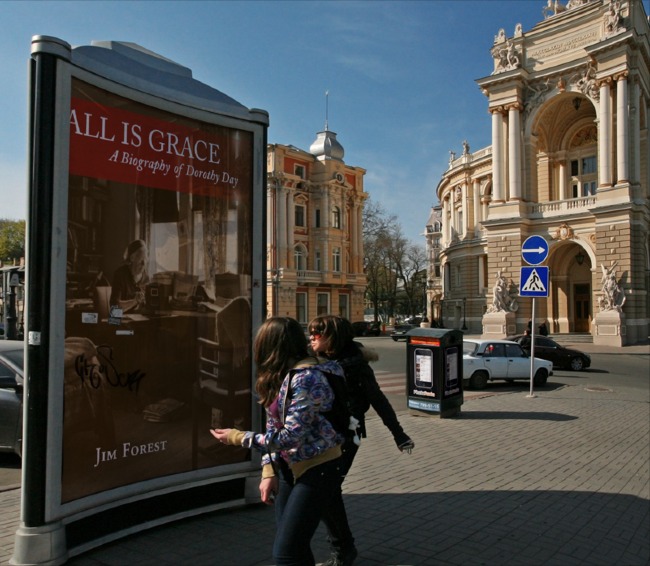
All is Grace: a Biography of Dorothy Day

by Jim Forest

In these times when social concerns are so important, I cannot fail to mention the Servant of God Dorothy Day, who founded the Catholic Worker Movement. Her social activism, her passion for justice and for the cause of the oppressed, were inspired by the Gospel, her faith, and the example of the saints….
A nation can be considered great when it defends liberty as Lincoln did, when it fosters a culture which enables people to “dream” of full rights for all their brothers and sisters, as Martin Luther King sought to do; when it strives for justice and the cause of the oppressed, as Dorothy Day did by her tireless work, the fruit of a faith which becomes dialogue and sows peace in the contemplative style of Thomas Merton.
— Pope Francis
speaking before both Houses of Congress in Washington, DC

Can you think of a word that describes a person who devoted much of her life to being with people many of us cross the street to avoid? Who for half a century did her best to make sure they didn’t go hungry or freeze on winter nights? Who went to Mass every day until her legs couldn’t take her that far, at which point Communion was brought to her? Who prayed every day for friend and enemy alike and whose prayers, some are convinced, had miraculous results? Who went to confession every week? Who was devoted to the rosary? Who lived in community with the down-and-out for nearly half-a-century? Whose main goal in life was to follow Christ and to see him in the people around her?

A saint.

Can you think of a word that describes a person who refused to pay taxes, didn’t salute the flag, never voted, went to prison time and again for protests against war and social injustice? Who spoke in a plain and often rude way about our “way of life”? Who complained that the Church wasn’t paying enough attention to its own teaching and on occasion compared some of its pastors to sharks?

A troublemaker.

And there you have Dorothy Day in two words: saint and troublemaker.

She was a person of contradictions: activist and contemplative, political radical and a theological conservative. Intending to found a newspaper, The Catholic Worker, she ended up founding a movement. The most important monuments to her are the many houses of hospitality that stretch from San Francisco to Amsterdam, places of welcome for many who have been treated as throwaways, but also centers of work for a nonviolent, sharing society. Dorothy Day continues to open doors for many, in terms of spiritual life, community building, the healing of division, service of the poor, and the renewal of churches.

“All work,” she wrote, “whether building, increasing food production, running credit unions, working in factories that produce for human needs, working in the handicrafts — all these things can come under the heading of the works of mercy, which are the opposite of the works of war.”

Many regard Dorothy Day as one of the saints of our time; at the initiative of the Archdiocese of New York, her official canonization process is now underway. The Vatican has given her the title “Servant of God Dorothy Day.”

All is Grace offers a richly illustrated biography of Dorothy Day. Jim’s earlier biography, Love is the Measure, published several years after Dorothy’s death, is now replaced by this much expanded edition that draws on her letters and journals. The book is now twice the size — 350 pages — and includes more than 250 photos, many never published before.

All is Grace was the title of a book Dorothy intended to write but never finished. One sees her use of the phrase in this passage in one of her “On Pilgrimage” columns from 1954: “Our life of grace and our life of the body goes on beautifully intermingled and harmonious. ‘All is grace,’ as the dying priest whispered to his friend in The Diary of a Country Priest. The Little Flower also said, ‘All is grace’.”

Jim Forest worked with Dorothy Day during the last twenty years of her life.

The publisher is Orbis Books.

* * *

read “Saint Dorothy?”, a chapter from All Is Grace: https://www.jimandnancyforest.com/2012/01/05/saint-dorothy/

* * *

In May 2012, All is Grace was selected as Book of the Year by the Association of Catholic Publishers.

* * *

All is Grace won two Catholic Press Association Awards:

1st place for biography:

“Dorothy Day, the pre-eiminent twentieth century American Catholic social activist, writer, and advocate for the poor, comes to life in this magnificent biography enriched by numerous quotations from her letters and writings. Hundreds of photos put a face on the movement for social justice that lives on in this new century.”

2nd place for design and production:

“A nifty sepia-tone photograph of an older Dorothy Day in her cluttered office graces the cover of this attractive trade paperback book. Hundreds of interesting photographs are reproduced on the 344 pages of this book and they show good tone variations The type selection is excellent and the page designs evidence a lot of carefully planning when various typefaces, body text, and photographs appear on the same page.”

* * *

Dorothy Day’s last arrest, age 74 (photo: Bob Fitch)


All Is Grace: There is much to be gained by studying the lives of great men and women. Human history is adorned by the lives of those able to see beyond themselves, to couple a vision of a better world with the energy and determination to make it happen. Dorothy Day was such a person. Founder of the Catholic Worker Movement and tireless advocate for the poor and oppressed, Day gathered around her people of similar passion and showed that even the least individual can make a difference. Forest … has done an admirable job of documenting Dorothy Day’s remarkable life and career. Day’s outward journey brought her to the far corners of the Earth seeking justice and peace. But it was her inner journey, which taught her “how to see Christ in every person,” that ultimately defined her place in history. The struggle for dignity and equality continues. Day’s life demonstrates that grace abounds in the human spirit, a grace that must define humans’ ultimate destiny.
— Publisher’s Weekly, 14 March 2011

Dorothy Day was one of the most prominent and influential converts to Catholicism in the history of the Catholic community in the United States. I’m reading her excellent biography by Jim Forest, All is Grace, and plan to give copies to friends this Christmas.
— Cardinal Timothy Dolan, Archbishop of New York

From the first page of All Is Grace you realize that Jim Forest is a skillful storyteller, brimming with enough detail to be gripping, lively enough never to drag. Alternating between the fascinating facts of Dorothy Day’s life, the world in which it unfolded and the arc of her inner life, we are treated to a story that is part history, part biography and part philosophy. And this seems fitting for a woman who sought to engage the world and all its suffering and beauty…. All Is Grace ceases to be a book just about Dorothy Day and widens to include the growing community, as well as Dorothy’s own growing family….

The gift of this book is the use made of recently published collections edited by Robert Ellsberg, The Duty of Delight, Dorothy Day’s diaries, and All the Way to Heaven, her letters. Jim Forest carefully weaves in these resources and the result is a life’s story told with much depth….

We might be amazed and inspired by what she accomplished, and rightly so. But we should be even more amazed and inspired to learn along the way that there was much sorrow, loneliness and second-guessing. All Is Grace is, at times, heart wrenching in its honesty due to the candor and diligence with which Dorothy recorded and reflected on her life and Jim Forest’s use of these writings….

This warm, engaging account matches tone with content, and like Dorothy did for many a volunteer, “you can glimpse exciting possibilities in yourself you hadn’t seen before.”
— review by Amanda Daloisio for The Catholic Worker (click here for full text of the review)

Our corner bookstore called with our copy of All Is Grace this afternoon. All else has been put aside. “They were of course all intending to be surprised, but their astonishment was beyond their expectations.” [Jane Austen, Pride and Prejudice] This will be the indispensable book on Dorothy Day.
— John Williams, Seattle

All Is Grace is a substantially revised and expanded edition of Love Is the Measure, originally published 15 years ago. Founder of the Catholic Worker movement, Dorothy Day is one of this century’s most prophetic voices and has recently been proposed as a candidate for sainthood. The author is secretary of the Orthodox Peace Fellowship; his other books include a biography of Thomas Merton.

Drawing from Day’s recently published letters and many other sources, this expanded edition with copious photos and illustrations chronicles in rich detail the life and mission of a social reformer, peace activist and ardent campaigner for social justice. From the turn of the 20th century, it traces her family’s struggles, the evolution of her faith, her writings, her religious and literary “heroes,” her baptism at age 30 and publication of the first issue of The Catholic Worker newspaper in 1933 in downtown New York City. Forest catalogues the many issues taken up in the pages of the Worker: growing racial divides in the United States, Day’s widespread travels, the founding and spread of houses of hospitality, her special relationship with daughter Tamar as “a lonely single parent,” a deepening spiritual life, protests during world wars, arrests and imprisonment, trips to Rome during Vatican II, and life at Maryhouse, up to her death and funeral.

In the book’s postscript entitled “Saint Dorothy?” Forest notes that it was the Claretian religious order that took the first step in promoting recognition of Day’s sanctity. New York’s Cardinal John J. O’Connor, 17 years after her death, launched the actual process of canonization. Finally, in “Dorothy Day: A Personal Remembrance,” the author sheds light on lesser known qualities and daily activities of Day and the importance to her of storytelling, music, beauty, books, the Eucharist, devotion to St. Therese of Lisieux, the darkness following the abortion of her first child, the sacrament of confession, her respect for Christians of other churches, her concern for repairing the schism between the Eastern and Western Christian churches and much more—offering, in effect, a compelling window into the mind, heart and soul of a woman whose life was indeed grace-filled.
— Catholic Book Club Selection, May 2011, America magazine

For many readers, All Is Grace will shed light on many corners of Dorothy’s life about which they knew little or nothing. Her abortion and early relationships with men are honestly but not sensationally sketched here. The turbulence of her daughter’s marriage and the emotional difficulties of her son-in-law David Hennessey as well as Dorothy’s abrasive personality traits, her impatience with those she considered weak in faith, along with other aspects of her character and life — the deep passion of her love for Forster so amply documented in the letters — the full portrait of Dorothy Day here will make some critics think her canonization is inappropriate. Rather, as she says in her own writing, “We are all called to be saints. Sometimes we don’t see them around us, sometimes their sanctity is obscured by the human, but they are there nonetheless.”

In Dorothy’s case, as this magnificent biography reveals, the human neither obscures nor destroys the holiness given by God and incarnated by her — in her weakness, in her courage, in her anxieties and desperation, but also in her discerning vision that we are to be the hands, heart, ears of God in the world. This beautiful biography should be the text assigned in courses where Dorothy’s life and thinking are examined. It should also be the gateway to discovering her as well as a staple for retreats, retreat house libraries, adult education classes in parishes. I believe its amazing portrait of Dorothy will draw readers to her own writings.
— Michael Plekon, Cistercian Studies Quarterly

With All Is Grace, Jim Forest has given us the real Dorothy Day, sensual, confused, hungering, intelligent, radical, and wonderfully graced.
— Ed McCartan

Forest is an accomplished writer and his fluent prose is a pleasure to read…. The accumulation of details and insights in All Is Grace that accrue from Forest’s carefully chosen and illustrative anecdotes weaves a seamless portrait of Day that mirrors her profound incarnational sensibility. Excerpts from her writings reveal the almost palpable delight she took in the physical, sensual world, qualities that infused her distinctive prose style with warmth and clarity. She loved opera (Wagner was her favorite composer) and Russian novelists, especially Dostoevski. She practiced a rigorous voluntary poverty but did not starve her senses. Once, Forest writes, “she discovered chopped onions, herbs and spices in the fruit salad.” “A sacrilege,” she wrote, “to treat food this way. Food should be treated with respect, since Our Lord left himself to us in the guise of food. His disciples knew him in the breaking of bread.”

Day often quoted Dostoevski that “beauty will save the world.” In both its text and in its luminous photographs, All is Grace offers a vivid testimony to Day’s beauty, fidelity and, in the midst of suffering and hardship, a stunning witness of perseverance and hope.
— Rachelle Linnner, Catholic News Service

It is a pleasure to hold and read All Is Grace, Jim Forest’s revised and expanded biography of Dorothy Day. She was a writer, Roman Catholic convert, co-founder of the Catholic Worker in 1933, and editor of a newspaper that served as the organ of this renowned movement for social justice.

Dorothy’s compelling story, set in the 1920s through the 1970s, is told through an array of lovely photographs and with her own writings woven into Jim Forest’s insightful reflections and careful documentation of people, places, and events. The book is a rich resource of American history formed from an insurgent perspective, an outcome of this woman’s unswerving journey of faith and her practice of Christian anarchism. But on a personal level, which was her gift to so many of us, this story is inspirational and a call to action concerning the very fate of humanity and creation. In her words, “we are urging revolutionary change,” we are made to think about how we live together and how we treat each other in today’s world.

Dorothy’s life and work show with clarity that she possessed an incredible sensitivity to and delight in the presence of God. Jim Forest brings this out beautifully. We see her celebrate the ordinary in life as wondrous; we sense her intense love of those around her, from early lovers, to friends, co-workers, and family.

Also shared are her profound experiences of grief over the human errors and tragedies of this world. All is Grace includes material from Dorothy’s journals and letters, compiled and edited recently by Robert Ellsberg in The Duty of Delight and All The Way To Heaven. Her writings over many years describe in detail her family life, the challenges of living in community, and the joys and sorrows of meeting the needs of the poor through the works of mercy. Her correspondence and interactions with both people of significance and those of humble stations reveals a person of great kindness and humility herself.

Dorothy consistently set an example for overcoming our class system and the myriad forms of oppression and exclusion by seeing others as miracles or even as the face of Christ. This is indeed a radical message set in the center of a culture of discrimination, wars, and materialism. Yet Dorothy’s mode of indoctrination is always intertwined in great stories of her extensive travels, time in prison, and adventures through retreats and speaking tours. The book captures many of these stories, conveying to the reader the joys, humor, and grim realities of Dorothy’s visits across the United States and to the far reaches of Russia, India, and Africa.

For me, the most poignant selection is the chapter titled “Pregnancy, Faith, and Baptism.” As a woman and mother, Dorothy brings to us her intrinsic human experience of a conversion precipitated through the act of giving birth. “No human creature could receive or contain so vast a flood of love and joy as I often felt after the birth of my child. With this came the need to worship, to adore.” Such words, expressed in her exquisite writing style, are captivating.

The chronological arrangement of All Is Grace provides an easy, in-depth study of Dorothy’s varied life and the history of the Catholic Worker movement. She had a great interest and ability in reaching out to people and connecting with them on a personal level. This comprehensive book, which should bring enthusiasm and hope to our youth, is a fine tribute to Dorothy’s efforts to build community around the world. — Martha Hennessy

Martha Hennessy is a peace activist who lives at the Maryhouse Catholic Worker in New York City. She is a granddaughter of Dorothy Day. Her review was written for Fellowship magazine.

Love is the Measure, Jim Forest’s first book on Dorothy Day was always my favorite biography of Dorothy. A couple of years ago, I was excited when I heard that Forest was doing a re-write of his original book. I was expecting some revisions and a few additional photos but I never expected a total revision and update warranting a new title, All is Grace.

It seems the perspective of additional years of reflection, the opening of the cause for her canonization, and the release of Dorothy’s diaries and letters all impacted a fresh look at her life and Jim Forest so aptly gave us a new view of her remarkable life. It is written with the same personal attention to the details of each important phase of her live as was his first book. Each phase of her life is told like a separate story, written so personally as if he was with her at each step. It is the perfect way to tell the story of her life. Dorothy was fond of telling stories to others, and in my several meetings with her during the summer of 1976, she was more personally interested in my view points, opinions and life experiences than she was in talking about herself….

All is Grace is without question the definitive biography of Day. A bonus being all the photos (200+) that are distributed throughout the book.

— David Mueller (on the book’s Amazon page)

* * *

comments by various reviewers to the earlier edition, Love is the Measure:

This image is a creative work — it’s not likely there will ever be a poster campaign for a biography of Dorothy Day.

Forest finds plenty of events and nuances that other biographers have passed by… Forest provokes both laughter and tears. (The Christian Century)

Forest’s biography of Dorothy Day contains much intimate detail which is not found elsewhere….Hers was an inspiring life that is conveyed to the reader in a clear, concise and organized fashion in this readable and entertaining book. (Catholic New Times)

It is, quite simply, a good story, well told… Jim Forest has done us all a service in telling this story so well… For anyone interested in an accurate and vivid account of Dorothy Day and the Catholic Worker, this is the book to start with. (Prism)

Only because of Jim Forest’s gift with words have I come to know Dorothy Day. (Quaker Life)

An eminently readable account of the remarkable life of the “Grand Lady”… insightful accounts of her journey, along with graphic descriptions of the political and social climate of the sixties. (Living Prayer)

All is Grace can be purchased via any local bookshop and is also available from Amazon and similar web shops.

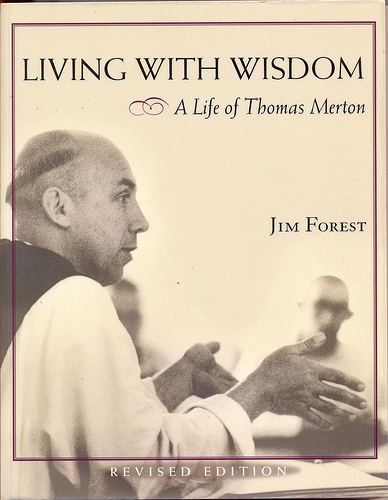
Living With Wisdom: A Biography of Thomas Merton (revised edition)

The Cistercian monk Thomas Merton remains a source of spiritual inspiration and a guide for many people. Merton was above all a man of prayer, a thinker who challenged the certitudes of his time and opened new horizons for souls and for the Church. He was also a man of dialogue, a promoter of peace between peoples and religions.
— Pope Francis
speaking before both Houses of Congress in Washington, DC
(Pope Francis has read the Italian translation of Living With Wisdom)

A book written with love by one who understands Merton and followed in his steps. The best introduction I can think of to Merton, his life, and work.

— Bob Lax (poet and close friend of Merton’s)

A superb introduction to the life of one of the most extraordinary monks of our time.

— Brother Patrick Hart, Merton’s former secretary

This is the best short introduction to Thomas Merton ever written. Superlative!

— James Martin, SJ
associate editor of America magazine, author of My Life With the Saints

If you have to read one book about Thomas Merton, this is the one to read. It is concise, insightful, complete.

— Paul Wilkes, director, writer, co-producer of the PBS documentary, “Merton”

Living With Wisdom is the most complete, balanced, readable, wide-ranging and up-to-date biography of Thomas Merton.

— Gerald Twomey
editor of Thomas Merton: Prophet in the Belly of a Paradox

Numerous readers discovered Merton through his hefty autobiography, The Seven Storey Mountain. Forest is one of them. In Living With Wisdom, Forest introduces the many facets of the 20th-century Trappist monk whose life included not only the physical work, worship, and contemplation of a monastic community, but prolific writing as well (a partial list of Merton’s works is two pages long). Forest lucidly chronicles Merton’s life, illuminating it with the events that shaped it and the insights that emanated from it. Although his esteem for Merton and his contributions to the peace movement are apparent, he treats Merton’s weaknesses frankly. As a result of Forest’s clarity and conciseness, his work is an excellent choice for general religion collections.

— Library Journal

The most accessible yet discerning account of Merton’s life and work

Ordinarily a revised edition of a book that is fairly well known hardly merits yet another review. However that is not the case with this expanded, updated and beautifully designed (by Roberta Savage) biography of Thomas Merton, by Jim Forest. The first version was in 1979, then a further, larger one in 1991, and now this latest edition timed for the 40th anniversary of Merton’s death, commemorated on December 10, 2008.

The revised edition is to the best of my knowledge, the largest and the richest collection of photos of Thomas Merton published in one volume. It accompanies one of the most accessible yet discerning accounts of his life and work, crafted by Jim Forest. There are other photo collections, such as the out-of-print Hidden Wholeness, and of course, the most comprehensive biographical effort is Michael Mott’s The Seven Mountains of Thomas Merton. Yet Living with Wisdom possesses an intimacy and vision unmatched in other publications.

Jim Forest knew Thomas Merton — a number of the photos, particularly in Merton’s hermitage — were taken by Jim. And Jim is a most skillful biographer, as this and other of his efforts attest.

In fact, when you leaf through it, you immediately realize that many elements combine to produce a singular volume. The sheer number of photos, many previously unpublished, document the entire sweep of Merton’s fascinating life. Finally it is good to see the faces of Amiya Chakravarty, D.T. Suzuki and Merton’s old guru the monk Bramachari, also Jacques Maritain, Dom Jean Leclerq, Thich Nhat Hanh, the Dalai Lama, among others whom Merton treasured.

Not only in the photos but also in Forest’s introduction there is a rare encounter with the energy, the hilarity, the restlessness of the person that Merton was. Forest’s first sight was of a monk rolling on the floor, convulsed in laughter! Likewise, I treasure Merton’s comments about his great love for beer, that he drinks as much as he can get his hands on — an admission that for me, balances everything else he says about reading the psalms, the liturgical services, his hermitage quiet as ideal for prayer and the spiritual life in general.

Somehow the photos are a visual counterpart to these accounts of Merton’s humanity. Whether smiling or concentrated on a text, this is the face of someone I wanted to know, immensely interesting, as the Dalai Lama said, “deep.” One photo is incorrectly captioned, the one on p. 218. It shows not the Trappistine nuns at Redwoods, California but the Precious Blood sisters in Eagle River, Alaska, to whom Merton gave a retreat on his way to the Far East.

The photos alone would make for a splendid book, but the core of the volume is, as indicated, Forest’s lively biographical portrait, generously interlaced with quotations from Merton’s writings. Though included in other publications, the self-assessment of his own authorship by Merton in 1967 is revealing and there is a photo of the graph he constructed himself adds greatly to the narrative.

In his new afterword, Jim Forest notes the now notorious decision by then Bishop Donald Wuerl to omit Merton’s profile in an American Catholic Catechism because, among other reasons, “the generation we are speaking to had no idea who he [Merton] was,” and because the “details of his searching at the end of his life” were uncertain. The facts, as Forest reminds us, make these charges ridiculous and embarrassing.

Most of Merton’s books remain in print over a half century after their original publications. The number of new books about him or new editions of his books and correspondence increases every year. Amply documented accounts of his commitment to monastic life and priesthood in the Catholic Church are available and have been now for years — not to mention the testimony of fellow monks such as Frs. John Eudes Bamberger, Matthew Kelty and Brother Patrick Hart, to mention only a few.

I began reading Thomas Merton when I was 13. I am now 60. To describe his shaping of my life is beyond the limits of this review, but I want to affirm his importance to me as a teacher, a critic, a prophet, and above all a man of prayer, as Evagrius Ponticus says, a “true theologian.”

To say that I grew up with Merton’s writing, pursued a vocation to religious life, later to marriage, academic work and the priesthood is to simply acknowledge the ways in which his life and work shaped my own. And in saying this, I am giving voice to the experience of thousands, in many different churches and religious traditions or outside these.

The title of this book comes from Merton himself, who in Dancing in the Waters of Life, wrote: “What more do I see than this silence, this simplicity, this ‘living together with wisdom.’ “ Readers of Merton may immediately connect the mysterious feminine figure “Proverb, ” a young woman who appeared in his dreams.

He later connected her with Sophia, the Wisdom of God, with the Mother of God, with Christ the Wisdom of God, and with every creature who is a child of God. Someone to whom I gave an anthology of Merton’s writings as a gift admitted that reading him now, many years after first doing so, she discovered that he had grown up, deepened—or perhaps she had.

For those who know Merton, for those yet to make his acquaintance, Jim Forest’s book will I think, offer the same realization. Something, it seems to me, Fr. Louis would smile at and approve.

— Michael Plekon, Cistercian Studies Quarterly

* * *

The book’s web page on Amazon.com click this link: http://www.amazon.com/Living-Wisdom-Life-Thomas-Merton/dp/1570757542/ref=sr_1_1?ie=UTF8&s=books&qid=1232202147&sr=1-1″>

Looking back on the Milwaukee 14

The Milwaukee Fourteen burning draft records 24 September 1968. (from left to right: reporter from Milwaukee Journal whose name I forget, Jerry Gardner, Bob Graf, Jim Forest, Fr. Larry Rosebaugh, Brother Basil O’Leary, Rev. John Higgenbotham, Donald Cotton, Fr. James Harney, Fr. Alfred Janicke, Fred Ogile, Michael Cullen, Fr. Tony Mullaney, Fr. Robert Cunnane and Doug Marvy)

Here are two exchanges about the Milwaukee 14, the first with a student, Dyllan Taxman, the second with a Milwaukee-based writer, Pegi Taylor…

* * *

Here are responses to questions I received from  Dyllan Taxman, an eighth student in Milwaukee, Wisconsin. For a history research project,  Dyllan decided to look into an act of civil disobedience that I took part in back in the summer of 1968 — September 24 — when the Vietnam War was raging. A group of fourteen people broke into nine draft boards that had offices side by side in a Milwaukee office building, put the main files into burlap bags, then burned the papers with homemade napalm in a small park in front of the office building while reading aloud from the Gospel. We awaited arrest, were jailed for a month, freed on bail, then tried the following year, after which we went to prison for more than a year (for most of us it was 13 months).

Jim

* * *

>> What made you do this?

I had been in the military myself so didn’t have to worry about the draft, but as a draft counselor (a big part of my work with the Catholic Peace Fellowship) I was painfully aware of how thousands of young people were being forced to do military service in an unjust war about which they knew little or nothing, or even opposed. Anyone who knew the conditions for a just war could see this war did not qualify.

It seemed to me that people committed to the Gospel ought to offer some sort of witness against the war and conscription (really, a kind of slavery). I had been impressed by a similar but smaller action in Catonsville, Maryland, in which the priests Daniel and Philip Berrigan — both good friends — had played a major role. It seemed to offer a model.

>> How did all 14 of you meet?

Bonds of friendship. Many of us knew Michael Cullen, a founder of the Casa Maria Catholic Worker house of hospitality in Milwaukee. As I recall, the idea began to take shape when Dan Berrigan and I were staying with Mike and Nettie at Casa Maria while in Milwaukee to speak at a national conference of Franciscan teaching nuns.

>> Who would you say was the leader of the group?

There was no leader. It was very much a group effort. I was a kind of press secretary (my background is mainly in journalism) and did the first draft for the group’s statement, but that too was something we all had a hand in.

>> Were you scared?

You bet! I recall my knees shaking as Jim Harney and I walked together to the building where the draft boards had their offices.

>> Did you tell your family about this before-hand? If so, did they approve? If not, were they shocked to find out? (did they agree with it or not)

A few people in the family knew. The ones I talked with approved.

>> How long did you plan this out? Was it spontaneous or carefully planned?

There was very careful planning — several weeks of preparation.

>> What do you think is the effect, now 38 years later, of the act that you, and the rest of the 14 did that day?

I was amazed at the impact — more than I would have expected: a two-page photo in Life magazine of the action, front page coverage in newspapers across the country, reports on TV news programs nationwide, national press attention while the trial was going on, respected poets coming to Milwaukee to do public readings in our support, lectures given by various scholars, supportive mail from all sorts of people (one of the astronauts on the first moon trip sent me as photo he had taken of the earth from space). One of the “epistles” in Leonard Bernstein’s “The Mass” was a letter about visiting me in prison.

Now, 38 years later, of course it’s just one item on a long list of protest actions that occurred during the Vietnam War. What surprises me is that it hasn’t been altogether forgotten. I recently received a newly made Milwaukee 14 poster!

>> Do you think that your actions that day had an affect on the draft?

Sure. For starters it closed down conscription for a time in a major US city. In Milwaukee for several months the only people who were sent to the war were volunteers. Judging from the mail we received, I think we helped more draft-eligible people decide that they would not take part in the war. More people became conscientious objectors. The fact that about half our groups were Catholic priests (and one a Christian Brother teaching economics at Note Dame) meant that our action had particular impact on the Catholic Church. It probably was a factor in the opposition to the war that was increasingly voiced by the Catholic hierarchy.

>> Do you approve with more recent protest such as protesting the soldiers in Iraq?

I’m not quite sure what the question is here. Do you mean protesting the war in Iraq? If so, I wish there were a great deal more protest. I am puzzled that the protest that have been going on hasn’t involved far more people. I see most of the soldiers in Iraq, even though volunteers for military service, as victims of the war who were driven to volunteer because of poverty and joblessness. Many of them, even if they come home alive and without physical injuries, will spend the rest of their lives battling with deep psychological scars and a haunted conscience.

>> Do you think that your motives for this protest are/were completely understood by the public or do you think that your actions were in some way misunderstood?

There were a great many who understood. It was, after all, a very simple deed. The religious basis was clearly expressed. A major goal was to encourage more draft resistance and indeed there was more. But of course there were many people who were astonished or even scandalized to see Catholic priests and committed lay people putting their freedom on the line by such an act of civil disobedience, and couldn’t understand.

I think for most if not all of us, the trial was at least as important as the action. We hoped to make the trial not so much a trial of fourteen people accused of burning papers but hoped to put an immoral and illegal war on trial. And that’s pretty much what happened. (If you have time to go the Library Archive at Marquette, my friend Phil Runkel can show you what they have re the Milwaukee 14. Probably they have a copy of the essay Francine du Plessix Gray wrote about the trial for the New York Review of Books. (Later it was included in a book called “Trials of the Resistance” — see: https://www.jimandnancyforest.com/2006/11/18/m14trial/.)

>> Do you still keep in touch with other members of the original 14?

Yes. I’m most often in touch with Bob Graf, who still lives in Milwaukee. I hope you have occasion to meet him. Thanks to Bob and Pat Graf, we had a Milwaukee 14 get-together in Milwaukee a few years ago.

>> Did you feel that during your stay in prison that you were a political prisoner?

I didn’t think much about myself in terms of such a label, but certainly we were seen as such by other prisoners, the guards, wardens, etc.

>> Did any of you end up going to Vietnam?

One of my regrets is that, for all the traveling I’ve done, I’ve never been to Vietnam. I lived in France for a time with a Vietnamese community and so am used to Vietnamese culture, food, music, etc., but I wish I might have visited Vietnam.

>> Would you do the same actions today if the same situation presented itself?

My present health being as it is — because of kidney illness I have to be at the local hospital three times a week for dialysis (an artificial kidney used to filter my blood) — major acts of civil disobedience would be quite problematic. [Postscript: In October 2007 a kidney donated by my wife was successfully transplanted.]

Also I think property destruction is not the ideal model of nonviolent protest — it’s on the borderline. I am still troubled by the cleaning woman we had to restrain when we entered the draft boards. What if we had caused her to have a heart attack? There is also the problem of secrecy. To plan actions of this type requires secrecy — and that in turn inspires distrust and suspicion. Also some of the actions that followed made me question what we had done. We stood around and took full public responsibility for what we did, welcoming the trial. Later in the draft board actions tended to become “hit and run” — actions often done anonymously. These had their value but in my view lacked the impact of actions in which those responsible said, “I did it, I’m glad, and here’s why.”

>> In the Constitution it states that when a government fails to protect your natural rights (one of which being life) you have the duty to overthrow it and form a new one. Then again, John Locke, one of the major influences on the framers of the constitution stated that you have to follow the laws and rules of the government in exchange for the protection of these rights (this is called the Social Contract). That situation seems to create a paradox in the situation you were in. What is your opinion on that?

My main text is the Gospel. The example of the saints is also important. I saw what we were attempting as being similar to what Jesus did in driving the money changers out of the temple. No one was injured or killed, but he made a protest which is recalled in each of the four Gospels. In the process he signed his own death sentence. His action surely had a great deal to do with the decision made by the religious leaders of the time that Jesus would be better dead.

>> Regarding Civil Disobedience, when do you think it is appropriate to break the law? And who should decide that? Also, when (if ever) is it considered all right to infringe on other peoples rights?

I’m not an anarchist. Laws may not be perfect but most of them exist to help us live together peacefully. Most of them are like barriers along the edge of a dangerous road that help keep us from driving into a ravine. But when a law is socially destructive, then we are obliged, as St. Peter said, “to obey God rather than man.”

>> What do you think the impact of this act was on your life specifically?

Every choice you make has consequences in your life and the lives of the people around you. Even little choices matter. If you’re in a bad mood, it will effect each and every person in your family. If you do something helpful — even a small thing like volunteering to wash dishes — that has a positive effect on the people you live with.

Being in prison was, for me, not without blessings. It gave me time to do some extremely valuable reading. Finally I read books like “The Brothers Karamazov”, which Dorothy Day had so often urged me to read. I became a more prayer-centered person. I spent time every day reading the Gospel and thinking about it. I got to know my fellow prisoners and their stories — amazing lives. Some of them were not guilty of the crimes for which they had been convicted — others were certainly guilty — but from each of them there was something to learn.

a drawing of me in prison made for his Sunday School class by my son Ben (age six at the time)

The very worst thing about prison was not seeing my son Ben for more than a year. When I think back on that, this still causes me great anguish. But I think too of soldiers who went to Vietnam and never saw their wives or children again, or came home with terrible injuries. My losses, and my son Ben’s, are hardly worth mentioning compared to that.

Thanks, Dyllan, for your probing questions.

PS There’s an autobiographical essay, “Getting from There to Here,” at this web address:

https://www.jimandnancyforest.com/2010/02/07/getting-from-there-to-here/

February 2, 2006

note: In the photo, I’m the guy wearing a tie standing near the left end. At the far left is a Milwaukee journalist taking notes.

* * *

May 29, 1993

interview with Jim Forest by Pegi Taylor for Wisconsin magazine

How did you hear about the August [1968] retreat in New Jersey?

I was in Washington for the National Liturgical Conference and George Mische, one of the Catonsville Nine, was in DC as well. I didn’t realize then but eventually it became clear that he thought of his post-Catonsville role as organizing actions. He took me for a walk and asked me if I was interested in joining the next action. He had a close connection with Phil Berrigan so it was clear he meant something on the lines of what the Catonsville Nine had done. I said yes, feeling as I said it as if I had been hit by lightning.

Why did you decide to get involved in the Milwaukee action?

Having been in the US Navy, I had no further military obligation myself, so I wasn’t myself facing the draft. I had left a job as a journalist with a daily newspaper in order to work full-time as secretary of the Catholic Peace Fellowship and as a result was counseling conscientious objectors almost every day. It was good and useful work, but I felt that what I was doing wasn’t enough. It seemed to me that those who opposed the war might have to make a greater sacrifice, at least the kind of sacrifice that was taken for granted in the military: being taken away from home and family. (I was married and had a young son.)

A most important factor was the war in Vietnam itself. It was clear that a great many people had to find ways to impede a war which was killing vast numbers of civilians. I was also concerned about what involvement in such a war would do to US soldiers.

A big factor in the decision was my closeness to Dan Berrigan. I knew Phil Berrigan also, but not as well. I got to know most of the people in the Catonsville Nine group and was much involved in their defense committee. I had a lot of respect for these people and what they did, though it didn’t occur to me at first that it ought to be a model for another action, not to say a series of similar actions.

Another factor was my close contact with a Vietnamese Buddhist monk and poet, Thich Nhat Hanh. Through him I developed a deep feeling for the people of Vietnam and for the Vietnamese culture. The Fellowship of Reconciliation had set up his speaking tours in the USA; on at least two cross-country trips, I travelled with him. This friendship made the horror of the war very concrete to me.

Another influence was Dorothy Day, the founder of the Catholic Worker and one of the speakers at the Liturgical Conference that year. Dorothy used the occasion to express her admiration for the Catonsville Nine and what they had done. I can’t recall exactly what she said, except that she compared the burning of draft records with Jesus turning over the tables of the money changers in the Temple. (Not many months later she was to do an about-face on the subject; while she still sympathized with all those who had carried out such actions, she came to the conclusion that she couldn’t support property destruction as a tactic of draft resistance.)

Had you considered getting involved in similar actions?

The only similar event up to that time was the Catonsville action. Had I known about it at the right moment, quite possibly I would have taken part. I can’t say. But as I recall I was on a cross-country speaking trip with Thich Nhat Hanh when it was being planned.

Did you see your participation as an act of Catholic witness?

Very much so. It seemed to me one of the tragedies of history that Christians, since the age of Constantine, had rarely put their obedience to Christ ahead of their obedience to the state. I was aware that few German or Austrian Catholics had resisted Hitler’s wars, that resistance to Hitler by the Church hierarchy had simply not happened, and that, far from being abnormal, this was typical of the role of the Church in a wide variety of political settings for centuries: “good” (meaning obedient) citizens first, followers of Christ only to the extent it didn’t conflict with obligations imposed by the state. Yet Christ had never killed anyone or blessed any act of killing  — very much the opposite.

It also seemed to me that for a Christian passivity is never enough. It isn’t enough not to commit an evil act; it’s necessary to try to change the minds of those who are harming others and to try to protect through active steps harm being done to others. More often than not, words aren’t enough. Often an action, even if it is only a symbolic gesture, is needed. Communication, in any event, is never simply verbal. The name “communication” is how you live, the spirit in which you live, and the choices you make.

How did leadership evolve within the group?

There was practically no leadership that I can recall. Decisions were made by consensus coming out of meetings, though sometimes consensus wasn’t easily reached. Everybody was listened to seriously and eventually we were of one mind about what to do. One of the hardest decisions we came to was the decision to defend ourselves in court. But I think we all felt very good about this decision once we got to it and never had second thoughts about it.

What role did you take in planning the action after the retreat?

Not much of a role. I wasn’t one of those looking for places where the action might happen. There were several cities that were being considered (New York City, where I lived, wasn’t one of hem) and two or three people appointed to see what the possibilities might be. When we met to hear the reports, it was clear that Milwaukee was the best site; more people from our group came from Milwaukee than any place else and there were nine draft boards side by side on the same floor of the same office building, with a convenient little park ideal for burning the draft records right across the street.

Were you roughed up by the police after the arrest?

Apart from handcuffs being made unnecessarily tight in a few cases, there is nothing to complain about that I recall. From our side, it was clear that whatever we were protesting, it wasn’t the police. We did our best to make that clear to them.

How do you see the relationship between the goals of the action and the goals of the trial then and now?

From the start it was clear in my mind, and probably in everyone’s mind, that the trial would be more important than the action. The action created the trial, and the trial might be, if we were lucky, a forum in which a great many issues of importance could be discussed. We hoped that the courtroom drama might have some influence in the way many others thought about the war and what personal response they could make to it. The action also gave us an event to speak about in many churches and colleges; in the months before the trial I did a lot of travelling, speaking all over the country from New England to Hawaii.

How would you compare your trial with the Chicago 7 trial?

I was in prison and couldn’t attend the Chicago trial. I didn’t see most of the press coverage. I can’t compare it.

Did you or others consider some sort of direct action to dramatize Judge Larson’s rulings?

Apart from some minor protests in the courtroom, none that I now recall. In fact I often felt a great deal of sympathy for Judge Larson, a decent man who gave us more chance to be heard than most other judges would have allowed and who was clearly wrestling with some of the issues we were raising. Still, it’s a pity he couldn’t have gone further, allowing the jury to hear more than it did. And it’s a pity he wasn’t in the end convinced that such an act of civil disobedience was justified in its context. But miracles rarely happen in courtrooms.

Why didn’t the trial get more media coverage?

Few who are hoping for headlines are satisfied with what they get. I doubt Sam Goldwyn thought Gone With the Wind got enough publicity. But we did amazingly well. There was the coverage the night of the action on NBC national news, with the film of the action being shown; the following week there was a two-page photo spread in Life magazine; both the action and the trial were all over the national press; the trial was sometimes on page one of The New York Times; there was a long essay about the trial in The New York Review of Books (a piece later published as part of a book, The Ultra Resistance); the composer Leonard Bernstein used a letter (written by Linda Henry about her first visit with me in prison) from that essay in one of his compositions, The Mass, a piece of music still being played. The Milwaukee papers, of course, gave the event and trial a great deal of attention and while one could complain about mistakes, omissions, occasional slanting, etc., still I think the reporters and editors did an honest job. And there was a play made about the trial, but the company that planned to put it on stage backed away from the script when it received advice that staging the play might jeopardize its foundation support and its tax-exempt status. (I have a copy of the script. Maybe someday it will at least be seen on a stage in Milwaukee.)

Did you do anything to try and increase media attention?

We had an excellent defense committee, people like Richard Zipfel), Bill Sell, Linda Henry and quite a number of others, all smart, resourceful people who in every possible way tried to help build something on the foundation of the action. This included their work with the press, which it seems to me was quite effective.

What was it like being in jail?

I would need a lot of time to fully answer that. I would just stress that in my case, the best thing about it was the chance it gave me to read and to deepen my spiritual life.

It was during that year that I started reading Dostoevsky, a writer who has had quite an influence on me since then. Still more important, I carefully re-read the New Testament.

I started using the rosary again, after some years of neglecting it. I never missed Mass. In a variety of ways I found my spiritual life getting steadily deeper while I was locked up and I am grateful for that to this day.

One of the most positive experiences I had in prison was getting a photo of the earth from space taken by one of the astronauts involved in NASA’s first moon-landing trip in July 1969. All the astronauts were military officers so it doubly impressed me that one of them would have thought about us, in such an appreciative way, while in space looking down at the earth, and, in the tumult of activity following their return, remembered to send me such a photo. The very same photo was used in the cover of Life magazine the week I received it at Waupun. On the other hand I had a lot of trouble being allowed to receive it. The “correspondent” wasn’t “approved”! Once I got it, it was the great treasure in my cell. I thought a lot about the earth, how beautiful it is, how small, and how invisible its political borders. There aren’t many gifts I’ve received in my life which meant nearly so much to me.

Jail was also a great place for listening. You get to hear a lot of life stories. Not everything you hear is true, but then you get to hear a lot of tall tales in the Navy. On the other hand you meet some people who really impress you in a positive way. You also occasionally meet people who were falsely convicted, and that makes you think a lot about what can be done to improve the court system.

If I were going to the same prisons today, I gather I would be in for a much harder experience. I’m told small prison cells in Waupun that had one inmate when I was there now have two, three or even four stuffed into them. That would be hell. How anybody can live in a tiny cell stacked in like herring and come not come out a greater danger to himself and to others, I don’t know.

How long were you in prison?

Including a month in the Milwaukee County Jail, I think it totaled 13 months. But that was much less than we had guessed we would serve when we were planning to burn draft records. I thought the most tangible victory we won in Judge Larson’s courtroom was a two-year sentence. (The Catonsville people had gotten six years and they did much less harm to the draft system than we did. They burned a single waste basket of paper; we burned hundreds of pounds of key draft files and in effect closed down Selective Service for a time in one major US city.)

What did you do while you were there?

I was at Waupun six months in two shifts, at Gordon Forestry Camp in the northwest for maybe two months between those shifts, and finally at Fox Lake for four months or so. I worked in the prison laundry, in a factory making office furniture, in a shipping department, in the kitchen, fought forest fires, helped clean state parks, worked at a trout hatchery; and finally was the clerk to the Catholic chaplain, Jim Koneazny (who still lives in Milwaukee though he has since married and left the active priesthood).

How did you view the other prisoners?

The great majority I got on with quite easily. I had grown up in poor neighborhood and later on been a part of the Catholic Worker community in New York City, which was in the Bowery area, so I was used to living with destitute people (at least 90 percent of the people in prison are poor).

I will never forget an older black man from Milwaukee. We worked side by side in the prison laundry at Waupun. By that time he had been in at least ten years. He was serving a life sentence for killing a guy who crashed into the back room of a Milwaukee bar where a wedding anniversary of my friend and his wife was being celebrated . The intruder insulted my friend’s wife. My friend, in blind rage and probably a bit the worse for wear from drinking, walked out to the car, came back with a gun he kept in his glove compartment, and shot the man. He told me he only meant to threaten the guy with the gun, to scare him off, but that the gun “just went off.” In any event, he killed a man. If the gun had been in my friend’s pocket and he had pulled it and shot the man on the spot, it would have been manslaughter. But the fact that he had gone to his car and come back with the gun made the crime premeditated murder. But what an honest, decent man he was, as fine a person as I’ve ever known. (I should add that he certainly took no pride in killing this other guy or justified it.)

How did the group feel about each other before and after the action?

We all had a high level of commitment to what we were doing. We got on quite well with each other both before and after the action, with the only hard part being Michael Cullen’s decision to pull out of the group and go on trial separately — a hard decision for him and hard for us too. But afterward, once we were both out of jail, it wasn’t stressful to resume my friendship with Michael, not at all. Yet I still regret we didn’t go through the same trials together.

Did people respond to you differently after the action and after the jail term?

That’s hard to know. It had a influence in some cases. For some we were heroes and that was embarrassing.

Women were excluded from the Milwaukee action. How does that look now?’

Silly, like a bird with one wing. The only good thing about it was, all being men, we had that month together in the Milwaukee County Jail, and that gave us the chance to come much closer to each other. Before that, most of our time together had been action-oriented.

What did you do once you were out of jail?

I joined Emmaus House, a community in East Harlem, New York, that was active in anti-war work, took in runaways, ran an educational program, and was involved in various inner-city projects. Later I became editor of Fellowship magazine for the Fellowship of Reconciliation, a job I had when the war finally ended. Then in 1977 I moved to Holland to head the staff of the International Fellowship of Reconciliation, a job I remained with for 12 years.

What did you do during the build-up to the Gulf War?

By that time I was no longer on the staff of International Fellowship of Reconciliation but was running Peace Media Service, an agency that gets out news of nonviolent initiatives in defense of life, human rights and the environment. A lot of our work in that period had to do with the danger of war in the Gulf, and now we’re still covering its aftermath.

Were you involved in actions protesting US policy in Nicaragua and El Salvador.

Yes, but I would want to add that it isn’t only the policies of the US government that have concerned me or which require protest.

How do you look on the situation in Bosnia?

It’s appalling and also poses a threat of a much larger war. It disturbs me that the press coverage in the US and most of western Europe focuses mainly on the war crimes committed by Serbians. God knows these are numerous but unfortunately the Serbs are far from alone in committing them. This Hollywood-like tendency to isolate one bad guy in the war is itself a factor that makes the war more dangerous.

I wish anti-military sanctions being imposed on Serbia were imposed on all combatants but at the same time humanitarian aid would be readily given to all who need it.

It also disturbs me that the peace groups that exist in all the republics of former Yugoslavia are more or less ignored in the US press. As long as the mass media considers violence more  newsworthy than nonviolence, many will turn to violence just to be noticed and taken seriously.

What kinds of peace action have you been involved in during the past ten years?

It depends what you mean by peace action. My own definition of peace work is anything you do to help people live and to protect the environment. In my own life today, peace work ranges from trying to be a decent father and husband to what I am doing as an editor and writer. There are occasional acts of protest in my life, but that’s the exception.

What are doing now?

I’ve mentioned Peace Media Service. In addition I’m secretary of the Orthodox Peace Fellowship. (East-west peace work often took me the former USSR throughout the 80s; and of the results on my ever deepening contact with the Russian Orthodox Church was to become Orthodox myself. My wife and I belong to an Orthodox parish in Amsterdam.)

I write books. The most recent, Living With Wisdom, is a biography of Thomas Merton. Love is the Measure, a biography of Dorothy Day, went out of print a few months ago but will be reissued this fall. Another recent book is Religion in the New Russia, about the impact of political change on religious life in the former USSR. Making Friends of Enemies [since revised and re-titled Loving Our Enemies] is still in print. There is also a recent children’s book, The Whale’s Tale, published in England, Holland and Germany — unfortunately not in the US. I also give lectures and occasionally lead retreats.

If you had it to do over again would you participate again in the Milwaukee 14 action?

Probably, but, if so, with more reluctance. Like so many men at that time, I was far more into my work than I was into being a parent. My year in prison was harder on my son than it was on me.

What advice would you give others drawn to social action?

Follow Christ — not the Berrigans, or Dorothy Day, or Gandhi, or Mother Theresa, or anyone, however heroic, inspiring or saintly. Don’t be bullied or manipulated or guilt-tripped into obedience or disobedience. You have a conscience; learn to hear it; no one can hear it for you.

Protest is not the most important part of peace work. Don’t imagine that you need to do something that involves a prison term in order for it to be of value.

Pay no attention to those in the peace movement who make a big deal out of having been to prison; every movement, including the peace movement, has its John Wayne types.

Avoid civil disobedience if you think you’re not going to be able to make good use of that kind of confinement.

Be aware that going to prison can, for some, be a way of putting a moral facade on what is mainly an abandonment of relationships and people or a life that may seem too ordinary, too prosaic.

The main thing is to try to build up a consistent pro-life ethic that connects with what you’re doing for a living.

No less important is developing the deepest possible spiritual life. No one needs this more than those who are trying to do something constructive about the injustice and suffering in this world.

Jim Forest

* * *

Milwaukee 14-related link:

A one minute film of the burning of draft records in Milwaukee:

http://www.youtube.com/watch?v=VSVW9KJi7JY

A piece about a whole earth photo that reached me in prison shortly after the first moon landing:

https://jimandnancyforest.com/2014/03/whole-earth/

A long essay on the trial of the Milwaukee 14:
https://www.jimandnancyforest.com/2006/11/18/m14trial/

The Milwaukee 14 Today page on Bob Graf’s web site:

http://www.nonviolentworm.org/Milwaukee14Today/HomePage

* * *
posted February 2006; updated 1 October 2018
* * *

A brief account of Margot Muntz’s life

by Nancy Forest

Each one of us has his or her own memory of Margot. They’re all so personal, and we’d be here all week if we were to begin to share them all. Margot had a unique way of making her relationship with each person very special, and what we treasure about her is not only what she meant to us as a group, but also what she meant to each one of us personally — our particular friendships with her.

I’m not going to talk about my relationship with Margot. I’m just going to talk a bit about her life — what I learned about her amazing history. We had a lot in common, which only really means that I know a little bit about the place she grew up and what she went through in her life.

Elizabeth Zwatschka was born on May 26, 1914, in New York City. Her mother was a Polish immigrant and her father was from Germany. Her father was a baker and eventually they opened a shop of their own in New Jersey. She had two brothers, John and Fred, and one sister, Lillian, who was killed in a car accident at the age of six. At that time, the early 20th century, the New York area was a real melting pot. It was the very end of the great flood of European immigrants that had been coming to America since the late 19th century. They sailed into New York harbor, many of them very poor. They landed on Ellis Island, within sight of the Statue of Liberty, and from there they were on their own. Most of the immigrants had the addresses of other people from their home countries, and they would seek those people out for help in finding a place to live and a job. Whole towns grew up in New York State and New Jersey, and in many other parts of the country, that consisted of people from one particular European country. They had their own churches, shops that sold the food they were used to eating, and the older ones spoke their own language. But the younger people wanted to assimilate quickly — to become Americans and to learn English — so the children of most immigrants never learned the language of their parents. Margot didn’t speak Polish or German, but her mother was a devout Catholic and she was raised in a Polish Catholic milieu.

One thing that the children of immigrants had in common was that they were influenced by their parents’ ambition and courage. It took enormous courage to leave Europe back then and to immigrate to America, knowing you’d probably never ever be able to return, not even to visit. I think we could see that ambition and courage, and a real sense of adventure, in the way Margot lived her life. Another thing the children of immigrants often had in common was their parents’ Old World ways. These immigrants brought with them a kind of 19th-century Old World grace and elegance that crystallized when they got to America. They never became 20th-century Europeans, but they didn’t become 20th-century Americans, either. I think we could recognize that in Margot, too. It was in her blood, in the way she was raised.

Her parents had a very difficult marriage. Her father was a very ambitious, violent man who was always looking for a better opportunity and better work. The family moved over and over again, from town to town, and Margot became tired of all the moving. Margot adored her mother; she regarded her as almost perfect, a woman of measureless love and devotion. She was afraid of her father, who drank too much, smoked too much, and made life miserable for her mother. “Your father is my cross,” her mother used to say. She said all she remembered about her father was his dark moods and frequent violent outbursts; he never smiled or laughed. Margot was determined never to allow herself to lose control the way her father did. She said she thought it was because of her father that she never learned to deal with her own anger in a constructive way.

She was very bright, but she didn’t go to college. Many girls didn’t back then. College was expensive for middle-class immigrant families, and if you sent anybody to college it was the sons. But Margot had a great love of books and a love of culture. Somerville, New Jersey, is quite close to New York City, and she went to New York — she may have lived there for a while when she was older — visiting museums, going to the ballet and to the theatre, going to bookstores. She especially loved the ballet, and she took lessons for many years. She never lost her love of ballet, and you could see the training she had in the graceful way she walked — her straight back and the relaxed, flowing way she moved her body. But she didn’t become a professional dancer. Why not? She told me once that she didn’t have “the right kind of body”. Maybe she was too small. At any rate, she new she had to support herself somehow, so she went to nursing school and became a nurse.

When she was in her twenties, in the late 1930s, she and one of her girlfriends decided to do something adventurous. They decided to take a Caribbean cruise. This was pretty adventurous at the time, but it wasn’t out of the question for young women from New Jersey. Europe would have been out of the question, but a Caribbean cruise was affordable. Maybe they went to Bermuda. At any rate, on the boat Margot met a young Russian seaman who was one of the crew. His name was Pierre Muntz. Pierre was from Odessa, but he was living in the Netherlands, in Amsterdam and he had become a Dutch national. Margot and Pierre fell in love. When the cruise was over, Margot went back to New York and Pierre to Amsterdam, and they promised to write to each other. Then the war broke out. It was impossible for Margot to go to Holland and impossible for Pierre to visit America, but they kept writing letters — for 7 long years. In 1946, after the war was over, Margot decided to do something that was just as adventurous as what her parents had done. She left the US and came to Amsterdam to marry Pierre. She had only been with him once, on that first cruise, and she hadn’t seen him in 7 years. This was not a romantic Europe she was going to. It was post-war Europe, Europe in tatters, Europe still on rations, with the trauma of the war still fresh. What a risk she was taking!

But she came, and they were married. They moved into the little apartment so many of us remember so fondly, on the Nicolaas Maesstraat.

Pierre worked as a seaman for the merchant marine, and he was gone nine months out of every year. So Margot was on her own much of the time, and she had to make a life for herself. As far as I can tell she and Pierre had a wonderful marriage. They were always deeply in love. Even at the end of her life she would say, “I didn’t deserve him!” But she was used to living in an intensely cultural city, and she made her way. It was through Pierre that Margot first met Matushka Tatiana and Father Alexis – way before the St. Nicolaas Church had been started. She once told me about meeting Tatiana for the first time. Tatiana and Pierre were both from Odessa, and Tatiana thought Pierre was a pretty wonderful guy — tall, handsome, intellectual. So when he introduced Margot for the first time — this tiny little American girl — Tatiana couldn’t believe it. At least that was Margot’s memory of the occasion, and she laughed when she told me.

Margot continued visiting museums and the theatre here in Amsterdam. At some point she decided to try her hand at translation work. There must have been a huge need for good native-speaking translators in the city at the time. With her interest in art and literature, she had no trouble finding work. She became one of the leading English translators for the Stedelijk Museum, and only stopped doing translation work for them when she was in her 80s. She never learned to use a computer, but they were quite willing to take her typewritten translations and have them converted to computer disks. What I never knew was that Margot used the money she earned as a translator to support a poor child in Greece.

Pierre was a heavy smoker. It’s hard for me to imagine Margot living in that tidy little apartment on the Nicolaas Maesstraat with a guy smoking like a chimney, but she did. At a certain point Pierre became ill and was diagnosed as having emphysema (emfyseem). He had to stop work, and Margot, with her nurse’s training, cared for him at home. One of her strongest memories from that time, I believe, was reading to Pierre from her beloved books as he got worse and worse.

Pierre died in 1964. They had been married 18 years, and Margot was 50. Sadly, they had been able to have no children. But after a while she was able to pull her life back together and keep on going. She started traveling — to Greece (she learned modern Greek), to Finland and to many other countries — making friends wherever she went. She kept writing to them, they would come visit her whenever they were in Amsterdam. Some of them are probably with us today.

Margot attended a few different churches in the Netherlands, both Protestant and Catholic, and was particularly enthusiastic about Huub Oosterhuis’s Studentenecclesia. But in about 1974 she was received into the Russian Orthodox Church — chrismated by Metropolitan Anthony in London — and was given the name Margarita. She was one of the founding members of the tiny St. Nicholas church and served as its treasurer and then its starosta until 1989. In December 2000 she received a certificate of appreciation from Patriarch Alexis II for the work she had done for the church.

Margot Muntz with Fr. Alexis and other members of St. Nicholas of Myra Russian Orthodox Church in Amsterdam

Margot Muntz with Fr. Alexis and other members of St. Nicholas of Myra Russian Orthodox Church in Amsterdam.

Margot kept her mind alert by reading. She loved books and had a small but very fine library. Poetry, novels, travel books — she spent a lot of time and money at the Martyrium on the Roelof Hartplein. Many of us have stories about Margot’s love of theatre — going to the ballet with her, to the opera, to museum exhibitions. She was filled with enthusiasm, sometimes. It was hard to keep her on the ground. But she also had a sharply-honed critical faculty, and if she didn’t like something she’d say so.

But what interested Margot the most, I think — more than books, more than museums and the ballet, more than art and the theatre — were people. She was simply fascinated by people. She loved nothing more than to sit down and talk to someone. She had an interesting way of carrying on a conversation. It was almost as if she had organized the questions in her mind. She would tick off the questions she wanted to ask one by one – how is your work, how are the children, how are your parents? At a certain point the conversation would develop a life of its own, but she had a wonderful way of getting it started.

Another important element in Margot’s life was the Orthodox Peace Fellowship, of which she was president from its founding in Holland in 1988 until a year before her death. She may also qualify as the most careful and dedicated reader of the OPF’s quaterly journal, In Communion. Soon after each issue appeared, we could always anticipate a phone call from Margot in which she would comment on each article, then make suggestions for the next issue.

And she never complained — not until the very end. She was a person full of joy. I remember her saying to me, “I can’t help it. I’m just joyful. That’s the way the Good Lord made me.” Once we were talking about a person who had had a particularly hard life, and she said to me, “How blessed we are. We have had such good lives and we have nothing to complain about.” And I thought, “Margot! You lost your dear husband after only 18 years of marriage. You weren’t able to have children. And you have nothing to complain about?” But she never did. She saw herself as enormously blessed.

Let me say one personal thing. For me, Margot is an example of a real Christian woman. She was not what I would call an effusively religious woman. That is, she didn’t act like she was a member of an exclusive club, the Christian Club. She just acted like a Christian. And there’s a big difference. She was the very picture of hospitality. We first met Margot back in 1988 at a special church event at the old Parochiehuis on the Kloveniersburgwal, and if it hadn’t been for her warm welcome I really wonder if we would have been so eager to start coming to the St. Nicholas church. But we did. In her life, she was what we are all called to be — people who are really on the lookout for strangers, ready to welcome them, to ask them where they come from, to let them know that we’re glad they’re with us. How many of us can remember being new in the church, and having Margot come up to them with her bright smile? How many of us have stories of talking to Margot, of her showing real care for us. She was exceptionally good at that, and most of us are not. We have so much to learn. But thank God for her example. And thank God for blessing us with her life and her goodness — and her joy.

Two Weeks in Scotland: 3-17 September 2005

Edinburgh isn’t far from Amsterdam — a 75-minute flight — but it’s a very different world: a more northern light, not at all the flatland that is Holland, and where a form of English is spoken that takes some getting used to.

Via the web we had booked ourselves into a bed-and-breakfast southwest of the city center. As it happened, the house was on a canal that led nearly to the heart of Edinburgh, a refreshing half-hour walk that seemed to place us in the rural countryside rather that the middle of a city. So pleasant was the route that, more often than not, we walked back and forth rather than take the bus. (Walking back at night, I felt obliged to warn Nancy about the dreaded Edinburgh Ripper, who often frequents the canal, and takes special pleasure in carving up naive tourists who dare to walk this path in the dark. In reality the greatest danger we encountered were ducks and swans.)

The guest house, the proprietor told us, wasn’t far from the home of J.K. Rowling, but we saw no sign of her, nor did we meet Harry Potter. Our host complained of the wall Rowling had put up to safeguard her privacy.

Having read in guide books about Edinburgh’s Royal Mile, with the castle at one end and Holyrood Palace at the other, we started off by exploring this most ancient of the city’s streets, but were at first put off by the density of tourists and tourist shops. We had hoped to find an Edinburgh that was less like the center of Amsterdam, which also can barely hold all its visitors. In fact the crowds were mainly concentrated at the castle end of the Royal Mile, and neither they nor the shops that target them were unpleasant.
Need exercise? Edinburgh is hillier than either Rome or San Francisco. Exploring the city day by day, we gradually rehabilitated many long neglected muscles.

The city has beautiful parks, most of all a long green strip running through the heart of the city, below the castle. The day we arrived it has a site of preparation for a concert and fireworks display scheduled for the following evening, the final event in the annual Edinburgh Festival, but we were so walked out the following night that we missed the fireworks.

We were also among the small percentage of visitors who failed to visit the castle, striking though it is perched on it high rocky base overlooking the city, possibly the most impressive castle in Britain. If we had stayed longer perhaps we would have gotten around to it, but we focused more on walks and museum visits.

In the latter category, there was an outstanding Gauguin exhibition at the Royal Scottish Academy. We were at the RSA and the adjacent Royal Gallery much of two days. There was also a major exhibition of the work of one of my favorite photographers, Henri Cartier-Bresson, at the Dean Gallery. The other museum where we spent many hours was the Museum of Scotland. It collection begins with the geology of Scotland and reaches into modern times. (See the Edinburgh photos)

Sunday morning we walked to the Liturgy at Orthodox Church of St. Andrew on Meadow Lane. The priest is Fr John Maitland Moir, now well into his 80s yet still in good health. We had last seen him during a brief visit to Edinburgh about 15 years ago. It was a striking to see how much the parish has grown — now there are many young families.

We enjoyed various pubs and pub meals though the place we returned to most often for supper was an Italian restaurant, Zizzi’s, on at the east end of the canal we so often walked. Inspiring cooking.
After five days in Edinburgh, we were off by train to Oban, a port town on the west coast of Scotland, a point of departure for ferries serving the Hebridean islands. (The Oban photos are included in the set of Iona pictures.)

The two days at Oban were the most restful part of our holiday. We had nothing to do, no museums to visit, no meetings, no appointments. It was cool enough to inspire Nancy to get a wool sweater and me to buy a fall jacket. Our one major exercise, beyond walking the harbor, was to climb the steep hill above the Oban Brewery to reach the “Tower,” the town’s one folly, a coliseum-like stone building that had been built a century ago by a local man who wanted to create employment.

We happened to meet my god-son Silouan in a local cafe and saw a good deal of him. He too was on his way to Mull to take part in the retreat/pilgrimage organized by Friends of Orthodoxy of Iona.

One of the highlights of Oban was the Catholic cathedral of St. Columba, a large, simple stone building which seemed to be open day and night. It is one of those churches that fills the visitor with a longing to pray. It was a blessing to be there.

Our good luck with the weather held up while in Oban. The first night there were treated to a sunset worthy of Tahiti — see the Oban photos — and, though less dramatic, we had another light show the second night.

On Saturday the 10th, along with others bound for the Iona pilgrimage, we took the ferry to Mull, then an hour-long bus ride across the island, east to west, to the village of Fionnphort, which put us on the wharf in sight of the island of Iona. Our retreat was to be centered in the Fionnphort village hall while the participants were lodged either in dormitories of the village hall or at guest houses in the neighborhood.

Once on Mull, the traveler crosses an visible border, entering a world so thinly populated and of such minor commercial interest that there is no McDonalds, no Burger King, no Pizza Hut, not even a Starbucks. The only chain, such as it is, is Spar: the vest-pocket grocery store in each town or village. But more impressive than the exodus from interchangeable fast- food outlets is the massive quiet, the Eden-like air, and — at night — skies much darker and immense than seen in most of Europe in the past hundred years.

The retreat/pilgrimage started Saturday and finished the following Friday evening.

There were a few lectures, but not so many that one felt over-loaded with talk.

Bruce Clark, chairman of Friends of Orthodox on Iona these past five years, spoke about the ways monasteries (understood as fortresses of spiritual life) have often hung on despite the most difficult political environments. St. Catherine’s on the Sinai has co-existed with the Muslim world since the time of Muhammed! One was reminded that monks are often as gentle as doves but wise as serpents, with their communities often managing to survive the rise and fall of kingdoms and empires.

Michail Neamatu, a young Romanian theologian, spoke insightfully about the Holy Cross, as did Bishop Kallistos two days later. As we celebrated the feast of the Holy Cross on Wednesday, the lectures and the Liturgy were in perfect alignment. (There were two Eucharistic liturgies during our days together, both held next to the abbey at St. Oran’s Chapel on Iona, the oldest building in that region of Scotland.)
Dr. David Winfield presented slides of the fresco restoration work he had led at the church of the Holy Wisdom in northeastern Turkey, now a museum church as the Greek population was forced to flee many years ago.

I gave a talk on “the essence of sin is fear of the Other.”

Apart from talks and liturgies and a delightful party the last night, our time together was a mixture of walks, boat rides and quiet time that could be used as we pleased.

Parts of three days were spent on Iona, the small island that St. Columba landed on after sailing from Ireland in 563. Not many missionary efforts have had so profound an effect on world history. The community was eventually destroyed by Viking raids, with many martyrdoms, but lasted four hundred years before retreating back to Ireland in the tenth century. (One of the surviving monuments of the community’s early years is the Book of Kells, now in the Trinity University Library in Dublin.)

Iona is often described as “a thin place” and truly it is that. I can hardly imagine someone visiting the island without thoughts of God. It’s not simply the rare beauty of Iona. In fact it’s an almost treeless island, quite austere, with a permanent population of about eighty people. No doubt it’s partly the abbey church, originally the main church of a Benedictine community founded early in the 13th century, along with a nearby nunnery. In the 17th century, however, the abbey properties in Britain were confiscated and the communities disbursed, after which the church buildings on Iona gradually fell into ruin. The abbey church was reroofed and partially restored more than a century ago. Then in 1938 George Macleod, a Glasgow pastor of the Church of Scotland, had the idea of rebuilding the abbey as a joint work for unemployed stone masons and seminarians — a means not only to restore ancient buildings but to repair the breach between the Church and the working class. Now the church, its cloister and the adjacent buildings look much as they did eight hundred years ago.

One of the special aspects of Iona is that it’s one of the oldest places on earth, much of it being composed of Lewisian Gneiss, extremely hard rock formed not quite three billion years ago. Lewisian Gneiss contains no fossils — there was as yet no biological life on earth. Iona belongs to the first day of creation.

Iona is also well known for its pale green marble. Few visitors leave with island without at least one green pebble. Several beaches are carpeted with smooth stones of various sizes, among which one occasional finds a “greenie.” (See the Iona photos.)
Not far from Iona is the still smaller island of Staffa, the end point of “the Giant’s Causeway,” an avenue of volcanic basalt columns that begins on the north coast of Ireland. Most of the highway is under the waves, but when it rears up at Staffa it’s an astonishing sight. We went there by boat on a day when the sea was calm enough to land, then followed a pathway that brought us into Fingal’s Cave, a cathedral-like opening amid the upright pillars of basalt, then later climbed up to the grassy fields above.

Nancy and I were not among those on the pilgrimage who managed to get to Inch Kenneth, a tiny island that in ancient times had been St. Kenneth’s home. Celtic monastic fragments still exist in the island. The day the sailboat was to take us there, as it had taken other pilgrims two days before, the weather was such that we went south instead of north, sailing round the southwest corner of Mull, close to many seals, at last coming to a remote beach. Along the way we passed by Erraid Island, the place where David Balfour landed after shipwreck in Robert Louis Stevenson’s novel, “Kidnapped.” The one beach on Erraid is now named in honor of Balfour.

On this particular day Nancy and I took separate trips. I joined the group on the sailboat and Nancy went with four other pilgrims by car to Castle Duart on the other side of Mull, a fully restored twelfth-century castle owned by the McClean clan, filled with artefacts, reconstructed dungeons, kitchens and ballrooms, clothing and weapons, and lots of McClean family photos. The family still live there.

To see southwestern Mull from the sea, at close range, is to be confronted with one of the great deserts of the northern world, a dramatic, barren landscape not unlike the landscape often seen in icons. This was the desert of the Celtic monks, still a dangerous place to be even in the 21st century. Many have drowned in these waters, while those who worked the land had a day-by-day struggle to survive. Now the local population is mainly sheep.

Pilgrimage, Bishop Kallistos pointed out at the beginning of the retreat, is the Moses-like discovery that one stands on holy ground and that creation itself is a burning bush. He had encouraged us to try to spend time alone on Iona, to give ourselves time to simply be pilgrims on the island, and to pray. Most of the pilgrims we spoke with took his advice. The pilgrimage was not so tightly organized that there was no time for such solitary wandering.

— Jim Forest
22 September 2005

See more Edinburgh photos and Oban, Mull, Iona and Staffa photos.

Orthodox Christians and Conscientious Objection

by Jim Forest

“Blessed are the peacemakers, for they shall be called children of God. — Matthew 5:9

Like fish, we human beings tend to move in schools. When the drums of war are beating and the latest slogan of mass destruction is announced (“for God and country,” “the war to end all wars,” “the war to make the world safe for democracy,” “the war to defeat the axis of evil,” “the war against terrorism”), few and far between are those who, having been summoned, refuse to take up weapons.

On every side, there are those who go willingly, convinced of the war’s rightness or at least confident their government knows what it is doing and would not spend human lives for anything less than the survival of the nation. There are still others who have their doubts but avoid knowing better — they rightly sense that it’s dangerous to look beyond the slogans. There are also those who know that the war at issue is deeply flawed or even unjustified, but who go along anyway, knowing there is always a price to pay for saying no and not willing to pay that price.

For many the idea of disobedience simply doesn’t occur. There is the joy — at least the sense of security — of being in step with others and acting in unity, even if it turns out that such unity is being put to tragic or murderous uses. We’re human beings, after all, and thus — for worse as well as better — profoundly social. We like to bond with those around us — to cheer for the same teams, to see things in a similar way, to be “good citizens,” to do “what is expected of us.” Those of us who are Christians may well find ourselves urged “to do our part” even by our bishops, pastors and theologians.

And yet there are those who say no — sometimes only a few, sometimes many. It depends on the war and also how tolerant or intolerant the government is regarding conscientious objectors. Not many men refused to serve in the armies of the Third Reich — the almost certain penalty was execution. A rare kind of courage — or faithfulness — was required. In the United States, which provided the option either of unarmed service in the military or alternative civilian employment that would be of benefit to the community, tens of thousands of Americans were recognized as conscientious objectors during the Vietnam War. (However many were not recognized because they only objected to the Vietnam War rather than all wars; as a consequence, many of them were sent to prison while others migrated to Canada or other countries.)

While many conscientious objectors are opposed to war and killing in general, no matter what a particular war’s justifications may be, many other are opposed just to the war currently going on. There are also those who might in theory have fought in purely defensive wars in the past in which the violence was more limited, but who find that the methods and weapons of modern war of their nature result in the death or maiming of far more innocent people than combatants and for this reason to refuse to take part in war.

Christ’s example

The majority of conscientious objectors are Christians. While some of them approach war via conditions laid out in what is usually called the “just war” doctrine, one of whose requirements is that for a war to be regarded as just it must safeguard the lives of noncombatants, the factor of greatest importance is the teaching and example of Jesus Christ as revealed in the Gospels.

Consider the question of war in terms of the example and teaching of Christ during the years between his baptism by John and his execution on the Cross. In which wars did Christ take part? Not one, nor did he say a single word of encouragement to those involved in the war of liberation against the Roman occupiers being fought in that period by those who were called Zealots. Did he kill anyone? Not one person. Indeed he managed to save the life of a woman who had been condemned to death. Did he harm anyone? Not a soul. Which of his followers did he commission to shed anyone’s blood? Not one follower.

Was Jesus a man without anger? Clearly not. In one of the few stories included in all four Gospels, we see him using a whip of chords to chase the money changers from the Temple while overturning their tables. It was a show of rage but not a threat to anyone’s life or health, unless we notice that by such a provocative action he endangered his own life.

He said that no greater love has anyone than to lay down his life for his brother. The church calendar is mainly a long list of martyrs who did exactly that. How ironic these words of Jesus are so often a text at the funerals of soldiers. Christ’s words of praise for those who lay down their lives for a brother is not a blessing to kill other brothers.

The only one of his disciples to shed blood, a brave action performed in Christ’s defense by Peter, was immediately admonished by Jesus, “Put away your sword, for whoever lives by the sword will perish by the sword.”

His last miracle before his crucifixion was to heal the wound of the man whom Peter had injured. This compassionate gesture provides a powerful example of what Jesus meant in commanding love of enemies to all those attempting to his follow him.

This raises the question: If one wishes to follow Christ, would that not include trying to be Christ-like in our response to war?

Surely the answer must be yes. Why call ourselves Christians unless we are trying to live in a more Christ-like way? In the words of the late Metropolitan Anthony of Sourozh, “We should try to live in such a way that if the Gospels were lost, they could be re-written by looking at us.”

What any attentive reader of the New Testament finds instead is that peacemaking is an essential dimension of any Christian vocation. It isn’t something optional. Christ stresses the significance of peacemaking by including it in the Beatitudes, a compact summary of the Gospels. The same is true of the Liturgy, in which peace is a condition of worship, as we are reminded every week by the first petition in the Liturgy is, “In peace let us pray to the Lord.” We are carefully warned against receiving the Body of Christ while being in a state of enmity.

The Approach of the Early Church

It is helpful to learn all we can about the early Church, in which Christ’s disarming words to Peter — “put away your sword” — were understood as being addressed to all Christians.

In the Apostolic Tradition of St. Hippolytus, one of the first bishops of Rome, written in the second century, the renunciation of killing men, women and children is a precondition of baptism:

“A soldier under authority shall not kill a man. If he is ordered to, he shall not carry out the order, nor shall he take the oath. If he is unwilling, let him be rejected. He who has the power of the sword or is a magistrate of a city who wears the purple, let him cease or be rejected. Catechumens or believers, who want to become soldiers, should be rejected, because they have despised God.” (Canon XVI: On professions)

In a criticism of Christians written by the pagan scholar Celsus in 173 AD, Christians were sharply condemned for what today would be called conscientious objection to participation in war. “If all men were to do as you,” wrote Celsus, “there would be nothing to prevent the Emperor from being left in utter solitude, and with the desertion of his forces, the Empire would fall into the hands of the most lawless barbarians.”

Defending the Christian community, the theologian Origen replied: “Christians have been taught not to defend themselves against their enemies; and because they have kept the laws that command gentleness and love of man, they have received from God that which they would not have achieved if they were permitted to make war, though they might have been quite able to do so.” (Contra Celsum 3,8)

The Christian refusal of military service, Origen argued, does not indicate indifference to social responsibility, but rather response at the spiritual and transcendent level: “The more devout the individual, the more effective he is in helping the Emperor, more so than the soldiers who go into the lines and kill all the enemy troops they can … The greatest warfare, in other words, is not with human enemies but with those spiritual forces which make men into enemies.”

In the same period St. Justin, the Great Martyr, wrote similarly: “We who were filled with war and mutual slaughter and every wickedness have each of us in all the world changed our weapons of war … swords into plows and spears into pruning hooks.” (Trypho 110)

Elsewhere St. Justin wrote, “We who formerly murdered one another now not only do not make war upon our enemies but, that we may not lie or deceive our judges, we gladly die confessing Christ.” (I Apol. 39)

“The Church,” said Clement of Alexandria, is “an army which sheds no blood.” (Protrepticus 11, 116) “In peace, not in war, we are trained.” (Paedogogus 1,12) “If you enroll as one of God’s people, heaven is your country and God your lawgiver. And what are His laws? You shall not kill, You shall love your neighbor as yourself. To him that strikes you on the one cheek, turn to him the other also.” (Protrepticus 10)

Saints who were conscientious objectors

In narratives of saints of the early Church that come down to us, some concern those who refused military service or, while in the army, refused to take part in war.

One of the most detailed concerns a young Christian named Maximilian, tried for refusing military service March 12, 295, at Mauritania in Northern Africa. On trial for his life, Maximilian told the proconsul Dion, “I cannot serve because I am a Christian…. I cannot commit a sin. I am a Christian.” “Serve, or you will die,” said the proconsul Dion. “I shall not serve,” responded Maximilian. “You may cut off my head, I will not serve this world, but only my God.” “You must serve,” said Dion, “otherwise you will die miserably.” “I shall not perish,” said Maximilian. “My name is already before the Lord. I may not serve.” Dion said, “Have regard for your youth and serve. This is what a young man should do.” “My service is for my Lord,” Maximilian replied. “I cannot serve the world. I have already told you: I am a Christian.” Proconsul Dion then pointed out, “In the sacred bodyguard of our Lords [the emperors] Diocletian and Maximian, Constantinus and Maximus, there are soldiers who are Christians, and they serve.” Maxmilian replied, “They know what is best for them. But I am a Christian and I cannot do wrong.”

It is a long transcript. Let me cut it short, only adding that the effort of the proconsul to convince Maximilian to become a soldier failed. That day Maximilian was executed with a sword. His last recorded words were, “Thank God.”

There is also the story of one of the great missionary saints of the fourth century, Martin of Tours, born only 21 years after the execution of St. Maximilian.

Martin (named after Mars, the god of war) was the son of a tribune in the Imperial Horse Guard. When only ten, in the year 316, Martin was drawn to Christ thanks to a providential encounter. Despite parental opposition, he became a catechumen. Christianity was at this time no longer illegal, but was far from being the dominant religion. Five years later, Martin – still a catechumen — was obliged, as the son of a veteran officer, to join the Horse Guard himself.

It was while he was stationed is Amiens, France, that the event occurred in his life for which he is especially remembered. Passing on horseback through one of the city gates of Amiens, he noticed a freezing beggar. Martin’s heart went out to the man. Ignoring the ridicule of those witnessing the scene, he responded by cutting his officer’s cape in two, giving half to the man who was nearly naked. It is a scene represented in countless carvings, paintings and stained glass windows, especially in churches and monasteries bearing Martin’s name. That same night, Martin had a vision in which he saw Christ wearing the cape he had given the beggar. (No doubt as a catechumen he knew the Gospel words, “I was naked and you clothed me.”) Martin’s baptism followed soon afterward.

Even in modern Europe — including Holland, where I live, a country where the Reformation succeeded in getting rid of almost all saint-connected celebrations — St. Martin is remembered every year on the eve of his feast day, November 11. The tradition is for lantern-carrying children go door-to-door singing mischievous St. Martin songs in the hope that they too will be objects of a compassionate response — the gift of some candy from all who open their doors.

Another story of St. Martin is told less often, perhaps because it is more challenging.

At about the age of twenty, on the eve of a battle with the Gauls at Worms, his company was called to appear before the emperor to receive a war-bounty on the eve of battle. Refusing to accept such a reward, Martin explained: “Up to now I have served you as a soldier. Now let me serve Christ. Give the bounty to these others — they are going to fight, but I am a soldier of Christ and it is not lawful for me to fight.”

The emperor accused him of cowardice, to which Martin replied that, in the name of Christ, he was prepared to face the enemy on the following day, alone and unarmed. His superiors planned to take him up on the offer, but before they could, the invaders sued for peace, the battle never occurred, and Martin was discharged from military service. Perhaps they sensed God’s hand in such an unexpected peace.

After his discharge, Martin became a monk under the guidance of St. Hilary in Poitiers. Later in life, the much-respected monk was chosen as bishop by the clergy and people of Tours. Regarding himself as unworthy, Martin tried hard to avoid the episcopal office. He went into hiding, but the noisy geese with which he took shelter gave him away. (Poor geese! In Austria, Germany and France, many of goose are roasted on St. Martin’s feast day.)

Martin lived a long life, dying at the age of 81 in 397. He was the first confessor who had not died the death of a martyr to be venerated in the West.

The Age of Constantine

The fourth century, of course, was also the century of St. Constantine, the first Roman emperor to favor Christianity rather than regard it as a threat to the social order. During the Church’s first three centuries, Christians had repeatedly been the object of state repression. Many had been martyred — burned, beheaded, crucified, eaten by wild animals, tortured to death. Imperial persecution finally ended in the year 313 when Constantine issued the Edict of Milan. Though Constantine himself was baptized only on his deathbed and was a member of the Church only the final hours of his life, he nonetheless acted as a protector of the Church and was a person whose life, at its best moments, was clearly influenced to the Gospel. Yet not all his legacy, so far as the Church is concerned, was positive. As St. Jerome observed, “When the Church came to the princes of the world, she grew in power and wealth but diminished in virtue.”

Constantine died in the year 337. Less than half a century later, Christianity had become not just a legal religion but the official religion of the Empire. Far from being persecuted, the Christians were favored by the state. For those who sought advancement, it was all but essential to be a Christian. No longer was the Church only concerned with a kingdom not of this world. Rather it was seen as the ruler’s partner in maintaining the kingdoms of this world.

While Christian attitudes toward war very gradually began to take a new direction following Constantine, remarkably the Church still maintained a profoundly critical attitude regarding military service and participation in war.

The First Ecumenical Council was held at Nicea near Constantinople in the year 325 in the presence of Constantine. One of the canons issued by the bishops declared:

“As many as were called by grace, and displayed the first zeal, having cast aside their military belts, but afterwards returned, like dogs, to their own vomit, so that some have regained their military stations; let these, after they have passed the space of three years as hearers, be for ten years prostrators. [Hearers and prostrators are categories of penitents who can be present, like catechumens, for the Liturgy of the Word, but are barred from the Eucharistic Liturgy.] But in all these cases it is necessary to examine well into their purpose and what their repentance appears to be like. For as many as give evidence of their conversions by deeds, and not pretense, with fear, and tears, and perseverance, and good works, when they have fulfilled their appointed time as hearers, may properly communicate in prayers; and after that the bishop may determine yet more favorably concerning them. But those who take the matter with indifference, and who think the form of not entering the Church is sufficient for their conversion, must fulfil the whole time.” (Canon XII)

In the Canons of Hippolytus, written not later than 340 AD, fifteen years later, one finds a section that expands on canons from previous centuries:

“Concerning the Magistrate and the Soldier: they are not to kill anyone, even if they receive the order: they are not to wear wreaths. Whoever has authority and does not do the righteousness of the gospel is to be excluded and is not to pray with the bishop.

“Whoever has received the authority to kill, or else a soldier, they are not to kill in any case, even if they receive the order to kill. They are not to pronounce a bad word. Those who have received an honor are not to wear wreaths on their heads. Whoever is raised to the authority of prefect or to the magistracy and does not put on the righteousness of the Gospel is to be excluded from the flock and the bishop is not to pray with him.

“A Christian is not to become a soldier. A Christian must not become a soldier, unless he is compelled by a chief bearing the sword. He is not to burden himself with the sin of blood. But if he has shed blood, he is not to partake of the mysteries, unless he is purified by a punishment, tears, and wailing. He is not to come forward deceitfully but in the fear of God.” (Canons XIII-XIV)

St. Gregory of Nyssa wrote late in the fourth century:

“Scripture not only prohibits inflicting the slightest wound, but moreover all foul talk and slander (Col. 3:8; Eph. 4:31) and similar things that proceed from the incensive power of the soul; yet only against the crime of murder our fathers have imposed canonical sanctions. With regard to this crime a distinction is made between involuntary homicide and premeditated murder. As voluntary, murder is considered, first of all, when someone dares to commit this act in a premeditated manner. Secondly those are considered as voluntary murderers who during a fight, while exchanging blows, strike in some dangerous place. For once overcome by wrath and giving way to the movements of anger, during their passion they will not accept anything into their minds that may prevent evil. Therefore a killing that results from a fight is attributed to the effect of compulsion, and not considered an accident. Involuntary homicide can be recognized by the feature that someone, aiming to achieve something else, by accident inflicts such great evil. For those who wish to heal the crime of premeditated murder by repentance, a triple lapse of time is required. Three nine-year periods of penitence are imposed, with nine years in each degree of penitence…

“Involuntary homicide is considered worthy of indulgence, although not praiseworthy. I say this in order to make clear that someone who has defiled himself with murder — be it involuntarily — is considered impure through his impure deeds and the canon considers such a person unworthy of the grace of priesthood. (Canon V, The Canonical Epistle of St. Gregory, Bishop of Nyssa, to St. Letoius, Bishop of Melitene)

While details of penitential practices varied from region to region, in the sixth century, in the canons written by St. Gregory the Great, bishop of Rome at a time when the Roman Empire in the west was crumbling, the act of killing still required a long break in Eucharistic life. That break was longest for anyone guilty of murder. As St. Gregory wrote: “He that willfully commits murder, and afterwards repents, shall for twenty years remain without communicating of the Holy Sacrament. Four years he must mourn without the door of the oratory, and beg of the communicants that go in, that prayer be offered for him; then for five years he shall be admitted among the hearers, for seven years among the prostrators; for four years he shall be a co-stander with the communicants, but shall not partake of the oblation; when these years are completed, he shall partake of the Holy Sacrament.”

Penance for involuntary murder was less severe — eleven years of exclusion from communion. But killing in war also involved the least extended penance: “Our fathers did not regard killing in war as murder; yet I think it advisable for such as have been guilty of it to forbear communion three year.” (Canons XI, XIII and LVI)

Christians had once been notable — for some notorious — for their abstention from war and their condemnation of gladiatorial combat and all blood sports. By the fifth century they were found in the military in every rank.

The Just War Doctrine

It was late in the fourth century that the primitive theological foundations were laid by St. Augustine, bishop of Hippo in North Africa, for Christian participation in war. While he maintained the traditional view that the individual Christian is barred from using deadly violence in self-defense, he proposed that defending one’s community was a different matter. However Augustine insisted that under all circumstances Christ’s command that his followers must love their enemies remained in force. (Does love of enemies actually occur in battlefield conditions? Few war veterans would answer in the positive.)

Beginning in the medieval period, a more developed doctrine emerged that sought to define what the conditions were for a just war. Theologians especially associated with the development of just war theory include St. Thomas Aquinas and St. Robert Bellarmine. Under the terms of this teaching, a war could be considered just, and thus Christians laymen could participate in it, if it met certain conditions: War must be declared by the legitimate authority of the state. It must be fought for a just cause and with a just intention, not simply to satisfy national pride or to further economic or territorial gain. The methods and weapons used must not produce evils and disorders graver than the evil to be eliminated. The lives the innocent and noncombatants must be respected. The war must have a reasonable chance of success so that the good results of the war will outweigh the evil caused by it. War must be the last resort. Finally, the burden of guilt must be clearly on one side.

In any western theological text book providing any treatment of war, the reader will find a section on the just war doctrine, though it never became a dogma.

While they have many things in common, one of the differences between the Catholic and Orthodox Churches West is that the just war doctrine was never embraced by the Orthodox Church, despite the fact the Orthodox Christians have been as likely to take part in wars as their western counterparts.

The Orthodox Church never saw war as something which could, even in the case of warding off invaders, be regarded as just or good. Even in situations where there seemed no viable alternative to war, war was regarded as an evil, albeit a lesser evil, but still evil, as inevitably war involves killing and the commission of other grave sins. For this reason clergy were and still are forbidden by Church canons to be combatants in war. Even to kill another person in self-defense or by accident precludes a person from serving at the altar. Thus there are Orthodox priests who do not drive a car because of the danger of inadvertently causing someone’s death.

Fr. Stanley Harakas, long-time professor of Orthodox Theology at Holy Cross Greek Orthodox School of Theology in Massachusetts, in writing about his search through patristic sources and Byzantine military manuals for texts concerning war, notes: “I found an amazing consistency in the almost totally negative moral assessment of war coupled with an admission that war may be necessary under certain circumstances to protect the innocent and to limit even greater evils. In this framework, war may be an unavoidable alternative, but it nevertheless remains an evil. Virtually absent in the tradition is any mention of a ‘just’ war, much less a ‘good’ war. The tradition also precludes the possibility of a crusade. For the Eastern Orthodox tradition … war can be seen only as a ‘necessary evil,’ with all the difficulty and imprecision such a designation carries.” Fr. Harakas discovered what he referred to as “the stratification of pacifism” in the Church. The discipline of not killing others under any circumstances, applied to all baptized Christians in the early Church, in time came to be required only of those serving at the altar and iconographers. [“No Just War in the Fathers,” Harakas, posted on the Orthodox Peace Fellowship web site.]

Soldier saints

One might ask: If war is seen in the Orthodox Church as an innately sinful endeavor, then how come there are soldier saints on the Church calendar?

In the early Church converts were found in every profession, including soldiers in the military. One of these was the Great Martyr George, the best known of all “soldier saints.”

In icons we are used to seeing St. George battling a dragon, but that image arose centuries after his death. In icons of the first millennium, George stands erect, usually dressed as a soldier, face to face with whoever is praying before the icon.

The actual George never saw a dragon. He died a martyr’s death not unlike that suffered by thousands of other Christians of his generation. The “dragon” George fought against was his own fear as he confronted the demands of his rulers to renounce his Christian faith. George, a young army officer, lived in the time of the persecutions of Diocletian and Maximian (303 to 311), when many Christians were being arrested and taken away to torturers and executioners. George had the courage to walk into a public square and shout, “All the heathen gods are devils. My God made the heavens and is the true God.” For this he was arrested, tortured and put to death. His witness is said to have led to the conversion of many and to have given renewed courage to others who were already baptized.

His legendary battle with a dragon emerged centuries later: According to the story, a dragon lived in a lake in the region of Cappadocia in Asia Minor and was worshiped by the terrified local people, who fed him their children to subdue the dragon’s rage. When it was the turn of Elizabeth, the king’s daughter, to be sacrificed and she was going toward the lake to meet her doom, St. George appeared riding a white horse. He prayed to the Father, Son and Holy Spirit, then transfixed the dragon with his lance, and afterward led the vanquished creature into the city. The wounded monster followed Elizabeth, says the Legenda Aurea of Blessed James de Voragine, “as if it had been a meek beast.” Afterward George called on the local people to be baptized.

The icon of St. George in combat with the dragon is a simple but powerful image of the struggle against evil and fear, represented by the dragon. The white horse St. George rides is a graceful creature as light as air and as fearless as his rider. The thin cross-topped lance the saint holds is not tightly grasped but rests lightly in his hand — meaning that it is the power of God, not the power of man that overcomes evil. George’s face shows not a trace of anger, hatred or anxiety. Often, in the upper left hand corner of the icon, the hand of the Savior is extended from heaven in a sign of blessing.

While there is no record of St. George having taken part in war, one finds in the church calendar saints whose life story includes combat on the battlefield.

One of the best known of these in the Russian Orthodox Church is St. Alexander Nevsky, a prince of Novgorod. In his early life he led successful military campaigns against the Swedish army and later against the Teutonic Knights; Russians still commemorate his victory against the Teutonic Knights on the ice of the Lake Chud in 1242. In 1938, Alexander Nevsky was portrayed by the Russian film maker, Sergei Eisenstein, as an invincible warrior, an image that met Stalin’s needs at the time and is still dominant in our own day. However, when we study Russian history, we meet not only a warrior but the person Alexander Nevsky later became.

Exchanging his armor for the robe of a diplomat, Prince Alexander succeeded in normalizing relations with Khan Batu, saving Russia from a war it could not win and winning concessions protecting Church life. Finally he retired from both military and diplomatic roles to put on monastic robes and lead a penitential life. After he died, the people of Russia remembered him as the prince-warrior who became a peacemaker and in the end embraced the ascetic life of a monk. It was as a monk that he was shown in early icons. It was only centuries later, at the time of Czar Peter the Great, that icons of the prince-turned-monk were revised so that he was shown dressed as a warrior rather than a monk. “In this way,” noted the Russian biblical scholar, Fr. Georgi Chistyakov, “a monastic saint was made into a Russian version of Mars, the god of war, whose worship is connected with the cult of arms. The modification of the icon was pure paganism, Orthodox only in its form, a slander against the saint himself.”

Like Alexander Nevsky, many saints were soldiers at some time in their lives whose acts of courage and endurance on the battlefield still excite admiration. Nonetheless, the Church has never canonized anyone for his military skills, heroism under fire, or achievements in war.

National identity versus religious identity

To consider the question of conscientious objection requires facing the ways nationalism has shaped my view of myself and may even have damaged or silenced my conscience.

It is not possible to assign a date to the emergence of nationalism as a popular ideology. Some see it as being a major factor in the European reformation movements of the 16th and 17th centuries and the schisms that followed. The French Revolution, at the end of the 18th century, is sometimes seen as a starting point. But it is only in the 19th century that nationalism emerged with vigor in many countries and former countries that had in the past been swallowed up by their neighbors, such as Wales by England or Serbia and Greece by the Ottoman Empire. Such modern nations as Italy and Germany had been a patchwork quilt of smaller political units until the late 19th century. For many, nationalism meant the recovery of linguistic and cultural life as well at least some degree of political autonomy. In a country like the United States, nationalism was a means of creating a unifying bond between people whose roots were in other countries. This is probably the reason that the United States alone has a daily ritual in its schools of pledging allegiance to the flag, a “melting pot” exercise.

Nationalism posed, and still poises, a challenge to Christians. Am I first of all a member of the nation into which I happened to be born? Or am I first of all a member of the Body of Christ into which I was baptized? If the state orders me to act in one way and the Gospel in another, which has priority? Am I even capable of recognizing that there might be a conflict between God and country?

It can be an agonizing dilemma. The state has at its disposal extremely powerful methods of winning assent. If these fail, it has the power to punish. One also risks the censure of family, friends, neighbors, co-workers and even of fellow Christians.

We are easily influenced by the society in which we live, not only by nationalism, in the sense of unswerving devotion to nation, but also by the ideologies the nation promotes at a given time. Had you been a German in the Hitler years, you would have been under immense social pressure to greet your neighbor with a raised right hand and the words, “Heil Hitler!” Had you been a Russian in the Lenin and Stalin years, you might have succumbed to atheist propaganda and been someone destroying icons rather than reverencing them. Had you been a white South African in the apartheid years, going along with apartheid would have been much easier than opposing it. Had you been born in a slave-owning society and been among those benefiting from such cheap labor, the arguments (some of them biblical) in favor of slavery might have seemed convincing.

It becomes still harder when the Church, within a nation’s borders, seems to promote nationalism or leave it unchallenged. Orthodox Christians have a tendency to be passionately nationalistic and in too many cases are not welcoming when people of another nationality enter their churches. It’s a long-running Russian Orthodox joke that one is first of all Russian and afterward Orthodox, but not necessarily Christian. Change the national label and it can easily be made into a Greek, Serbian, Romanian or Georgian joke.

There is also the word patriotism. Patriotism and Christianity have become connected words. Sometimes we even find the national flag within our church buildings. “For God and country” is a phrase so often repeated that it sounds more like one word than four. In every war we see photos of chaplains praying with soldiers out on the battlefield as well as leading services at chapels on army bases. We can assume that almost never is love of enemies a theme of sermons (not that it is often a topic of sermons anywhere).

To Kill or Not to Kill?

Finally each of us is left with questions we alone can answer.

I can recall the long hours I spent in the chapel of my Navy base in Washington, DC, reading the New Testament and praying for God’s help as I struggled with the question of whether or not I should remain in the military. My work was only distantly of any relevance to war as such — I was part of a team of Navy meteorologists working at the headquarters of the U.S. Weather Bureau. The closest our unit had come to being linked with war was to provide weather predictions that were used in timing the Bay of Pigs invasion of Cuba.

Even so, it seemed to me the most important thing I was doing in that period of my life was volunteer work in my free time at a church-sponsored home for troubled children. The work I was doing there made me wonder if involvement in works of mercy should not be the ordinary direction in life for a Christian.

It was not so much a question of making judgments about the military. I enjoyed my work and admired many of my colleagues. It was more a question of basic direction. It was a decision being forced on me because I had gotten into trouble with in the Navy for talking part in a demonstration protesting the Bay of Pigs invasion.

I had been given some questions to answer, one of which was: “Are there any circumstances in which you would not obey a command from a senior officer?” The obvious answer for any person with a conscience, no matter what his views about war, was, “Of course there are orders I would not obey. How can anyone promise unwavering obedience without knowing what his obedience might require?” But to give such an answer meant I had no future in the Navy and might even, as had been threatened by officers of the Naval Intelligence Service, be jailed.

Part of that night’s struggle was with fear. Would my friendships be damaged? What would happen to me within the military while my request for a special discharge was pending? What would my Navy co-workers think of me? Might I become an object of derision or violence? If imprisoned, could I survive in such an environment? How would this effect my future?

Somewhere in the middle of what seemed an endless night it became obvious to me that, no matter what else happened, anything less than a truthful answer to the question before me would be not only a mistake but a sin. In the days that followed, I ended up filing for a special discharge as a conscientious objector.

I was extraordinarily fortunate. One of the senior officers in my command gave me his wholehearted support, as did several priests and various other people. I didn’t go to prison. I was given an early discharge.

That night of reading, prayer and reflection has given me a lifetime store of sympathy for anyone facing hard vocational questions, especially those where, to answer without turning a deaf ear to conscience, might involve penalties of some kind.

I have no regrets about what I did at that time and what happened as a consequence, but I also have great sympathy for those who have made very different choices. I look back with profound respect for some of the people I worked with in the years I was wearing the Navy uniform. Not often in my life have I met their equal. My colleagues included were people of conscience who were deeply serious about their Christian faith. In supporting my application for discharge, one of them sacrificed a promotion from commander to captain. On the way to his decision, at least as hard as mine, he had stayed most of a night reading a book on war and Christianity. No doubt it was a night not only of reading, but also of prayer.

Of the many questions we face, the most important, it seems to me, is how best to follow Christ in the context of the world we live in, with its temptations, its ideologies, it slogans, its idolatries, it sins, it sorrows and its wars.

Seeking assistance

Should you decide either not to refuse taking part in war as a conscientious objector or to leave the military for that reason, you are not alone.

While laws about conscientious objection vary from country to country, most countries today recognize conscientious objection as a legal right, though in some recognition is often restricted to persons who object to war in principal rather than a particular war. In the USA, for example, in past periods of conscription, conscientious objectors to a particular wars have often had to serve jail sentences for their refusal to be part of the military.

Typically, conscientious objectors are required either to perform civilian alternative service or, if he or she does not object being in uniform, assigned to noncombatant service within the military. Civilian alternative service is often performed in hospitals or other community agencies.

Non-combatant military service has most often been performed in medical units, though any assignment is possible as long as the use of weapons is not required. It should be kept in mind that non-combatant personnel share in overall military goals. According to the US Army Field Manual, “The primary duty of medical troops, as of all other troops, is to contribute their utmost to the success of the command of which they are apart.”

Many people don’t think seriously about the question of war, peace and personal responsibility until they are actually in the armed forces. For those who become conscientious objectors while in the military, in most countries there are provisions for a special discharge. Usually any chaplain can provide information about how to apply for such a discharge. Many peace organizations also provide practical assistance to conscientious objectors, both in the military and out. Various religious and secular organizations exist to help conscientious objectors. Orthodox Christians seeking assistance should contact the Orthodox Peace Fellowship.

There is no shortage of people eager to tell others what to do, be they government leaders, leaders of movements, parents or friends. But each of us stands alone with his conscience before God. Each of us must arrive at his or her own choice. Part of the decision-making process, however, ought to be consultation with people you respect and trust. While once it was difficult to find a pastor who understood or respected conscientious objectors, today it is difficult to find one who does not. The legalization of abortion in many countries has spurred the Church’s understanding of its role in the protection of life at all stages. There is today renewed interest in the witness given against bloodshed by Christians in the early Church.

With or without the support and understanding of friends and family, the questions remain intimately one’s own. What will I do? About war? For peace? With the rest of my life? How can I best follow Christ? The basic question is much larger than whether or not to be a soldier. It’s a question of basic direction. It is a question of putting everything, including citizenship and political opinions, in the context of faith.

Whatever choice we make, we must always bear in mind our responsibility to love even our enemies and to recognize Christ in the stranger. “What you have done to the least person,” Christ reminds us in the Gospel, “you have done to me.” (Matthew 25:40)

* * *

Jim Forest is secretary of the Orthodox Peace Fellowship. Once a petty officer in the U.S. Navy, he received a special discharge as a conscientious objector. An author, his books include Praying with Icons, Ladder of the Beatitudes, Confession: Doorway to Forgiveness, The Wormwood File: E-Mail from Hell, The Resurrection of the Church in Albania, Living With Wisdom: A Biography of Thomas Merton, All Is Grace: a Biography of Dorothy Day, Religion in the New Russia, and Pilgrim to the Russian Church.

* * *

Text as revised September 12, 2008

We Have Met the Enemy and He Is Us

Pogo
talk by Jim Forest for the Orthodox Peace Fellowship meeting in Canton, Ohio, June 22, 2001

In the dawn of time, back in the nineteen-fifties, my favorite comic strip concerned an assortment of animals living in Florida’s Okefenokee Swamp. The artist, a whimsical man named Walt Kelly, referred to them as “nature’s schreechers.”

There was Pogo, a level-headed, pure-hearted possum overflowing with good will. It was Pogo who gave the strip its name. It would have been a Pogo-like child who told the emperor he was wearing no clothes. The swamp’s large cast also included Albert, a raffish, cigar-smoking alligator of large appetites, a turtle named Churchy La Femme who wore of pirate hat and had an keen eye for the ladies, Beauregard, a hound dog with a Sherlock Holmes orientation, an owl name Howland who was the swamp’s leading scientist and also occasional newspaper editor, a porcupine named Porkypine who had a knack for seeing the dismal side of things and being disappointed when the worst didn’t happen, Madamzelle Hepzibah, a romantic skunk with an accent fresh from Paris who loved to be wooed but was never won, and the fox Seminole Sam, a lawyer by trade who would never walk past a penny without putting it in his pocket, perhaps emptying your pocket while he was at it.

There was also P.T. Bridgeport, a bear in striped jacket and boater hat who spoke in circus-poster lettering and in my mind sounded like W.C. Fields. He was the model showman-salesman in a nation fascinated by shows and selling.

I mustn’t leave out Wiley Cat, who at a certain point in the strip’s history began to bear an astonishing resemblance to Joseph McCarthy. Wiley Cat saw sedition if the roses had red petals or if he found a red hen in the farmyard. You had to be a brave cartoonist in those days to dare making fun of the junior Senator from Wisconsin — being laughed at was not something that warmed his cold-war heart.

Not least in the cast was Deacon Mushrat, a severe, bespeckled muskrat who more a black morning coat, had a black string tie, spoke in black Gothic script, was in permanent pulpit-mode, smiled only when receiving the collection plate, and was in favor of kindness to the needy so long as the beneficiaries were abjectly grateful and didn’t forget to say “Amen.”

It was a well-drawn, wonderfully funny strip packed with puns and poetry and, on occasion, a good-humored political bite. Few people in America took on the fifties as daringly as Walt Kelly, including our obsession with spies, traitors, and nuclear weapons. He got away with it because he pretended this was just a comic strip and that these were, after all, only talking animals in a remote swamp. But of course these verbose animals were human beings in a paper-thin disguise. They were us, we were them. Their swamp was our country.

You may wonder why Jim Forest, who is supposed to be talking about “Following Christ in a Violent World,” is instead talking about a comic strip on the 1950s? The answer is that, while I was thinking about what I might say here in Canton, I found myself haunted by a single sentence that Pogo said many a time during the years this strip was being drawn: We have met the enemy and he is us.

This is the key verse from the Gospel According to Pogo.*

We have met the enemy and he is us, as I was to learn later in life, sums up a lot of the writings of the Church Fathers, the principal theologians of Christianity’s first millennium.

If you read the Fathers, you find that one of their main subjects is spiritual warfare, a life-long inner struggle against those soul-destroying tendencies the Church Fathers called passions. It is a battle with all those temptations and attitudes that, unresisted, can carry me or any of us to hell. In a world in which bad choices and enmity not only rise up in our darker thoughts but are relentlessly promoted day in and day out via the mass media, spiritual warfare is something no Christian can get along without.

It is striking how often the Church has used military metaphors to describe ordinary Christian life. In the Book of Revelations, John the Evangelist sees a two-edged sword emerges from Christ’s mouth. Paul uses not only a sword but helmet and shield in describing basic attributes of Christian life. In doing this he is only enlarging on Christ’s own words. He said that he came “not to bring peace but a sword.”

Sadly, it’s a text that has sometimes been used to justify weapons and warfare, though such a reading goes flat when we notice that Christ had no sword, killed no one, and blessed neither armies nor wars, not even the liberation war that was gathering steam under the Zealots in those days. As St. Tikhon, Patriarch of the Russian Orthodox Church in the first years of Communism, said in 1919 in an effort to prevent Orthodox Christians from participating in civil war:

For the Christian, the ideal is Christ, who used no sword to defend Himself, who brought the sons of thunder to peace, having prayed for His enemies on the Cross. For the Christian, the guiding light is the command of the holy Apostle, who suffered much for his Savior and who sealed his dedication to Him by his death.

In the Gospels we meet the Christ of healing and forgiveness, the Christ who brings the dead back to life. He speaks admiringly of the faith of a Roman centurion — an officer of Rome’s army of occupation — who seeks his help. He prevents the execution of a woman who had been found guilt of adultery. His final healing miracle before his crucifixion was on behalf of one of the men who had come to arrest him, someone wounded by Peter in his effort to use a sword to defend Christ. The early Church took very much to heart what Christ said to Peter on that occasion: “Whoever lives by the sword will perish by the sword.”

Yet, reflecting on the lives of the saints and the Church’s history, we see that Christ did indeed bring a sword.

There is the sword of division that occurs whenever a follower of Christ obeys God rather than man. The Church’s many martyrs are mainly men and women who suffered for failing to be the kind of people the authorities wanted them to be.

The sword also symbolizes truth, with its razor-sharp edge. It’s interesting to reflect that Gandhi’s word for nonviolence, satyagraha, means much more than the mere avoidance of violence. Satyagraha means the power of truth. Each time we recite the prayer that begins “Oh heavenly King,” we remind ourselves that the Holy Spirit is the spirit of truth. Living in the truth, being truthful people, is a sine qua non of spiritual life, that is life in the Holy Spirit. And it is no easy undertaking. While we remain in this world, it’s an endless battle. “Tell the truth,” says my wife’s screen-saver. “Don’t be afraid.” She is a profoundly truthful person but apparently even she needs to be reminded not to let fear keep her from trying to know the truth and to tell it.

I learned partly from our daughter Anne just how powerful a symbol the sword can be. Anne was about sword-length herself at the time and night after night she was having dragon nightmares. Our response was to purchase a silver-colored plastic sword from a local toy store and give it to her, hoping it might aid her in her night-time encounters with dragons — and it did. She felt much safer and stronger when she closed her eyes at night. In the course of several years, she wore out three plastic swords before she decided she no longer need a sword in bed with her. Before that day came, I can recall her surprise when she noticed Nancy and I didn’t sleep with a sword. Once at breakfast I mentioned a dream that had disturbed my sleep the night before.”You know, daddy,” she said, “if you had sword, you wouldn’t have dreams like that.”

It is not only children who battle dragons. Dragons symbolize evil. They are an image of anything that makes us afraid. Sooner or later we meet real dragons. We even find discover some of them have dug caves in our own souls. We are obliged to fight them. This is spiritual warfare. This is what the icon of Saint George the Great Martyr is all about. It is not that George had a white horse and went around looking for dragons to test his warrior skills and rescue ladies in distress. This young soldier probably didn’t have a horse and never saw a dragon. The actual dragon he met was imperial persecution of Christians. In the era of Diocletian, he suffered torture and was executed for professing his faith. His actual weapon was not a spear but the cross.

However the medieval legend of Saint George reveals the truth in its own metaphorical way and is a profoundly Christian story. An important detail of the legend is that George doesn’t kill the dragon; he only wounds and subdues it. Princess Elizabeth puts the dragon on a leash made from her belt and leads it back to the town. Responding to this miracle of courage, the people of the town are converted and prepare for baptism. The dragon to whom they once sacrificed their children in the end becomes their pet.

Another detail worth pondering is that the unbaptized people of Elizabeth’s town have long had their own solution to living with the dragon: they sacrificed some of their children to it. Human sacrifice to appease dangerous gods was a common practice in the pre-Christian world, and remains a central element in the pseudo- religion of nationalism: the offering of our children to the god of war.

We don’t have to look far to find a dragon. Most of the spiritual warfare we carry on in our lives is in response not to a terrifying creature in the distance but to a familiar adversary we meet in the mirror. The struggle against those soul-destroying tendencies the Church Fathers called passions is a struggle with myself.

We have met the enemy and he is us.

St. Paul tells us that we struggle “not with flesh and blood but with principalities and powers.” (Eph 6:12) This is crucial to any understanding of Christian peacemaking.

I say “Christian peacemaking” and just simply “peacemaking” because our center point is not an ideology or philosophy or political movement of peace. It is Christ himself. It is not simply that Christ is peaceful but rather that he is peace. For us peacemaking is not a secular word. It is participation in who Christ is: the Logos, the Second Person of the Holy Trinity, our maker and redeemer, who not only came to live us with us as a man among men, but gives us an example of what is to be fully human, to become people in whom the image of God is not only present, if largely hidden, but has become visible; a people in whom God’s likeness has been restored.

Battling the principalities and powers rather than flesh and blood is the essence of Christian peacemaking and why in the Beatitudes Christ calls peacemakers children of God.

A large part of our struggle with principalities and powers is recognizing that these powers rejoice in God’s sons and daughters being in enmity with each other. This means we have to struggle to overcome whatever makes us into enemies with our fellow human beings. This means trying to identify aspects of the process of enmity — to see the ways in which enmity plants itself in me and the way enmity can become the organizing principal both of one’s own life and of whole societies.

I mentioned the Gospel According to Pogo. We can also speak of the Gospel According to John Wayne — or any other movie star who plays similar roles. This is our main story. It’s a movie we have made thousands of times and continue making. It can be adapted to any background — not only the 19th century western frontier, but 20th century urban strongholds of the Mafia or an intergalactic backdrop a la Star Wars. These are always stories of how decent, brave men find no honorable recourse but to take up a gun and kill those who are evil and indecent. The latter are always people who rejoice in their malevolence. There is no image of God in them. Repentance and conversion are out of the question. The community can only protect itself from the dangers such men pose by killing them. This is our culture’s main story, and a powerful myth it is.

The Christian conviction is that no human being comes from bad seed — no one is genetically programmed to evil. Neither is any of us lacking a capacity for evil. As Solzhenitsyn wrote:

The line separating good and evil passes not through states, nor between classes, nor between political parties either — but right through every human heart — and through all human hearts. This line shifts. Inside us, it oscillates with the years. And even within hearts overwhelmed by evil, one small bridgehead of good is retained. And even in the best of hearts, there remains… an un-uprooted small corner of evil.

[Gulag Archipelago, vol. 2, “The Ascent”]

The person who commits evil deeds has lost his way but, if we wish to see him with Christ’s eyes, we will see him as being in the grip of invisible powers which are making use of his life. The man himself is not our enemy, only the demons who have gained a foothold in his life. Our hope is that the person threatening our lives today may in the future be someone we need no longer fear, and that we might either help in his salvation or at least not impede it. But if we see only an enemy in him, someone to hate, we are already in hell, we are in the kingdom of hatred.

“The Church never has any enemies,” Archbishop Anastasios told me when I was in Albania in March. “We may be regarded as enemies but we have no enemies.” These words come from the leader of a Church which suffered one of the harshest persecutions in the history of Christianity. This is no vague, distant memory. Many of the persecutors are still alive. Many of them still hate every manifestation of religion, especially Christianity.

As was the case with the early Church, the Church in Albania refuses to have enemies. It is not fighting a “holy war” against them, not even thinking a holy war against them, but rather has a paschal confidence that anyone, no matter how much an enemy he has been or seems to be, can in the blink of an eye become a fellow disciple of Jesus Christ or in some other way devoted to God and no longer anyone’s enemy. The key word is conversion.

In the early Church the primary model of transformation is Paul. He was among the most passionate enemies of Christianity at first, a man who approved of Christ’s crucifixion and consented to the execution by stoning of the Church’s first deacon, Stephen. Yet Christ makes of him not only a disciple but an Apostle as well as one of the authors of the New Testament. We find other models in the repentant thief crucified with Jesus, in St. Mary Magdalene, in St. Moses the Black, in St. Mary of Egypt and in so many others.

Peacemaking begins with the eyes, with the way we see others. A nun friend of mine often uses the phrase “hospitality of the face.” Our face should be a place in which others experience a real welcome.

Peacemaking is also a life of prayer for the other, not only those whom we love but also those we fear, those who threaten us. Christ’s commandment is, “Love your enemies, pray for them.” Take this out of the Gospel and you have removed the keel from the ship. How can we love an enemy whom we do not pray for? It is impossible.

If we want to overcome enmity, it starts with prayer. This is not a small or easy step. The fact is that the last person in the world we really want to pray for is the person we fear or despise. The first glimpse we have of the enemy within ourselves is our reluctance to pray for those whom we fear or hate. We need to keep a list of our enemies and make prayer for them part of our daily life.

Prayer is an invisible binding together. The moment I pray for another person, there is a thread of connection. I have taken that person into myself. Praying for him means to ask God to bless him, to give him health, to lead him toward heaven, to use me to help bring about his salvation. As soon as this occurs, my relations with that person or community of people is changed. You look differently at a person you are praying for. You listen differently. It doesn’t mean you will necessarily agree. You may disagree more than ever. But you struggle more to understand what is really at issue and to find solutions that will be for his good as well as your own. In fact, the saints tell us, the deeper we go in the life of faith, the freer we become from worrying about our own welfare, the more we worry about the welfare of others.

Keep in mind that love is not simply a sentimental condition — happy, joyful feelings for certain beloved persons. Love is how we respond to the other. It is doing what we can safeguard his life and to pray for his salvation. If you say you love someone but you let him starve to death, there is no love. If you say you love God but you abandon your neighbor, there is no love for God.

Yet how hard it is to overcome the temptation not to seek God’s image in other people. On the contrary, how easy it is not to see that image or even to imagine its exists. Truly we have met the enemy and he is us.

Some years ago, at a Syndesmos conference on the Greek island of Crete, I gave a talk in which I summarized Orthodox teaching about war. I pointed out that the Orthodox Church has never embraced the just war doctrine, that the Church regards war as inevitably sinful in nature even in cases where no obvious alternative to war can be found, that no one has ever been canonized for killing, that priests are forbidden by canon law to kill or cause the death of others, and that under all circumstances and at all times every baptized person is commanded by Christ to love our enemies. There was nothing remarkable in what I said, no novel doctrines, nothing borrowed from non-Orthodox sources, yet the lecture stirred up a controversy not only in the hall in which I was speaking but into the city itself, as the translator’s words were being broadcast live over the diocesan radio station.

The debate continued that night when the local bishop, Metropolitan Irinaios, and I took part in a radio conversation with listeners. Responding to a man who called in to denounce Turks as barbarians who only understood violence, I summarized what Christ had to say on the subject of loving one’s enemies and pointed out that Christ lived, died and rose from the dead in a country suffering occupation, yet he neither blessed nor took part in the Zealot’s armed struggle against the occupiers. “That’s all very well,” the caller responded, “but now let me tell you about a real saint.” He preceded to tell me about a priest who, in the 19th century, played a valiant role in the war to drive the Turks off the island.

In fact we have soldier saints, like Great Martyr George, but when we study their lives in order to find out why the Church canonized them, it was never for their courage and heroism as soldiers but other factors. Most were martyrs — people who died for their faith without defending themselves. There are saints who got in trouble for refusing to take part in war, in some cases dying for their disobedience. One saint, Martin of Tours, providentially escaped execution and went on to become a great missionary bishop. There is Ireland’s renowned Saint Columba, who is on the Church calendar not because he was co-responsible for a great battle in which many were slaughtered but because he went on to live a life of penance in exile, in the process converting many to Christ.

All of what I’m saying probably sounds fine. It isn’t hard to admire saints. Most people realize that the Gospel is not a summons to hatred or violence. But what about our ordinary selves living here and now? What does this have to do with how we carry on our lives?

Most of us will readily admit we are only partial Christians — that is to say, our conversion is far from complete. When we go to confession, we don’t even try confessing all of our sins because no priest in the world would have time to hear them all. We try to think what the main ones are and focus on them, or perhaps deal with them thematically. We’re painfully aware that we have far to go.

We have met the enemy and he is us.

One of the great obstacles is that we tend to be more nation- than Christ-centered people. We are formed less by the Gospel than by a particular economic, social, political and cultural milieu. Our thoughts, values, choices, “life style” — all these tend to be formed by the mass culture in which we are born and raised. In America Christians easily find themselves following a Christ who has been Americanized: a Christ who smiles like a presidential candidate, a Christ of success rather than the cross, a Christ who blesses manifest destiny, a Christ untroubled by our wars, or by the Cuban or Iraqi children made dead by economic sanctions, or all the children killed before birth through abortion, or the many ways we push our neighbors toward tragic choices by our failures to help or to develop structures of mutual support.

Yet we have in the Church so many saints who provide us with models of what it means to follow Christ wholeheartedly, without holding anything back.

One such saint — not yet formally canonized — is Mother Maria Skobtsova, a Russian refugee in France who devoted herself to the care of the homeless and destitute — and also to the renewal of the Church. She and the community she was part of helped save the lives of many people, especially Jews, when France was occupied by Nazi armies. On one occasion she managed to smuggle children awaiting deportation out of a stadium in which thousands of Jews had been rounded up. It is hardly surprising that eventually she was arrested and ended her life in a German concentration camp, Ravensbrük, dying on Good Friday in the place of a Jewish woman. Yet we find in her many letters, essays and the acts of her brave life not a trace of hatred for Germans or Austrians, even those who were captive of Nazi ideology. She was part of the resistance to Nazism, but was no one’s enemy, not even Hitler’s. Her small community produced two other martyrs: the priest who assisted her, Fr. Dimitri Klepenin, and her son, Yuri, who was then just entering adulthood.

At the core of their lives was the conviction, as Mother Maria put it, that “each person is the very icon of God incarnate in the world.” This is not some new idea that was discovered by a few saintly Christians in Paris in that grim time but what C.S. Lewis referred to as “mere Christianity.” It is because each person is an icon of God that everyone in the church in honored with incense during the Liturgy.

Mother Maria had been married and become a mother before taking the monastic path. Before that happened her husband left her and one of her children had died. She embraced a celibate vocation, but her understanding of monastic life was not the traditional one of withdrawal. She was opposed to living a life that might impose “even the subtlest barrier which might separate the heart from the world and its wounds.” Like any Orthodox Christian, the Liturgy was at the core of her life, but it was seen giving daily life a divine imprint. “The meaning of the Liturgy must be translated into life,” she said. “It is why Christ came into the world and why he gave us our Liturgy.” She was determined to live a life in which the works of mercy were central. As she wrote: “At the Last Judgment I shall not be asked whether I was successful in my ascetic exercises, nor how many bows and prostrations I made. Instead I shall be asked, Did I feed the hungry, clothe the naked, visit the sick and the prisoners. That is all I shall be asked.”

No one has lived in a more violent time than she, a time in which there were more temptations to keep one’s head down and quietly survive. Yet instead she and those who worked with her give us a model of centering one’s life on those whose lives are threatened. Then it was especially the Jews. In our time the list of those in danger is much longer, including not only the born but the unborn as well as those who are handicapped or old. We live in what many people have come to identify as a culture of death. The only question each of us must struggle with is where to focus our life-saving activity. It is not just a question of saving lives but making clear to others, through our response to them, that they bear God’s image — thus that there is a God, and that God is love.

We have met the enemy and he is us — no small foe. Yet if we will only cooperate in Christ’s mercy, struggling day by day to die to self, day by day our conversion will continue.

Let me close with these words from St. Cyprian of Carthage:

You have many things to ponder. Ponder paradise, where Cain, who destroyed his brother through jealousy, does not return. Ponder the kingdom of heaven to which the Lord admits only those of one heart and mind. Ponder the fact that only those can be called the sons of God who are peacemakers, who, united by divine birth and law, correspond to the likeness of God the Father and Christ. Ponder that we are under God’s eyes, that we are running the course of our conversion, and life with God Himself looking on and judging, that then finally we can arrive at the point of succeeding in seeing Him, if we delight Him as He now observes us by our actions, if we show ourselves worthy of His grace and indulgence, if we, who are to please Him forever in heaven, please Him first in this world. [“On Jealousy and Envy”, chapter 18]

* * *

* In an interview with actress and author Emma Thompson published by The New York Times 22 September 2012, she is asked: “If you could require the president to read one book, what would it be?” Her response: “The president — any president — could usefully acquaint him/herself with Walt Kelly’s cartoon strip of Pogo Possum living in the swamps of Georgia. Very perspicacious about politics.”

http://www.nytimes.com/2012/09/23/books/review/emma-thompson-by-the-book.html?nl=books&emc=edit_bk_20120921

* * *

A memory of Adolfo Perez Esquivel and Pope John Paul II

by Jim Forest

Adoldfo Perez Esquivel, Jim Forest and Pope John Paul II

One of the people who became important in my life once I joined the staff of the International Fellowship of Reconciliation in 1977 was Adolfo Perez Esquivel. From his office in Buenos Aires, Argentina, Adolfo led Servicio Paz y Justicia (Service for Justice and Peace), a continental network whose beginnings had much to do with the work of Hildegard and Jean Goss-Mayr, IFOR’s traveling secretaries.

On the 5th of April, 1977, we received a frantic call from his wife, Amanda: “Adolfo has been arrested!” In that period, when Argentina was being ruled by a military dictatorship, this meant that within a matter of days Adolfo was likely to be dead. He would become another of the disappeared — a disaparecido — like thousands of other dissidents who had been targeted by the Argentine military junta.

What could we do that might prevent Adolfo being murdered? The idea we came up with was to arrange Adolfo’s nomination for the Nobel Peace Prize and get reports of his nomination into the world press. Such a proposal could be formally initiated by former recipients of the prize. I had gotten to know two of them, Mairead Corrigan and Betty Williams, founders of the Peace People movement, during my most recent trip to Belfast. They had also met Adolfo and were impressed with the work of Servicio. I phoned them and we worked together on a nomination letter and then on press releases both from IFOR and Peace People. Within hours the news of Adolfo’s Nobel nomination was making its way into print in hundreds of newspapers. We knew there was only the slightest chance of Adolfo receiving the award — he was little known outside Latin America — but hoped the Argentine generals would be made more cautious about Adolfo’s life. And they were. Though he was repeatedly beaten and tortured, he wasn’t executed. It took fourteen months of campaigning and appeals from several governments and such non-governmental groups as Amnesty International, but finally Adolfo was released.

IFOR staff prepared a dossier for the Nobel committee about Adolfo’s life and work, his writings and interviews with him, but regarded it as a pro forma exercise. Following his release, we gave little further thought to his Nobel nomination. Adolfo had survived and had resumed his work — this is all we had hoped for. Adolfo himself was our prize. But then in the late summer the phone rang — a call from Oslo with the news, shortly to be made public, that the committee had decided that Adolfo had been chosen. I thought at first the call might be a hoax.

On the 10th of December, along with Hildegard and Jean Goss-Mayr, I was in Oslo with Adolfo and his family for the award ceremony. We had been put up in what must have been the city’s most prestigious hotel. On the morning of the presentation, we were driven by limousine the few blocks to the aula.

Describing himself as “a small voice for those who have no voice,” in his acceptance speech Adolfo said: “I am convinced that the gospel power of nonviolence presents a choice that opens up for us a challenge of new and radical perspectives. It is an option which gives priority to the essential Christian value: the dignity of the human being; the sacred, transcendent and irrevocable dignity that belongs to the human being by reason of being a child of God and a brother or sister in Christ, and therefore, our own brother and sister.” I was impressed by his emphasis on the contemplative foundation that is needed for peace work to be constructive. “For me it is essential to have the inner peace and serenity of prayer in order to listen to the silence of God, which speaks to us in our personal life and the history of our times, of the power of love.”

Weeks before the trip to Oslo, Adolfo had phoned from Buenos Aires to ask me to arrange a meeting with Pope John Paul soon after the Nobel ceremony. I called the Papal Nuncio in The Hague and explained to him Adolfo’s hope that there might be such a meeting. I warned him that the Argentinean hierarchy, so compromised in its association with the military junta, was likely to do all in its power to block such a meeting, but the nuncio assured me there would be no problem. “The Holy Father decides on such matters himself,” he said, “and my request will go directly to his desk.” A few days later the Nuncio called with the news that we could meet John Paul for a private audience on the 13th of December.

Before the private audience there was the pope’s weekly public audience in the Aula Paolo VI, a large hall close to St. Peter’s Basilica. We were given places in the press gallery, which meant having an opportunity to watch from above the pope walk down the aula’s central aisle, repeatedly stopping and listening to people desperate to say something to him or receive a blessing. It took half an hour for him to make his way to the front of the hall. As a journalist, I had often watched famous people encountering crowds, but had never before seen anyone respond with such attentive care to so many people. It was astonishing. Pope John Paul’s impressed me as a man of inexhaustible energy. It was easy to imagine that he had been a mountain climber earlier in his life.

Finally John Paul reached his throne in the front of the hall. Behind it was a large modern sculpture representing Christ’s resurrection. Once the pope was seated, the master of ceremonies introduced various pilgrim groups present in the hall. Then the pope gave a lecture on marriage, part of a series on this topic. After the general audience there were brief meetings with individual pilgrim groups, beginning with a crowd of people, mainly in wheel chairs, who had significant physical handicaps.

These encounters were still going on when the Vatican staff person responsible for us escorted us to the papal throne room elsewhere in the same building. To Adolfo’s dismay, his wife Amanda went and sat briefly on the quite plain papal throne at the far end of the room. “I am the first woman pope,” she announced, laughing.

When John Paul at last entered the room, we immediately got down to business. For Adolfo this was not simply an opportunity to meet the pope and receive a blessing. He had a definite agenda: first to thank John Paul for his efforts to prevent a war between Argentina and Chile, an event that was far from unlikely at the time, and to present a letter signed by many young Argentineans and Chileans promising him that, in the event his efforts failed, they would refuse to fight. John Paul looked carefully at the letter and the many pages of signatures, and — speaking in Spanish — expressed his gratitude for the courage of those who had made such a commitment.

Next Adolfo gave the pope a large album of photos, with explanatory text, of people who had been kidnapped in Argentina and never seen alive again — the desaparecidos. John Paul looked through the album page by page while the conversation with Adolfo continued. Adolfo told the pope about his own experience being kidnapped and tortured and expressed his grief that the Argentinean hierarchy had been silent about the crimes committed by the junta.

A fourth item on the agenda concerned the Church in El Salvador. Earlier in the year Archbishop Oscar Romero had been assassinated while celebrating Mass. Adolfo urged the pope to appoint the acting archbishop, Arturo Rivera Damas, to become Romero’s successor. This was a controversial proposal. There were many in El Salvador’s power structure who wanted a bishop who would bless their activities, not condemn them, as Romero had done. The pope listened carefully and promised that what Adolfo asked for would be done. (Rivera Damas was later appointed Archbishop of San Salvador.)

The pope had gifts for us. We each received a silver rosary. Adolfo had a gift for him as well, a copy of my biography of Thomas Merton, which had recently been published. Merton’s writings, Adolfo told John Paul, had been a major influence in shaping his faith and vocation.

This was the one moment in the audience when I had a brief exchange with the pope. Adolfo had introduced me as the book’s author. John Paul, switching from Spanish to English, asked me if I had known Merton. “Yes,” I responded, “he had been my spiritual father during the last seven years of his life.” John Paul said he too was a great admirer of Merton’s writings. A close friend of his, he said, was both the publisher of his own books in Poland and also the publisher of Polish translations of many of Merton’s books. He had read them all, he said, and still had them in his library. He looked through my book, pausing over various photos.

At this point a bishop who had been standing behind the pope throughout the audience reminded him that our audience had taken considerably longer than had been scheduled. The pope apologized, gave us a final blessing, and left for his next appointment.

There is one other detail on the Rome visit worth recalling.

In the weeks before the trip to Rome I had tried but failed to arrange a meeting with the cardinal who headed the Pontifical Commission for Justice and Peace. The morning following our papal audience, Adolfo decided that, even without an appointment, we should go and seek a dialogue on the spot. After all, pictures of our meeting with John Paul were on the front page of Rome’s newspapers. If the pope would meet us, surely a cardinal would.

We had a good friend on the cardinal’s staff. Once we arrived at the Commission offices, we asked the receptionist to contact him. A few minutes later he appeared, obviously in panic. “Please leave immediately,” he begged. “The cardinal refuses to see you and does not want you in the building. If you don’t leave, I will be fired and never have a job again in the Vatican civil service.” He said he would meet us in fifteen minutes at a certain nearby café. Once there he explained that the Argentinean hierarchy had more influence in his department than the pope. It was a lesson in Vatican realities. Even the pope’s example sometimes has little influence on his own curia.

* * *
Jim Forest
e-mail: [email protected]
Orthodox Peace Fellowship web site: http://www.incommunion.org
Jim & Nancy Forest web site: https://www.jimandnancyforest.com
photos: http://www.flickr.com/photos/jimforest/
* * *

The Essence of Sin is Fear of the Other

lecture given by Jim Forest at Manchester Metropolitan University, Manchester, England, on February 10, 2005

Thinking about the theme of this lecture — the essence of sin is fear of the other — a particular story came to mind, one I’ve often thought about for almost twenty years. It involves the sort of dangerous encounter that none of us would wish for: the invasion of one’s home by a killer armed with a deadly weapon. This is a true account of what occurred in one household two decades ago, in February 1984.

At the center of the story is Mrs. Louise Degrafinried, 73 years old at the time, and her husband, Nathan. They lived near Mason, Tennessee, a rural community northeast of Memphis. Both were members of the Mount Sinai Primitive Baptist Church.

The other key participant is Riley Arzeneaux, a former Marine sergeant who was serving a 25-year prison term for murder. He had escaped from Pillow State Prison several days before along with four other inmates. Once on the run, Riley had gone his own way. Somehow he had obtained a gun. The police were in active pursuit both in cars and helicopters — a massive manhunt. Riley had been sleeping rough. It was winter. There was ice on his boots. He was freezing and hungry.

Having come upon the Degrafinried home, Riley threatened Louise and Nathan with his shotgun, shouted, “Don’t make me kill you!”

Here comes the astonishing part. Louise responded to their uninvited guest as calmly as a grandmother might respond to a raucous grandchild. She started out by identifying herself as a disciple of Jesus Christ. “Young man,” she said, “I am a Christian lady. I don’t believe in no violence. Put down that gun and you sit down. I don’t allow no violence here.”

Riley put the weapon on the couch. He said, “Lady, I’m hungry. I haven’t eaten in three days.”

Louise calmly asked Nathan to please get dry socks for their guest while she made breakfast. Within a few minutes she prepared bacon and eggs, toast, milk and coffee, setting the table not only for Riley but for Nathan and herself. A striking detail of the story is that she put out her best napkins.

When the three of them sat down to eat, Louise took Riley’s shaking hand in her own and said, “Young man, let’s give thanks that you came here and that you are safe.” She said a prayer and asked him if there was anything he would like to say to the Lord. Riley couldn’t think of anything so she suggested, “Just say, ‘Jesus wept.'”

Later a journalist asked how she happened to choose that text. She explained, “Because I figured that he didn’t have no church background, so I wanted to start him off simple; something short, you know.”

The story crosses yet another border, a confession of love. After breakfast Louise held Riley’s hand a second time. She had asked about his family and learned of the death of his grandmother. Riley, trembling all over, said that no one in this world cared about him. “Young man, I love you and God loves you. God loves all of us, every one of us, especially you. Jesus died for you because he loves you so much.”

All the while the police have been searching for the Riley and the other four convicts. Louise had been on the phone when Riley arrived — as a result of the abrupt ending of the call, her friend had alerted the police. Now they could hear the approaching sirens of police cars. “They gonna kill me when they get here,” Riley said.

Louise told Riley to stay where he was while she went out to talk to the police.

Several police cars had surrounded the house. Guns ready, policemen had taken shelter behind their cars in expectation that Riley might open fire on them. Instead they were face to face with an old black women, Louise Degrafinried.

Standing on her porch, she spoke to the police exactly as she had spoken to Riley. “Y’all put those guns away. I don’t allow no violence here.”

There are people who have a voice-from-heaven authority. The police were as docile in their response to this determined grandmother as Riley had been. They put their guns back in their holsters. With their arms around Riley, Louise and Nathan escorted their guest to one of the police cars. He was taken back to the prison. No one was harmed.

The story of what happened to two of the other escaped convicts is a familiar tragedy. They came upon a family preparing a barbecue in their backyard. The husband, having heard about the escaped prisoners on the radio, had armed himself with a pistol. He tried to use it but was himself shot dead. The men took his wife hostage, stole the family car, and managed to drive out of the state before they were captured and the widow was freed.

Another of the five, Ronald Lewis Freeman, was killed in a shot-out with police the following month.

The story of the Degrafinrieds does not end with Riley’s return to prison. Louise was asked to press charges against Riley for holding her and Nathan hostage but refused to do so. “That boy did us no harm,” she insisted. As both she and Nathan refused to testify, the charges were dropped.

Thanks to the Degrafinrieds, Riley’s life was not cut short, though twenty more years were added to his prison sentence. Louise initiated correspondence with Riley. She asked for his photo and put it in her family album. Throughout his remaining years in prison — he was freed in 1995 — Louise kept in touch with Riley and he with her. Louise actively worked for Riley release.

“He usually called on her birthday and around Christmas time,” Louise’s daughter, Ida Marshall, related to a journalist after her mother’s death in 1998. It was Ida Marshall who wrote Riley with the news of Louise’s death.

Louise had enormous impact on Riley’s life. “After looking back over all my life in solitary, I realized I’d been throwing my life away,” he said in a 1991 interview.

Riley recalls praying with Louise Degrafinried when she came to visit him in prison. “She started off her prayer,” he recalled, “by saying ‘God, this is your child. You know me, and I know you.'” “That’s the kind of relationship I want to have with God,” Riley said.

In 1988, Riley became a Christian. “I realized,” he explained, “that meeting the Degrafinrieds and other things that happened in my life just couldn’t be coincidences. After all that, I realized someone was looking over me.”

Louise Degrafinried was often asked about the day she was help hostage. “Weren’t you terrified.” “I wasn’t alone,” she responded. “My Savior was with me and I was not afraid.”

It’s similar to a comment Riley made when explaining the events that led to his conversion. “Mrs. Degrafinried was real Christianity,” he told mourners at her funeral. “No fear.” Riley sat in the front pew at the service and was among those carrying Louise Degrafinried’s coffin to its burial place.

Riley Arzeneaux now lives in Nashville where he works as a foreman at Crown Tent & Awning Company. He and his wife have a son.

I cannot say this is the end of the story. As you can see the consequences of that extraordinary encounter in Mason back in 1984 are still with us.

There is a lot of implicit theology in what happened that day. A large part of the Gospel is woven into this story.

One of the most striking elements in the story is hospitality. Far from begging for their lives, the Degrafinrieds focused their attention on receiving Riley into their home. They put clean, dry socks on his feet. They put out their best napkins. They cooked for him and ate with him. They held nothing back. He was addressed in caring, disarming terms — Louise prefaces much that she says with the words, “young man.” They prayed with their guest and invited him to pray. When Riley couldn’t think of a prayer, Louise proposed a Gospel verse that connected Riley directly to Christ’s sorrow: “Jesus wept.” Indeed Jesus weeps for Riley and all those like him, people who have lost their way in life and become a hazard to themselves and others. Riley was made safe in the Degrafinried home and then his hosts protected him from the police. Even when he was back in prison, the hospitality continued. Far from thanking God they have survived Riley’s visit and hoping never to see him again, the Degrafinrieds came to regard Riley as a member of the family. His relationship with Louise and Nathan has even veen taken up by their children. Riley was given a place of honor at Louise’s funeral, was called on to speak, and joined family members in carrying her body to its final resting place. Not many months ago Riley was a guest speaker at the Mason elementary school whose principal is one of the Degrafinried children. The hospitality that Riley experienced 21 years ago continues to this day.

Hospitality is an essential dimension of Christian life. We experience the hospitality of Christ in receiving communion. The church is a community of eucharistic hospitality.

Hospitality has to do with our willingness to make room in our lives not only for those who in some way are related to us — spouses, children, relatives, friends, neighbors, co-workers, employers, etc. — but for those who are strangers or even people we prefer to avoid.

Every act of welcoming engagement with others is an act of hospitality. In marriage, hospitality becomes a vocation: a man and a woman commit themselves to a lifetime of welcoming each other. Parenthood is hospitality to our own children. The circles of hospitality are small at first but gradually widen. The front door of one’s home acquires a sacramental significance: the place we welcome others.

Christ calls us toward an extremely difficult level of hospitality: the love of enemies. But to understand such love we need to reconsider the word “love.” As used in the New Testament, it has nothing to do with romantic love. The love Christ speaks of is like the sun shining on both the just and the unjust, love that does not depend of affinity or affection, love that struggles to protect the life of the other and even hopes to assist in saving the soul of the other. The “other” is the stranger, the outrider, the person who irritates us, the competitor, the enemy. “Love your enemies,” Christ commands, “and pray for them.” Enemy, if understood in the Latin sense — that is inamicus — simply means non-friend. We may be hesitant to recognize many people as our enemies, but the world provides us with an enormous number of non-friends.

Our very salvation depends upon communion — with God and with each other. It’s a theme at the core of the Gospel. Christ doesn’t often speak about the Last Judgement, but when he does, it is in terms of mercy. He says that mercy will be given to those who were merciful. The hospitality of heaven will be given to those who offered hospitality. “I tell you solemnly,” he says, “that what you did to the least person you did to me.” He gives a series of specific examples: food for the hungry, drink for the thirsty, clothing for the naked, welcoming the homeless, caring for the sick, visiting those in prison. These are all very concrete actions that Christ speaks of — not very “theological,” if we think of theology as a realm of intellectual activity, of principles and insights, etc. Many Christians would prefer a Last Judgment that concentrated on their professed beliefs rather than their actions. We would rather the doors of heaven open to us because we had recited the Creed correctly and had an excellent attendance record in regard to church services.

Hospitality is at the heart of Louise and Nathan’s response to the arrival of Riley Arzeneaux at their door. Equally striking is their freedom from fear. No doubt they had heard via radio and TV that five armed men had escaped from prison and that a manhunt was underway. For several days local people had been repeatedly warned about five convicts being at large and advised to take precautions. A good many people understood that to mean that they ought to keep their weapons handy. America has a well developed gun culture. Many own guns precisely for such contingencies. But there is no trace of reliance on firepower in the Degrafinried household. As Louise says to both Riley and to the police, “I am a Christian lady. I don’t allow no violence here.”

Where does one obtain the kind of fearlessness that makes it possible to receive an escaped murder as a guest sent by God? All I can guess from the articles and interviews I have read is that the Degrafinrieds had been freed from fear by the depth of their conversion to Christ, the Christ who entered Jerusalem knowing that his crucifixion awaited him, the Christ who prayed on the cross that those who were involved in his execution could be forgiven, the Christ who rose from the dead. The resurrection of the dead refers not only to our final rising but how we are living our lives before death. The Degrafinrieds are people who had already risen from the dead when they met Riley Arzeneaux. They were people who had risen from fear of death. I don’t mean to say there was no longer any trace of fear in their lives, only that fear was clearly not the driving force.

Many who have written on the spiritual life have emphasized the necessity of overcoming fear. The monk and author Thomas Merton wrote: “One of the things we must cast out first of all is fear. Fear narrows the little entrance of our heart. It shrinks up our capacity to love. It freezes up our power to give ourselves.” [Seasons of Celebration, p 116]

Fear has its function in life. It’s something like an alarm clock. It’s a helpful means of rising from sleep on time, but not something that you want ringing 24 hours a day, seven days a week. Unfortunately for most of us the alarm clock of fear is ringing much too often. Most of us are still prisoners of fear. We make many choices, small and large, because of fear. Most of us take great care not to do things that involve grave risks, especially the risk of being in the company of potentially dangerous people. They frighten us. Fear stands in our way — fear of death, fear of the other. When things we sought to avoid happen despite our best efforts to avoid them, we tend to be paralyzed. If a young Riley Arzeneaux armed with a shotgun were suddenly to appear at our door, not many of us would find space within ourselves to worry about his freezing feet or his empty stomach. Probably we would feel like people on an airplane about to crash.

Blocked by fear, we are people who have not yet acquired the spirit of peace.

One of the especially beloved saints of the Orthodox Church is St Seraphim of Sarov. “Acquire the Spirit of Peace,” he would sometimes say, “and thousands of people around you will be saved.” Seraphim lived much of his life as a hermit in the Russian forest but had countless visitors. Hospitality was a major aspect of his life. Most of his visitors were pious people seeking advice, but not all his visitors were safe. A bear would sometimes come to visit him. Seraphim explained to a terrified nun who once happened to witness Seraphim sharing his bread with the bear that he, after all, understood fasting but the bear did not. On another occasion Seraphim was visited by several thieves who heard that was a treasure buried in his log cabin. Not finding it, they nearly beat him to death. In portraits of Seraphim in later life, you see him stooped over, his back permanently damaged, supported by a walking stick. He did nothing to defend himself from the thieves nor did he seek their punishment. He saw the robbers as “unfortunate ones,” a term Russians in former times often used in referring to people we tend to refer to in harsher, more condemnatory terms: criminals, convicts, pathological killers, etc. Seraphim’s attitude was not unlike Louise Degrafinried, who assured Riley Arzeneaux that he wasn’t by nature an evil man, only had fallen into bad company.

Shaped as we are by what I sometimes call the Gospel According to John Wayne, we tend to think of a significant part of the human race being composed of people who are genetically evil. Either the evil is somewhere in their DNA or they were so damaged early in life that they have became unchangeably dangerous and need to be either permanently isolated or simply executed. But the Christian view is that each person, as a descendent of Adam and Eve, bears the divine image and that no one, even the most demon-possessed person, is incapable of repentance and conversion.

Another saint of the Orthodox Church, St. John of Kronstadt, said: “Never confuse the person, formed in the image of God, with the evil that is in him, because evil is but a chance misfortune, illness, a devilish reverie. But the very essence of the person is the image of God, and this remains in him despite every disfigurement.”

St. John of Kronstadt was not a person who had any illusions about human beings and our capacity to commit serious sins. Kronstadt was a naval base not far from St. Petersburg, a place of much drunkenness, prostitution, and disorderly behavior. The people St. John met in daily life, and whose confessions he often witnessed, were frequently men who had committed acts of violence. He knew quite well the grave sins men commit, and also was familiar with the human talent for justifying our sins.

In the same period when St. John was serving the sailors in Kronstadt, Dostoevsky was writing novels which explored what lies behind our sins. In the novel Crime and Punishment, Dostoevsky provides his readers with a richly detailed account of how a bright young man in St. Petersburg, Raskolnikov, gradually becomes a murderer: how he uses his clever mind to turn the unthinkable into the doable, how he develops an ideology that not only permits but justifies murder, how what he would once have recognized as a great sin is made into an act of heroic virtue. He comes to sees himself as having become a superman, a Napoleon-like person who has freed himself from the prison on “bourgeois morality.”

Raskolinokov’s name was carefully chosen by Dostoevsky. “Raskol” means division or schism: a radical break in wholeness, the destruction of community. The break occurs first invisibly, in his spiritual and intellectual life, only later through bloody deeds. Through murder, Raskolnikov has become a schismatic destroyer of society. He has altogether lost the awareness of the existence of God. Through an act of double homicide, he has severed his bonds with all the human beings around him.

Having committed murder, first intellectually, then in action, Raskolnikov is no longer a person, only an individual. A person is the self in a state of communion with others, a communion made possible by being in a state of communion with God. An individual is the self experienced in a state of apartheid.

Dostoevsky’s novel is not only a study of how a man becomes a murderer but also how he repents. In the latter part of Crime and Punishment, the reader witnesses a process of change in Raskolnikov that results in conversion.

We catch a glimpse of the younger Raskolnikov in Riley Arzeneaux in his first encounter with Louise and Nathan Degrafinried. He is in such a fear-driven and disconnected state that he is able to threaten the lives of two elderly strangers. Riley had lost the capacity to care, to empathize, to love.

But it’s quite different for Louise and Nathan. They are able to glimpse the image of God in Riley. They see in him an angry child who has lost his way, someone who urgently needs to be cared for. In their response to Riley Arzeneaux, they provide us with a model of loving hospitality and of a life not ruled by fear.

If the essence of sin is fear of the other, the essence of our healing is love of the other. It’s what the Gospel is all about: God’s mysterious love of us despite all the efforts we make not to be lovable, and how transforming love can be when it passes through one life to another — as happened 21 years ago in a small house in Mason, Tennessee.

* * *

The most detailed account of the story I’ve come upon was “Bless You, Mrs. Degrafinried” by William H. Willimon, published in Christian Century, March 14, 1984. It was based on the author’s interview with Louise Degrafinried. I have found additional details in various Memphis newspaper accounts published in 1998 after the death of Louise Degrafinried as well as in a recording of a talk by Riley Arzeneaux given in 2004 at the Northwest Elementary School in Mason, Tennessee. The school’s principal is a daughter of Louise Degrafinried.