icon of Saints Anne and Joachim, the parents of Mary and grandparents of Jesus
by Jim Forest
It is related in a second century apocryphal Christian text, the Infancy Gospel of James, that Mary’s parents were Anne and Joachim.[i] They are among the saints always invoked at the end of every Orthodox Liturgy. No words better communicate how blessed is the vocation of marriage than the icon of Anne and Joachim embracing each other. (The full name of the icon is the Conception of the Mother of God.)
The mother of the Messiah was the only child of Joachim and Anne, who met and married in Nazareth. Like Abraham and Sarah, they waited for decades for a child until Anne was past her child-bearing years. Even then they prayed, vowing that if they were blessed with either son or daughter, they would offer their offspring as a gift to the Lord. After the promise was made, an angel appeared to Anne, announcing she would bear a daughter “whose name would be proclaimed throughout the world and through whom all nations would be blessed.” Soon after Mary’s birth, Joachim and Anne brought her to the Temple in Jerusalem to offer her to God. According to tradition, the couple lived long lives, Joachim until he was 80, Anne until she was 79.[ii]
“God is love,” Saint John the Evangelist declares. We see in the gentle embrace portrayed in the icon not only the love that joins Joachim and Anne in marriage, but we glimpse the deliverance of the world in the love which unites the grandparents of the Savior. So much depended on Anne and Joachim’s devotion to each other and to God.
In modern writing about the nativity of Christ, some authors reject the Gospel account of his virgin birth, not only because they object to miracles in general, but in some cases because they see a pregnancy occurring through the Holy Spirit’s intervention as diminishing the value of procreation within marriage. The problem is made more complex because in the history of Christianity celibacy has often been presented as a higher vocation, with marriage and sexual activity between husband and wife as something only to be grudgingly tolerated.
This icon reveals a very different attitude. We see in it a celebration not only of the sanctity of the parents of Mary, but a ringing affirmation of the vocation of marriage. Here Joachim is the ideal husband and Anne the perfect wife. The essence of marriage is suggested by the slight bending of Anne and Joachim, each toward the other. Each is the servant of the other rather than one the ruler and the other the slave. Their faces touch while the two arms visible in the image make a crossing gesture similar to that associated, in Orthodox practice, with receiving communion.
There is another remarkable detail: Anne’s outer garment seems blown open not by a wind but by the inner opening of Anne to her beloved. Though husband and wife are clothed in the most modest way one can imagine, the icon communicates a climate of the deepest intimacy.
In some versions of the icon we find a single building behind the two, suggesting the perfect unity that should occur within marriage. In other versions, there are two houses, one behind Joachim, the other behind Anne, both with open doors, with the two connected by a red banner draped between the roofs: another symbol of separation overcome — between man and woman, but also between humanity and the Creator.
note: This is an extract from Praying With Icons (Orbis Books).
[i]. A new translation of the Infancy Gospel by James plus two other Mary-related ancient texts was published in 2007 by Paraclete Press: The Lost Gospel of Mary: The Mother of Jesus in Three Ancient Texts by Frederica Mathewes-Green.
[ii]. The principal ancient text about Saints Anne and Joachim, neither of whom is mentioned in the New Testament, is a second century text, the Protevangelium of Saint James, sometimes called the Infancy Gospel of James. “It must be pointed out that the historical evidence on which the legend is based is by no means satisfactory,” comments one of the authors of The Saints (Guild; edited by John Coulson, et al, p 691), “but it is to be remembered that the legitimacy and authenticity of the devotion depend on the approval of the church, which it possesses, and not on the legendary account of its origins.” It is noteworthy that God has blessed those who have invoked the grandparents of Jesus with many miracles.
In the name of the Father, the Son and the Holy Spirit.
Normally at this point in the liturgy we would discuss today’s readings. Instead I am proposing that we turn our attention to one of our most familiar and frequently used Orthodox prayers. I’ll recite the English translation we use in our home:
O heavenly king, the comforter, the spirit of truth, who is everywhere present, filling all things, the treasury of blessings and the giver of life, come and abide with us, and cleanse us of every impurity, and save our souls, O good one.
Not many words — about forty. I suppose most of us know the prayer by heart. It’s a prayer especially associated with Pentecost — the descent of the Holy Spirit on the Apostles — that moment when at last Christ’s followers understood what they had witnessed and what Christ had prepared for them to do. It’s a prayer also placed at the beginning of the Office of Oblation that precedes the Eucharistic Liturgy. Because it’s a prayer connected with every liturgy as well as morning and evening devotions at home, it is a prayer of prayers. Brief as it is, it teaches us a great deal.
The first words of the prayer — “O heavenly king” — remind us that we are not people lacking a ruler. We have a ruler to whom we are uniquely responsible and whose demands on us have absolute priority. Christ has given us — not laws, in the usual sense — but a few commandments.
The Sermon on the Mount opens with the Beatitudes, which the Russian Church refers to as “the commandments of blessedness.” The Beatitudes are in fact a very brief summary of the Gospel. Each Beatitude has to do with aspects of living a Paschal life — that is a life not shaped by death. One way of reading each Beatitude is to use the phrase “Risen from the dead” at the beginning of each verse — for example, “Risen from the dead are the poor in spirit… Risen from the dead are they who mourn…”
There is also the commandment to forgive, and not just once or twice but seventy times seven. Even one act of forgiveness is rarely easy.
And there are the paired commandments — to love God (not as easy as it sounds) and to love our neighbor (much harder than it sounds). The commandment to love God is welded to the commandment to love our neighbor as ourselves. In the Gospel it is made clear that the neighbor referred to is not only a friendly person living next door with whom we sometimes have pleasant conversations and who might even go to the same church we do. The neighbor the commandment refers to is whomever God puts in front of us. We are not talking about relationships of mutual affection but of proximity, however brief, temporary and unsought: the beggar on the street, the atheist who despises Christianity root and branch, the heretic whose nutty theology makes an Orthodox Christian run for cover, the politician who takes stands we find appalling, the person who just stole my wallet, the wounded stranger lying at the side of the road, the person who threatens my life or the lives of people dear to me.
Perhaps most difficult, there is the commandment to love our enemies and pray for them.
We have a king and, if we are serious about calling ourselves Christians, we are people attempting to live under his rule. But it’s not easy. We are sailors almost always sailing against powerful winds, the winds of our own insecurity, fears and selfishness, the winds of unhealed wounds and bitter memories, the winds of doubt and disbelief, the winds of politics, of propaganda, of slogans, the winds of what we sense we should say and think in order to get ahead in our lives, to be successful.
Our king is a heavenly king — a king, that is, not of this world — and yet a king who loves this world, who gives himself for the life of the world, a king who heals the sick in soul and body, a king who feeds the hungry, a king who forgives sins and saves the lives of sinners, a king who weeps, a king who prays for the forgiveness of those who are crucifying him, a king who hides himself in the hungry, the thirsty, the naked, the homeless, the sick and the imprisoned, a king who regards our response to the least person as the decisive factor of salvation. Not your usual king.
Our king is someone whom we address as “consoler” or “comforter.” In the original Greek text, the word is “parakletos,” which can mean strengthener, advocate, counselor, consoler, encourager, comforter, helper, defender. No single English word is fully adequate. The English word most often used in translation is “comforter,” which comes from a Latin root, “comfortare,” meaning to strengthen. God offers us simultaneously both strength for the struggle and consolation.
On the theme of strength, I often think of a remark made by Father Sergei Ovsiannikov, the rector of my parish in Amsterdam: “It is a question whether a Christian ought to be a soldier, but it is obligatory for every Christian to be a warrior.” This is what Christ our king tells us when he says, “I come not to bring peace but a sword.” This is not an order for us to go out and buy a sword. He neither possessed or used deadly weapons and reprimanded Peter when he used a sword against one of the men who had come to arrest him. But every word Christ spoke and every action he performed cuts like a sword. It’s the sword that equips us for spiritual warfare. Saint Paul describes the ideal Christian as a kind of a soldier who bears only one weapon, “the sword of truth.” In western iconography you can always recognize Paul not only because he is bald but because he carries a sword, a visual metaphor of his wielding the sword of truth. To use a phrase from one of the early theologians, Clement of Alexandria, we belong “to an army that sheds no blood.” We are on a battlefield but we seek no one’s death. We seek only to further our own incomplete conversion and to be made useful to God in the conversion of others.
God’s Holy Spirit is identified in the prayer as “the Spirit of Truth,” a phrase that often reminds me of the saying, “Speak the truth and shame the devil.” And there is the Russian proverb, “Eat bread and salt and speak the truth.” What a challenge it is to know the truth, speak the truth and to live a truthful life. To speak truthfully is something much more than saying what you sincerely believe on some topic. Just to know the truth about simple things is not easy. How many innocent people are in prison today for crimes they didn’t commit because a witness mistakenly identified them as the guilty party. The witness gave his or her testimony in all sincerity but was in error and the wrong person is now spending long years in prison as a result. Sincerity does not equal truthfulness. One can be sincerely wrong.
How great a challenge it is to live a life shaped by truth — to long to know the truth and to struggle day after day to free oneself from errors, many of which seem to enter our lives through the air we breathe. We live in a flood tide of opinions and slogans.
We next have the phrase “everywhere present and filling all things.” We might sometimes wish, like Jonah, for God to be anywhere but here, but God cannot be unpresent. Light cannot hide itself in darkness. Even in hell God is not absent — it’s impossible. But it’s possible to ignore God’s presence. Hell is what we experience when we attempt to be absent from God, that is not to love. As Bernanos put it, “Hell is not to love anymore.” But God is everywhere present. A well-made church does everything possible to help make us aware of that presence and open our hearts to it, but God is not less present in your kitchen or in a supermarket or in prison or in a place where people are enduring torture.
Moving on, we address God as the “the treasury of blessings and the giver of life.”
Who isn’t interested in treasure? As a boy I used to make treasure maps and imagine myself finding pieces of eight. I’ve outgrown that fantasy, but who doesn’t seek a treasury of blessings? The treasure referred to in this prayer isn’t gold. It is a life in communion, first of all with God, but also with each other. Connection. As Saint Dorotheos of Gaza said, “The closer we come to each other, the closer we come to God. The further we go from each other, the further we go from God.”
In recognizing that God is “the giver of life” we are reminded that the Creator is not the giver of death. As Christ says in John’s Gospel, “I have come to give life and to give it abundantly.” [John 10:10]
Only now comes what we are actually asking for in this short prayer: “Come and abide in us and cleanse of every impurity and save our souls, O good one.”
One could make a list a mile long of various impurities that most of us struggle with. There are so many! So many addictions, so many lusts, so many destructive habits. I want to focus briefly on only two impurities: tribalism and fear.
Tribalism first. One aspect of our damaged human nature is a strong tribal tendency, bringing with it the illusion of separateness and of being more dear to God then those across the border of our group identity. While the life of anyone in this church could be saved by blood or organ donations given by a Latin American Aztec, an Alaskan Inuit or an African Zulu, in day-to-day life we prefer to see ourselves as linked with those who share our nationality, ethnic heritage, skin color, language and primary stories, or — when tribalism has a religious character — with those who share a similar ritual life and a similar religious vocabulary. I’ve been in Orthodox parishes where the unspoken question was, “Why are you here? Your ancestors did not come from the place where our ancestors were born.”
Within our tribal and sub-tribal boundaries, we are willing to make notable sacrifices, even to give our lives if there is no honorable alternative. The tribe excludes far more than it includes. We see ourselves as separate from the vast majority, though in God’s reality we are all brothers and sisters, equally descended with us from those mysterious first humans we call Adam and Eve, and equally the object of God’s love and mercy no matter where we live and no matter what the local flag may be. There is a rabbinic commentary that says the reason God made only one Adam and one Eve was that so no one could regard himself as being of higher descent.
Finally let us consider fear, fear being the primary force restraining us from acts of love.
One of the often repeated Gospel messages is: “Be not afraid.” But most of us are polluted by fear, and perhaps never more so than since the two towers of the World Trade Center fell. High on the list of our anxieties is fear of radical Muslims in groups like Al Qaida, militants who are waging a ruthless jihad against us, with many Christians among the dead and wounded. Such fear is certainly not baseless. Truly we have mortal enemies. Keep in mind that most Moslems share our fear, as the main targets of Islamic terrorists are their fellow Muslims whom the jihadists see either as heretics or as conscientious objectors to jihad.
If you want an example of a very different way of relating to Muslims, consider Saint Catherine’s monastery in the Sinai Desert. This is one of the oldest monasteries in the world, a place of uninterrupted prayer and worship since its founding in the sixth century. If you look attentively at photos of the monastery, close to the monastery church you will notice a white tower. This is the minaret of the only mosque within a monastic enclosure. The Fatimid Mosque, still used by the monks’ Bedouin grounds-keepers and neighbors, was originally a hospice for pilgrims, but in the year 1106 the building was converted to its present use. It must be one of the oldest mosques in the world. A document signed by Mohammad himself instructs Muslims not to mess with St. Catherine’s. An instruction from Muhammad surely has provided a shield, but so does the monks’ remarkable hospitality to Muslims help explain how the monastery survived all these centuries in Muslim territory and how it became the safe harbor for some of the oldest icons and biblical manuscripts to survive from Christianity’s first millennium. It’s a striking witness to a genuinely Christian response to conflict in a non-fear-driven manner.
Christ tramples down death by death. Similarly the cure of fear is fear — not fear of others but fear of God. These are two very different fears. Fear of God is not similar to the terror someone might feel if he had to stand before someone who could order your execution. Fear of God is something vastly different — a condition of absolute awe and astonishment that must overwhelm any person aware he stands in God’s presence. Fear of God is an empowering fear. It gives us the strength to swim against the tides of hatred, enmity, propaganda, and socially-organized bloodshed in which we are made complicit even if others do the actual killing.
The fear of a tyrant cannot open the gateway of love — only the fear of God does this. To love another as Christ commands — that is to be willing to lay down one’s life for another even though he is your adversary — is never one’s own achievement but only God’s gift, specifically a gift of the Holy Spirit who purifies the heart. Even love of one’s wife or husband, one’s children or parents, is God’s gift. It is impossible to love without God’s grace, yet only that love is perfect which sees and responds to God’s image in those whom we have no familial or social obligation to love. “The soul that has not known the Holy Spirit,” taught Saint Silouan of the Holy Mountain, “does not understand how one can love one’s enemies, and does not accept it.” As a young man, this Russian monk once nearly killed a neighbor. Later in life, having become a monk, he insisted, “He who does not love his enemies does not have God’s grace.”
I hope I have left you with something to think about.
Let’s finish where we started, by repeating this simple prayer:
O heavenly king, the comforter, the spirit of truth, who is everywhere present, filling all things: the treasury of blessings and the giver of life, come and abide with us, and cleanse us of every impurity, and save our souls, O good one.
(a talk to be given at a conference of the Orthodox Peace Fellowship in Washington, DC, on 19 October 2013)
By Jim Forest
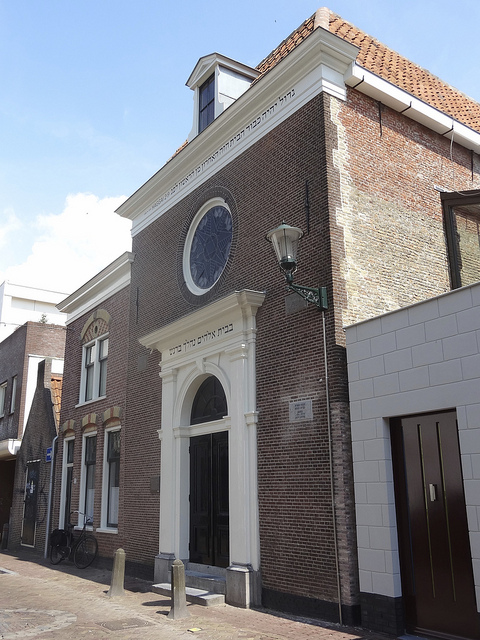
I live in Alkmaar, a half-hour train ride to the northwest of Amsterdam. It’s one of Holland’s smaller cities —population about 100,000. Probably it was more like 25,000 people during the Second World War. One feature of Alkmaar is its synagogue. For centuries there had been a synagogue in the town to serve the local Jewish community. Both Amsterdam and Alkmaar had officially welcomed Jews at the time of their expulsion from Spain in 1492, but that aspect of Dutch life came to end in 1941 when Holland was occupied by the German Army. On the 5th of March 1942, 213 Alkmaar Jews — all the local Jews who were not in hiding — were gathered at the synagogue and from there transported, via Amsterdam and the Dutch concentration camp, Westerbork, to Auschwitz. Only a few survived. The synagogue was closed.
the main entrance to Auschwitz (photo: Jim Forest)
Auschwitz: one of the most hellish of words, two syllables that contain the names of all concentration camps, all places of annihilation. Here was constructed an immense factory for the assembly-line production of dead bodies which were then converted into smoke. Auschwitz was a zone of absolute nihilism that made visible a demonic longing to murder God and to obliterate the divine image in man — a place for the death of conscience.
It had long been a hope of mine to go on pilgrimage to this Golgotha of the modern world. The chance finally came last year, thanks to an invitation to give a lecture at a conference on interfaith dialog held at the University of Wroclaw in Poland.
I was one of three Orthodox Christians from outside Poland who came to the conference. The other two were Metropolitan Kallistos Ware, from Oxford, and Archimandrite Ignatios Stavropoulos, from a monastery near Nefpaktos in Greece. With us was Father Vladimir Misijuk, a priest who has translated several of Metropolitan Kallistos’s books into Polish, and Dr. Pawel Wroblewski, one of the initiators of the conference in Wroclaw. The day after the conference ended, we traveled together to Auschwitz, now called the Auschwitz-Birkenau State Museum.
The local weather seemed to be in mourning — chilly, gray, on the edge of foggy. The area for miles and miles around Auschwitz is flat and thinly populated. The town near the camp, Oswiecim, is almost entirely of post-war construction — the population had been removed by the Germans before construction of the concentration camp was started so there would to be no local witnesses.
Standing near Auschwitz’s only surviving crematorium, our delegation was met by an historian on the museum staff who led us into the camp’s oldest zone, passing under the notorious Arbeit Macht Frei sign — Labor Brings Freedom.
I had imagined Auschwitz-Birkenau as one camp, but soon learned that Auschwitz served as the nucleus for more than forty other camps, with nearby Birkenau the point of delivery for the daily trainloads of captives, mainly Jews but also Christians, gypsies, homosexuals and political opponents of the Nazis.
In Auschwitz itself, nearly all the buildings had been constructed of brick. It could pass for a solidly-built military post. It would not have been hard to convince a naive visitor, so long as he didn’t look behind the wrong doors, that the conditions of life at Auschwitz weren’t so bad. Why there was even an orchestra! On the other hand, were a visitor to be taken inside the buildings, he would have soon discovered that there are hells in this world worse than any hell he might imagine in the next. For example, there was Block 10 — the domain of Nazi doctors carrying out the most vile medical experiments. One of the physicians, Josef Mengele, became known as the “Angel of Death.” Block 11 served as a “prison within the prison.” A small court operated here at which many were sentenced to death. The basement cells were for those deprived of all food and water. Among those who died in one such cell, now marked by a tall Paschal candle, was Maximilian Kolbe, a Franciscan priest who volunteered to take the place of a condemned fellow prisoner. Kolbe has since been canonized by the Catholic Church.
We stopped for a time in the yard between Blocks 10 and 11. This had been used as a place of summary execution for those convicted of breaking camp rules. Even a baseless accusation by an irritated guard could mean death before a firing squad. Here Metropolitan Kallistos led us in a prayer, long silences between each phrase, both for those who perished here and for the guards, prisoners of obedience, who did most of the actual dirty work. We also prayed with the awareness that, while the Nazis bear ultimate responsibility for what happened at Auschwitz, centuries of Christian anti-Semitism had helped create an environment of contempt and hatred without which the Shoah would have been impossible. It is no comfort that the Nazis themselves despised Christianity and its Jewish founder.
The charts, maps, photos and exhibits we saw in the various buildings we passed through effectively told the story of the creation and uses of Auschwitz and its surrounding network of camps. We passed through room after room containing the mute evidence of people who, after stripping naked for a delousing shower (so they were told), were gassed by the hundreds at a time — all children under fifteen, their mothers, the elderly, those judged unfit. Among those condemned on arrival, the lucky ones were those closest to the shower heads — they died immediately — while those further away took up to twenty minutes to breathe their last. Among the exhibits were empty canisters of Zyklon B, the substance from which the lethal cyanide gas was released.
Our final stop in the original Auschwitz was the camp’s one surviving place of gassing and body burning. It had escaped destruction because, when much larger gas chambers and crematoria were built at Birkenau, this smaller building had been converted into a bomb shelter. The adjacent crematorium, with its tall square chimney and just two ovens, was also left intact.
Birkenau, about a mile away, didn’t bother with brick structures for housing its captives. It was a vast gridiron of quickly-erected wooden barracks filling a vast area, barrack after barrack as far as the eye could see. Though a small number of barracks survive, in most cases only the foundations remain. The single brick building left standing is at the entrance to Birkenau, a one-storey structure crowned with an observation tower in the center under which prisoner-bearing freight trains arrived from every part of Europe. A few hundred yards beyond the station, truly the end of the line, was the area where an S.S. doctor presided over the selection process. Some were judged healthy enough to work — a slow death sentence for all but a few — while the rest were led away to the nearby gas chamber. About 75 percent were killed on arrival.
We visited two barracks, one of them still containing the deep wooden bunks on which inmates — up to a thousand per barrack — were stored at night like cigarettes in a carton. The shed-like structure provided almost no defense against the elements.
Walking from place to place in the two camps, I felt as if I had turned to wood. Words failed me — indeed my emotions failed me, and they still do. It’s not possible to respond in word or sentiment in an adequate way to evil of such magnitude. The awful images are unerasable. Having been there in the flesh, the events that happened in this rural corner of Poland are forever engraved in me.
Any pilgrim to Auschwitz is brought closer not only to the people who suffered and died there but also to all the people who played roles, major and minor, in the Holocaust.
One thought kept running through my mind: this human-made hell could never have existed without fear and obedience. Those who ran Auschwitz and similar camps, from the commandants to the lowest ranking guard, knew they would themselves be killed if they failed to obey orders. They decided it was better to survive than to die, better to be an executioner than a victim. While no doubt some of the staff at Auschwitz were already psychopaths when they arrived, most of those assigned here were, at least at the start, ordinary people, probably relieved that they hadn’t been sent into combat.
Adolf Eichmann, the chief bureaucrat of the Holocaust, claimed that he had no ill feeling against Jews. He did what he did because it was his assigned duty. He was “just following orders.” At his trial in Jerusalem he pointed out that he personally “never killed anyone.” He was a good and loyal citizen, a patriot, doing only what German law required of him. The declaration that “I was just following orders” could be made not only by the staff of Nazi concentration camps but by all those who created and staffed the Gulag Archipelago or who dropped nuclear weapons on Hiroshima and Nagasaki or who firebombed Tokyo or Dresden or Coventry or London or who showered napalm and Agent Orange on Vietnam. It remains true of those today whose daily work involves killing or assisting those who kill. Only psychopaths want to kill. The rest of us who are caught up in one way or another in work that results in killing are, if not “just following orders,” then flowing with the political and economic currents of the society in which we happen to live. Better to go with the flow than dare to say no.
We would prefer those people, like Eichmann, who do monstrous things to themselves be monsters, but, as Auschwitz survivor Primo Levi, wrote: “Monsters exist, but they are too few in number to be truly dangerous. More dangerous are the common men, the functionaries ready to believe and act without asking questions.” [Primo Levi, If This is a Man.] I recall an Israeli friend, a child at the time of the trial, telling me how startled she was to notice, in a newspaper photo of Eichmann in his cell, that this enemy of the human race was wearing the same bedroom slippers that her father wore.
In his essay “A Devout Meditation in Memory of Adolf Eichmann,” Thomas Merton reflected on the fact that the several psychiatrists testifying at Eichmann’s trial found Eichmann normal, even perfectly sane. One of them said that Eichmann was “more normal, at any rate, than I am after having examined him.” [Hanna Arendt, Eichmann in Jerusalem (New York: Penguin Books), p 25]
“The whole concept of sanity in a society where spiritual values have lost their meaning is itself meaningless,” Merton commented. “A man can be ‘sane’ in the limited sense that he is not impeded by disordered emotions from acting in a cool, orderly manner, according to the needs and dictates of the social situation in which he finds himself. He can be perfectly ‘adjusted.’ God knows, perhaps such people can be perfectly adjusted even in hell itself. And so I ask myself: what is the meaning of a concept of sanity that excludes love, considers it irrelevant, and destroys our capacity to love other human beings, to respond to their needs and their sufferings, to recognize them also as persons, to apprehend their pain as one’s own?” [Thomas Merton, Raids on The Unspeakable (New York: New Directions, 1964), p 45-9]
If a man like Eichmann is sane, we need to ask ourselves if “sanity” has come to mean merely the capacity to live successfully in society, no matter how toxic it is. Clearly it’s sane to regard having a successful career as more important that having an operating conscience. Sanity is to play it safe; sanctity is dangerous. God calls us to sanctity.
One of the ways the Church helps us move toward sanctity is by occasionally identifying models of sanctity, canonizing them, and making sure they are remembered by putting their names on the church calendar. Thus each day of the year provides an opportunity for us to discover and reflect upon one or more stories associated with a saint’s life.
I suggest we take a quick look at just two recently recognized saints who, in the era when the crematorium chimneys of Auschwitz were bellowing the smoke of genocide, were models of what we might describe as holy disobedience, that is Gospel-shaped acts of disobedience to demonic secular authorities.
First let me draw your attention to Alexander Schmorell, canonized last year at the Russian Orthodox cathedral in Munich, the very city in which Hitler began his march to absolute power. Alexander Schmorell, a German medical student of Russian descent, was both a devout Orthodox Christian and also a co-founder of a small but very significant anti-Nazi group that, at Schmorell’s suggestion, christened itself the White Rose. The name was inspired by the chapter “The Grand Inquisitor” in Dostoevsky’s novel, The Brothers Karamazov. In it we find ourselves in Seville during the height of the Inquisition. In this time of terror, Christ appears in the city’s cathedral square, its pavement still warm from the burning of a hundred heretics the day before. Responding to a mother’s desperate appeal, Christ raises from the dead a young girl, her daughter, whose open coffin is being carried across the square on its way to the cemetery. “The procession halts,” Dostoevsky writes, “the coffin is laid on the steps at [Christ’s] feet. He looks with compassion, and His lips softly pronounce the words, ‘Maiden, arise!’ and she arises. The little girl sits up in the coffin and looks round, smiling with wide-open wondering eyes, holding a bunch of white roses they had put in her hand.” This merciful action completed, Christ is recognized by the Grand Inquisitor, who immediately orders his arrest.
In the context of the story, the white rose is a paschal symbol, a sign of the victory of life over death. The resurrection of the girl is set against the background of a world that seems to be under the rule of Satan, a world not unlike the Third Reich. The adoption of the name White Rose was the group’s way of declaring their Christian conviction that he who has defeated death can also lift us from our graves — not only the grave to be dug at the end of our lives but the grave of fear-driven obedience that we occupy here and now.
Before their discovery and arrest, the members of the White Rose managed to publish and widely circulate a series of six open letters denouncing Nazi ideology and calling for resistance. One leaflet contained the only known public protest by any German resistance group specifically against the Holocaust: “Here we see [in the mass murder of Jews],” the text drafted by Schmorell declared, “the most frightful crime against human dignity, a crime that is unparalleled in the whole of history.”
As was bound to happen, eventually the White Rose members were arrested, tried and executed. Alexander Schmorell was beheaded on the 13th of July 1943. In his last letter to his family, he wrote: “This difficult ‘misfortune’ was necessary to put me on the right road, and therefore was no misfortune at all…. What did I know until now about belief, about a true and deep belief, about the truth, the last and only truth, about God? Never forget God!” Thanks to a witness, we also have an account of his last words: “I’m convinced that my life has to end now, early as it seems, because I have fulfilled my life’s mission. I wouldn’t know what else I have to do on this earth.”
Let us look at Mother Maria Skobtsova — Saint Maria of Paris — a woman of similar courage. Would that there was time to talk in some detail about her remarkable life, which began within the Russian Empire before the Bolshevik Revolution and ended in a German concentration camp. Along the way she was married twice, becoming a mother before she became a monastic. After her second marriage disintegrated, she was consecrated a nun by her bishop, Metropolitan Evlogy, who greatly valued the diaconal work she was doing.
In 1933, twelve years before her death, she founded a house of hospitality and chapel on the Rue de Lourmel in Paris. One member of the core community that took root there was her son, Yuri. There was also a remarkable young priest, Father Dimitri Klépinin.
When Paris was occupied by the German army in 1940, it became a special priority of the community to assist the many Jews who came seeking shelter and help in escaping. Father Dimitri issued many false baptismal certificates. Under Gestapo interrogation, he was knocked to the floor after pointing out that Christ was himself a Jew. Remarkably, on that occasion he was released. The community and its allies smuggled many people — how many no one knows — out of Paris to the south of France or Switzerland.
In July 1942 came the mass arrest of 12,884 Jews. Almost 7,000 Jews, two-thirds of them children, were brought to a nearby sports stadium. Held there for five days, the captives were at last sent to Auschwitz. Mother Maria had often considered her monastic robe a godsend in her work. Now, with some bravado on her part, it opened the way for her to enter the stadium. For several days she was able to work there, trying to comfort the children and their parents and distributing what food she could bring in. She even managed to rescue a number of children by enlisting the aid of trash collectors who smuggled the children out in trash cans.
Early in 1943, the long-expected event happened: Mother Maria, Yuri, Father Dimitri and another collaborator, Ilya Fondaminsky, were arrested. All four later died in concentration camps, in Mother Maria’s case in Ravensbrück, not far from Berlin.
The last day of Mother Maria’s life was Good Friday 1945. The shellfire of the approaching Russian army could be heard in the distance. Accounts vary as to what happened during the last hours of her life. According to one report, she was simply one of those selected to die that day. According to another, she took the place of a fellow prisoner, a Jewish woman.
Although perishing in the gas chamber, Mother Maria did not perish in the Church’s memory. Soon after the end of World War II, essays and books about her began appearing in French, English and Russian. On the first day of May 2004, at Saint Alexander Nevsky Cathedral in Paris, Mother Maria, her son Yuri, Father Dimitri Klépinin, and their friend and co-worker Ilya Fondaminsky were officially recognized as saints.
Perhaps the shortest expression of Mother Maria’s credo is this brief sentence: “Each person is the very icon of God incarnate in the world.” With this recognition, she said, comes the obligation to venerate the image of God in each person. She saw no other path to heaven except to participate in God’s mercy. “The way to God lies through love of people,” she explained. “At the Last Judgment I shall not be asked whether I was successful in my ascetic exercises, nor how many bows and prostrations I made. Instead I shall be asked: Did I feed the hungry, clothe the naked, and visit the sick and the prisoners? That is all I shall be asked.”
Alkmaar’s synagogue (photo: Jim Forest)
At its core, the holy disobedience these saints displayed is not at all unusual. The church calendar is packed with names of saints who refused to follow orders, from the time of imperial Rome to our own day — men and woman who refused to comply, refused to conform, refused to obey, refused to please the ruler, refused to reverence idols, refused to kill, refused to bear false witness, refused to renounce their faith, refused to ignore their suffering neighbor. Their holy disobedience to man was founded on the bedrock of their holy obedience to God. You find them on the church calendar on every day of the year. Many more such saints are not yet formally canonized only because they have died too recently. There are martyrs dying today.
May Saint Alexander of Munich, Saint Maria of Paris and all the saints who refused to please Caesar give each of us the courage to say no when a no is needed.
By the way, I am happy to tell you that, seventy years after the Alkmaar synagogue was closed by the Nazis, it was restored and reopened. I’ll take you to see it if you ever come to visit.
One of the unique aspects of being human is the role stories play in our lives and have played as far back as the human story is told. Stories inspire, enlighten, connect, delight, warn, admonish and surprise. We need them with an urgency that resembles hunger. Not merely entertainment, stories can save lives or turn us into killers.
In 1955, when I was thirteen, I went to the Museum of Modern Art in New York to see a photo exhibition that has haunted me ever since. Its theme was “The Family of Man.” The curator, Edward Steichen, brought together a vast sequence of photos that not only asserted but demonstrated that, for all the diversity of culture, skin color, local economy and development, varieties of religion and differences of clothing, we are indeed one human family bound together in love, pain, labor, awe, anger, gratitude and death. I bought the exhibition book and have hung onto it through many moves, returning to it ever since as if it were a Bible without words. Taken as a whole, the collection has as its golden thread the radical us-ness of being. It helped me understand that beneath our separateness is our unity. It’s about the “our” in the Our Father.
Among the images that I especially love is one of an old African storyteller in a fire-illuminated hut. We see him at the top of a circle of young people, boys and girls who are listening to the old man with absolute attention and wonder. The storyteller’s eyes are wide open, his mouth a perfect O, his eyebrows arched high into his forehead, his hands raised above his head, all ten fingers outstretched. If he were telling the story of Jesus’s life, this might be the moment when the disciples discover the empty tomb.
The photo is an icon of the power of story telling.
“In traditional African cultures, not even the chief or the healer is as important as the storyteller,” Joseph Donders, a Dutch priest who had spent much of his life in Africa, once told me. “The survival of the tribe from generation to generation depends on stories, but only so long as the stories reveal truth. With truth-revealing stories the storyteller becomes the guardian not only of his actual audience but of those not yet born. This is because, in times of crisis, people are guided not by theories or principles but by stories. True stories are life-saving, false stories lead toward disaster. Stories are proven true by the test of time. An old story that has been told for centuries and has been tested in many times of crisis can be regarded as true.”
“The testing of stories,” he added, “requires the passage of many generations. In fact two thousand years is about right.”
Our conversation led us to consider the question of what was the most basic story in the modern world. We quickly agreed that, in its purest form, it’s the western movie and decided to call it the Gospel According to John Wayne. (Not John Wayne the man, who may have been as nonviolent as Gandhi, but John Wayne the actor in the gunslinger roles he often played.)
At that the core of the Gospel According to John Wayne is a good man with a gun defeating bad men with guns.
The story needn’t be set in the Old West. The core elements adjust to any setting: rural or urban, past or present, or a Star Wars future where distances are measured in light years. The Gospel According to John Wayne can also be the Gospel According to Luke Skywalker or the Gospel According to Clint Eastwood. The moral is the same in any case: We are saved by deadly weapons and the courage and skill of those community defenders who wield them.
In the classic Western version, it’s the story of men who are evil to their core threatening decent people in a newly-settled town in the lawless West in which there is a battered saloon at one end of the street and a newly painted church and school house at the other. Endangered by pathological killers, the well-being of the townspeople depends on the courage of one brave man and those, if any, that he is able to rally behind him. The iconic scene is the gunfight on Main Street — one man with a gun facing another man with a gun and both pulling the trigger. There is sometimes a prefatory scene before the shoot-out in which we see the reluctant hero open a drawer and grasp his revolver, a weapon he once put away with the hope of never using it again. He is not, such scenes make clear, a man of violence but now there is no alternative. He straps on his holster, inserts six bullets in the gun’s chambers and walks out the door knowing he may be dead within the hour. In fact he survives. Goodness triumphs. It’s the men who love killing whose day ends in coffins.
It’s far from an ignoble story. There is real courage in it — the readiness of an honorable man to risk his life to protect his defenseless neighbors from wicked men whose death we who watch the film cannot help but wish for and, once it happens, welcome. If only briefly, it seems the world has been made a safer place.
The big problem with the Gospel According to John Wayne is that it hides from us the troubling fact that there is no such thing as a completely evil person — also the uncomfortable fact that there is no such thing as a completely good person.
Few biblical texts have more profound implications than this passage in the first chapter of Genesis: “God created man in his own image, in the image of God he created him; male and female he created them.”
If so, then there are no bad seeds. Our DNA obliges none of us to commit murder. No matter how damaged a person becomes in the process of growing up and entering adulthood, all of us are born bearing the divine image and can never entirely lose it.
For John of Kronstadt, one of the Russian saints of the nineteenth century, to become aware of this was one of the main challenges of Christian life. “Never confuse the person,” he said, “formed in the image of God, with the evil that is in him, because evil is but a chance misfortune, illness, a devilish reverie. But the very essence of the person is the image of God, and this remains in him despite every disfigurement.” Saint John’s insight was not developed at a comfortable distance from the rough side of life — he was parish priest in Kronstadt, a port city with thousands of sailors and more than its share of drunkenness, crime and violence of every kind.
In common with ordinary Russians at the time, Saint John of Kronstadt avoided dehumanizing labels for men who had been convicted of criminal actions. They were instead commonly referred to as “unfortunates.” It was this attitude that helps explain why so few executions occurred in pre-revolutionary Russia. Those who were convicted of murder and other grave crimes were instead sent to labor camps in Siberia.
The inability to see Christ in the other is the most common form of spiritual blindness, as one of the most prominent saints of the fourth century, John Chrysostom, often stressed. “If you fail to recognize Christ in the beggar outside the church door,” he said, “you will not find Christ in the chalice.” Or as Dorothy Day put it, “Those who do not see Christ in the poor are atheists indeed.” Or as Thomas Merton wrote: “Guard the image of man for it is the image of God.”
Yet the Gospel According to John Wayne remains a compelling story — the brave lone man who puts himself in the line of fire and kills a human monster whose death is a blessing for every decent person. Moral: The community can only be protected by good guys — or good women — killing bad guys.
In the latter part of “Gone With the Wind,” a film that presents slavery as having been not so bad, the heroine, Scarlett O’Hara, returns to her family plantation, Tara, after Southern defeat. Scarlett finds the mansion intact though the crops have been burned, her mother has died of typhoid, her father is insane with grief, her two sisters are ill, and most of the (formerly happy) slaves have run off. Forced to take up labor that in better days had been done by slaves, Scarlett’s life now centers on reviving the plantation through blood, sweat and tears, even if the paradise that the Tara plantation once had been for her is lost indeed. When a drunken Yankee soldier arrives and seems poised to rape Scarlett, she stands on the mansion’s grand curved staircase, revolver hidden behind her back, then, at the last moment raises the weapon and shoots him in the face. Afterward, in shock, she says to her sister-in-law, “I’ve done murder.” To her credit and the credit of the storytellers, Scarlett uses a razor-sharp word, murder, that doesn’t mask what she has done. After pulling the trigger and seeing at close range the death she has caused, perhaps Scarlett realizes she might have aimed at the man’s legs and protected herself without becoming a murderer.
How rare is the movie in which the hero is allowed to aim for the legs or, rarer still, find a bullet-free, nonviolent solution. Film after film, the implicit message is that, in confrontations with evil, there are no non-lethal — still less nonviolent — solutions. It’s a kill-or-be-killed world, period, next subject.
Crazy for God
by Frank Schaeffer
New York: Carroll & Graf
406 pages, indexed, $26
Frank Schaeffer doesn’t really fit into a brief description. An American, he grew up in rural Switzerland. His parents were fervent Calvinist missionaries living in a Catholic culture which they regarded as barely Christian. Their chalet, known as L’Abri, became a house of hospitality in which a never-ending seminar on culture and Christianity was the main event. Though an Evangelical, a strain of Protestantism usually hostile to the arts, Frank’s father was an avid lover of art done in earlier centuries by, in most cases, Catholic artists — an enthusiasm that in time inspired his son to become an artist. Later Frank gave up the easel to makes films, first documentaries in which his father was the central figure, then more general evangelical films, and finally several unsuccessful non-religious films aimed at a general audience. Eventually — profoundly disenchanted with the form of Christianity his parents had embraced, and still more alienated from the shrill varieties of right wing Evangelical Christianity that both he and his parents had helped create, Frank joined the Orthodox Church, where he still remains, though no longer in what he refers to as the stage of “convert zeal.” After his son, John, became a Marine, Frank became something of a missionary for the Marine Corps, and the military in general, at the same time avidly supporting the war in Iraq in which his son was a participant. A statement I helped to write that urged George Bush not to attack Iraq was the target of a widely-published column Schaeffer wrote in the early days of that war. Now he regards the Iraq War as a disaster and has become an outspoken critic of George Bush.
“Crazy for God” is a gripping read, both candid and engaging. More than anything else, I was touched by Schaeffer’s unrelenting honesty. There are pages in which you feel as if you are overhearing a confession. Yet it’s a very freeing confession to overhear, in the sense that it allows the reader to make deeper contact with painful or embarrassed areas of his own wounded memory. The book also serves as an admonition not to create a self for public display which is hardly connected to one’s actual self.
Being raised in a hothouse of Calvinist missionary zeal, in which Schaeffer and his three sisters became Exhibit A (especially whenever their mother wrote or spoke about Christian Family Life) is not something I would wish on any child. I expect Frank Schaeffer will always be in recovery from that aspect of his childhood.
Those — and they are many — who still revere his parents (or for that matter Schaeffer’s earlier self, in the period of his life when he was a hot voice packing in the evangelical/Christian Right crowds) are furious at this lifting of the curtain.
Yet I found Schaeffer much harder on himself than on his parents, whom he sees as having been damaged, in some ways made crazy, by the burden of a harsh Calvinist theology. Nonetheless his parents emerge as real Christians whose loving care for others, including people whom many Christians would cross the street to avoid, was absolutely genuine. (I was impressed by the book’s account of his parents’ response to homosexuals who came to visit L’Abri. They were as warmly received as any other guest.)
While objecting to his parents’ theology and the distortions that it created in their lives and in the lives of many influenced by them, clearly he loves them passionately and deeply respects the actual Christian content of their lives — their “grace, generosity, love and unconditional support.”
Schaeffer’s book also reminds me that it’s one of the recurring tragedies of US history that, from time to time, various movements of self-righteous, ideology-driven Christians decide it’s time to try to impose their ideas on society at large. Schaeffer has to live with the painful memory of having been one of the key figures helping to create one of the constituencies that did the most to put George Bush in the White House in their one-issue hope that he would find ways to make abortion, if not illegal, at least less frequent. After eight years in the Oval Office, in fact abortion is no less deeply embedded in American life than it was before Bush’s election. Little if anything was done by his administration to help women who felt they had no option but abortion find alternatives.
I was touched by Schaeffer’s comments about the powerful influence children can have on their parents, far more than the children usually realize. As Schaeffer has come to understand, in reflecting on his relationship with his father, that influence is sometimes far from positive.
Schaeffer — now far more caring about the quandaries others face than he was earlier in his life — has in the process become aware that self-righteousness is often the hallmark of each and every “movement,” whether religious or secular, and whether for the unborn, for peace, for those on death row, for animal welfare, for the environment, etc., etc.
In putting the book down, I find myself profoundly grateful for where Frank Schaeffer’s journey has taken him so far, yet hope for further evolution in his views in regard to the military and how those in the armed forces are used. I take it as a given that he is aware there are men and women who died or live crippled lives in part because of the impact on their lives of several of Schaeffer’s earlier books which viewed the military uncritically and seemed unaware of how often those sent into battle — because of accidents, misinformation, panic, bad orders, or even the passion for vengeance — kill innocent people. Nor does he seem aware of the damage, often unhealable, done to those who bear responsibility for such deaths. I hope Schaeffer will give more thought to why the early Church took such a radical stand in regard to warfare and other forms of killing, accidental or intentional, and what that might mean for any Christian in our own day.
Also I would have been glad to hear more about what drew him to the Orthodox Church and what keeps him there, now that he is past what he calls the “zealous convert” stage. In his autobiography, being Orthodox is a minor topic.
As “Crazy for God” bears witness, life is mainly shaped by one’s parents and family, peer group pressure, and — not least — the white water of ambition. Religious beliefs, far from being primary, are often shaped and adjusted by our social goals. I was reminded several times of one of Kurt Vonnegut’s insights: “Be careful what you pretend to be. You become what you pretend to be.” It’s something of a miracle that Frank Schaeffer escaped from the highly profitable world of the Television Church.
“Crazy for God” also reminds me of what a dangerous vocation it is, more perilous than mountain climbing, when one becomes a professional Christian, writing or speaking about the Gospel, Jesus Christ, the kingdom of God, making some or all of your living doing this. It’s a danger I live with too.
The Catonsville Nine: A Story of Faith and Reistance in the Vietnam Era
by Shawn Francis Peters
Oxford University Press, 2012
review by Jim Forest
It’s now 44 years since nine Catholic peace activists entered a draft board in Catonsville, Maryland, filled two wastebaskets with several hundred draft files, and burned the papers with homemade napalm in the parking lot. It would have been a news event no matter who had taken part, but the involvement of two Catholic priests, the brothers Daniel and Philip Berrigan, made the headlines even bigger.
The event was one among thousands of protest actions aimed at America’s role in the Vietnam War, already several years old and destined to continue another seven years, but for many people — me among them — the Catonsville raid was a turning point in our lives. It also triggered passionate debate about the limits of peaceful protest. Could the destruction of property be called nonviolent?
The prime movers of the Catonsville Nine were Phil Berrigan and George Mische. Earlier in his life, Mische had worked for US-funded groups fostering labor movements in the Caribbean and Latin America. Phil had fought as an infantryman in World War II where his courage and leadership qualities won him a battlefield commission. As Shawn Francis Peters’s book makes clear, even as a priest engaged in the civil rights and anti-war movements, Phil remained very much the infantryman he had been years earlier. Dismayed that the peace movement was having no discernible impact on events in Vietnam, he became convinced of “the uselessness of legitimate dissent.” In his frustration, he opted for firing the cannons of civil disobedience.
US troops were mainly draftees; few young men had a longing to go to war in a country that posed no threat to the US and whose borders most Americans couldn’t find on the world map. The key role conscription played in keeping the war going led Phil to target draft board offices and their papers. (One of the Catonsville Nine, Tom Lewis, called them “death certificates.”)
Peters has written a complex, gripping account of what led up to the event, the raid itself and its aftermath. One by one the participants are brought to life — an artist, a nurse, three former missionaries (one a former nun, another an ex-priest), an Army veteran who had become a peace movement organizer, a teacher who belonged to a Catholic religious order, plus the Berrigans. It wasn’t just the Catonsville Two. The book becomes much more than the story of the Berrigan brothers and includes much more than Vietnam. Finally the impact of the Catonsville action is evaluated. While only inconveniencing the Selective Service System, many were inspired to refuse participation in the war while some whose records were destroyed never heard from a draft board again.
The trial, a remarkable drama in its own right, is in many ways the highpoint of the book. Federal judge Roszel Thomsen is shown as a man who allowed a remarkable degree of latitude in his courtroom, even permitting, on the trial’s last day, everyone present to stand and recite the Our Father. (Later, while the nine were serving their prison terms, he cut their sentences short.) Sadly, during the trial he would not permit the defendants to bring forward a “justification” defense — the argument that destruction of draft records was justified as a reasonable means of inhibiting prosecution of an unjust and illegal war. The trial has been reenacted in a play and film still being seen by audiences all over the world.
The book has its sad stories. One of the most poignant concerns Mary Moylan. Refusing to turn herself in, she spent nine years in hiding, for a time was part of the “Weather Underground,” then, weary of dodging the FBI, turned herself in to serve her long-deferred two-year sentence. After her release she returned to nursing but eventually had to give it up due to eye failure. In 1995 she died of the consequences of alcoholism. Her friend Rosemary Ruether regards Moylan as “a casualty of war” and suggests “an alternative Vietnam memorial bearing the names of all those whose lives were destroyed in protesting the war.”
Those interviewed by Peters include the women at the Catonsville draft board who struggled to protect their files and lawyers for the prosecution, one of whom sympathized with the raid. Peters has obtained and mined previously unseen FBI records that bear on the case, revealing how personally obsessed FBI director J. Edgar Hoover was with the Berrigans and their collaborators.
I was press secretary of the Catonsville Nine Defense Committee and knew all of the nine, especially Dan and Phil, and so come to the book with more than a bystander’s curiosity. The narrative reopens some old wounds but also renews my compassion for who we were and why we put so much on the line, in my case a year in prison for participating in the burning of draft records in Milwaukee that followed the Catonsville action.
In the post-Catonsville period, with similar raids multiplying, I eventually became alienated from Phil, whom I saw as undervaluing forms of war protest that involved no legal penalties and for bullying people into actions which inevitably led to prison, for which not all were well prepared. (In response, Phil correctly pointed out that few soldiers are prepared for the wars in which they are conscripted to fight and often suffer much worse consequences.) Phil could be astonishingly cruel in his judgments not only of adversaries but of co-workers — his words sometimes seemed to have been fired from a sawed-off shotgun.
Even for someone like myself, very much an insider, the book has its surprises. I knew that, for a time, Phil had been on the borderline of violence, but I had no idea that, prior to Catonsville, Phil had briefly considered bombing a draft board, albeit at night when no one was present. Later on, shortly before being imprisoned for burning draft records, he explored heating tunnels in Washington, DC, playing with the idea of using explosives to disrupt work in the federal office buildings linked by the tunnels. Happily he never gave in to the temptation to speak in the language of bombs.
At the time of the Catonsville draft-record burning, novelist Walker Percy asked how it differed from cross burnings carried out by the Ku Klux Klan. Peters’s book succeeds in showing how great the contrast is, not least because at Catonsville no one wore hoods, no one was threatened, and there was no reliance on the cover of night. Acting in the full light of day, each of the nine insisted on awaiting the police and taking full responsibility for what they had done with all its consequences.
The words of Daniel Berrigan will continue to haunt us so long as wars are fought: “Our apologies, good friends, for the fracture of good order, the burning of paper instead of children…. And yet the times are inexhaustibly good. The truth rules. Christ is not forsaken.”
PS During a visit yesterday with Dan Berrigan, now 91, I saw the book on a reading table next to his bed and asked how he liked it. He spoke of it in glowing terms.
The Trial of the Harrisburg 7 and the New Catholic Left
by William O’Rourke
Notre Dame University Press, 2012
review by Jim Forest
Appearing before a Senate committee on November 27, 1970, FBI director J. Edgar Hoover made the startling charge that two Catholic priests, Daniel and Philip Berrigan, were leaders of “an anarchist group” that was “concocting a scheme to kidnap a highly placed government official” and also “to blow up underground heating conduits and steam tunnels serving the Washington, DC area in order to disrupt federal governmental operations.” The group’s goal, said Hoover, was to force the end of US bombing operations in Southeast Asia and the release of all America’s political prisoners. The prominent official to be kidnapped, it quickly turned out, was President Nixon’s National Security Advisor, Henry Kissinger.
The story was page-one news from coast-to-coast and put clerically-clad Dan and Phil Berrigan on the cover of Time magazine the following week.
An indictment was issued in January 1971. Then, in April, came a superseding indictment that added the more winnable charge of conspiracy to destroy draft records; it was like accusing chickens of conspiring to lay eggs. In addition to Phil Berrigan, seven others were charged: Eqbal Ahmad (a scholar), Elizabeth McAlister (nun), Tony and Mary Scoblick (former priest and former nun), Ted Glick (a draft resister), Neil McLaughlin (priest), and Joseph Wenderoth (priest). In the revised set of charges, Dan Berrigan was demoted to an “unindicted co-conspirator,” thus not among those facing trial. When the indictment was published, both Berrigans were in prison for draft-record burning,
By the time Hoover made his accusations, the Berrigans had been steadily in the news for several years, seen as the principal leaders of “the Catholic Left,” a journalistic tag for those Catholics who had been resisting the war in Vietnam with acts of civil disobedience, especially raids on draft boards. In a three-year period, beginning in 1967, there had been dozens of such raids, the most famous of which was in Catonsville, Maryland in May 1968.
The trial took place in the early months of 1972 at the federal courthouse in Harrisburg, Pennsylvania, by which time the Harrisburg Eight became the Harrisburg Seven with Ted Glick severed from the group because of his petition to defend himself rather than have a lawyer act of his behalf.
At the trial’s end, after ten of the twelve jurors voted for acquittal of the seven, the judge declared a mistrial. It was a personal humiliation for J. Edgar Hoover. Following defeat, the government dropped the case. Glick was never tried.
William O’Rourke, then a young writer based in New York (and now professor of English at Notre Dame), was one of the people who made Harrisburg his home for the period the trial lasted and immediately afterward wrote his account — in turns gripping, funny and surprising — of what happened in and around the courtroom: The Harrisburg Seven and the New Catholic Left. Forty years later, now recognized as a classic of trial literature, the University of Notre Dame Press has put the text back in print, expanding it with a substantial afterword by the author and also adding an index.
Even decades after the events that prompted its writing, O’Rourke’s book remains a compelling account of a remarkable trial in which a team of gifted lawyers prevailed; the team included former US Attorney General Ramsey Clark, Jesuit priest and lawyer William Cunningham, Leonard Boudin, and Paul O’Dwyer. What turned the tide in the defendants’ favor was their lawyers’ devastating cross-examination of the government’s key witness, crook and conman Boyd Douglas. Douglas, a fellow prisoner of Phil’s but with access to the outside world, had acted as Liz and Phil’s private mailman, meanwhile copying their letters for the FBI.
The government’s principle evidence was a folder of letters exchanged between Phil Berrigan (in prison) and Liz McAlister, who had fallen in love with him and whom she later married. In her desperate effort to reassure Phil that the flame of war resistance was not dying out in his absence, Liz had written to report discussion of the idea of a “citizen’s arrest” of Henry Kissinger on the charge of committing war crimes. Both Liz and Phil were beyond naïve in trusting Douglas. The ideas that made their letters such exciting reading for J. Edgar Hoover were — like so many love letters — more in the realm of fantasy than reality. In fact no plot was hatched to arrest, kidnap or detain anyone.
And the heating tunnels? It was true that Phil, before going to prison, had toyed with the idea of using explosives in heating tunnels connecting federal office buildings in Washington. There was still a current of battlefield violence running within his adoption of nonviolence. Phil had won a commission while fighting in the infantry during World War II and was at home with munitions. But the idea, like so many others born of desperation to end a war that was wreaking havoc in Southeast Asia, never got further than taking a walk in the tunnels. On FBI instructions, Boyd Douglas had sought to resuscitate the idea, offering to obtain explosives, but his offer triggered only alarm and disgust.
The high point of the trial was the dramatic reading by US Attorney William Lynch of what were meant to be very private letters between Liz and Phil. During the recitation, O’Rourke watched their faces: “Berrigan sits with his chin raised, his jaw set to resist an impending blow; he has the curiosity of a man listening to someone else’s letters. Surprise thickens his eyes. McAlister averts hers.” It was the trial of Romeo and Juliet but with a political edge.
That the seven defendants would win the trial was nothing any sane person could have predicted, yet it was a costly victory. The strain of the trial divided the seven — several of them wouldn’t talk with Liz and Phil afterward — and left “the Catholic Left” in disarray. What O’Rourke describes as “a golden age of protest” was over.
“Public opinion,” O’Rourke comments in his new afterword, “certainly noted that the trial had ended ambiguously, without vindication for either side, but the public also absorbed the message that the priests and nuns involved no longer seemed exactly like saints and had, if not abandoned their commitment to nonviolence, at least flirted with it, coming closer to the other protest movements of the time that had taken on violence as a tactic, such as the Weathermen. The paradox made visible was this: by the end of the Vietnam War the most successful antiwar protest group still standing was the Vietnam Veterans against the War. It is a long, strange war that puts up the men who had fought it as the most effective protesters against it.”
One of the great joys for us in recent weeks was going to a poetry reading by Seamus Heaney in Amsterdam. The venue — a former church that is now a theater — was packed. It’s amazing how many Dutch people turn out for an evening of poetry in another language, and in this case despite one of the fiercest rainstorms I’ve ever experienced in Holland.
I had never seen Heaney before but his face was somehow familiar. Then it clicked. He has a remarkable resemblance to the actor Peter Ustinov. It’s a very pink, potato-shaped face topped with hair halfway between silver and snow. He wore a bright white shirt with round brown buttons, no tie, and a tweed jacket.
My favorite moment of the evening was a poem rooted in an Irish legend describing a tiny ship sailing in the air through an abbey church in ancient times. Our world of air and light was a submerged, invisible world to the little people sailing overhead. The anchor got tangled in something in the church and the ship was in difficulty as a result until one of the monks below freed the anchor. The ship sailed on, passing through the stone wall as through air. It is a poem of the two worlds we move between — the world that’s flat and the world that shimmers. Interesting that it’s a monk who notices the passing ship and helps preserve it from the dangers below; one may hope that the spiritual life will open ones eyes to what is generally missed.
Heaney commented, “You had better get into the marvelous. It’s more important than the matter-of-fact.” He recalled as a child the pleasure of seeing a whole world in the rain drops on a telegraph wire.
The function of the poet, he said, “is simply to write poetry, to let poetry happen, to let a poem come through. And many do this but wouldn’t have the arrogance to call themselves poets. I didn’t dare call myself a poet until I had published three books. To be poet is like taking vows, to belong to a holy order.”
He was asked about being a Catholic and coming from a Catholic milieu, which some other Irish writers have found a heavy burden. Heaney didn’t identity himself with “liberated ex-Catholics” who regard the Church chiefly as the wielder of a strap, hitting backsides and rapping knuckles, and forever lining up people to enter the confessional but expresses his debt to a religious up-bringing. “We never felt ourselves alone in the universe for one second,” he said. “You were given a strong sense of the universe. You were illuminated by a light-filled creation, the sense of a big shimmer of which you were a part. Sanctifying grace. You didn’t have to understand it. So for me the Church wasn’t a set of repressions but a sense of visionary possibilities. Catholicism has that aspect of poetry, the imagined elsewhere, the actual moving toward the radiant, ad majorem dei gloriam.”
(written in 1995)
* * *
The Annals Say
by Seamus Heaney
The annals say: when the monks of Clonmacnoise
Were all at prayers inside the oratory
A ship appeared above them in the air.
The anchor dragged along behind so deep
It hooked itself into the altar rails
And then, as the big hull rocked to a standstill,
A crewman shinned and grappled down the rope
And struggled to release it. But in vain.
‘This man can’t bear our life here and will drown,’
The abbot said, ‘unless we help him.’ So
They did, the freed ship sailed, and the man climbed back
Out of the marvellous as he had known it.
— from the book “Seeing Things” (Lightenings viii)
Seamus Heaney’s gravestone
* * *
Saint Kevin & the Blackbird
i.
And then there was Saint Kevin and the blackbird.
The saint is kneeling, arms stretched out, inside
His cell, but the cell is narrow, so
One turned-up palm is out the window, stiff
As a crossbeam, when a blackbird lands
And lays in it and settles down to nest.
Kevin feels the warm eggs, the small breast, the tucked
Neat head and claws and, finding himself linked
Into the network of eternal life,
Is moved to pity: now he must hold his hand
Like a branch out in the sun and rain for weeks
Until the young is hatched and fledged and flown.
ii
And since the whole thing’s imagined anyhow,
Imagine being Kevin. Which is he:
Self-forgetful or in agony all the time
From the neck on out down through his hurting forearms?
Are his fingers sleeping? Does he still feel in his knees?
Or has the shut-eyed blank of underneath
Crept up through him? Is there distance in his head?
Alone and mirrored clear in love’s deep river,
“To labour and not to seek reward,” he prays,
A prayer his body makes entirely
For he has forgotten self, forgotten bird
And on the riverbank forgotten the river’s name.
–Seamus Heaney
from “The Spirit Level” (London: Faber & Faber, 1996)
Charles & Rosanne at the time of their wedding in 1993
On the 24th of July my sister Rosanne breathed her last. She was 68. In her final hours each breath was a great labor. Her husband, Charles, and two of her four children were at her bedside when she exhaled that final time. I was a few feet away. Quite soon all four children were in the house along with grandchildren and cousins plus other members of our complex family in which bonds of DNA are not the decisive ingredient. The next morning Charles washed Rosanne and then all the family oiled her from forehead to toes before placing rose petals on her body.
Rosanne was startlingly emaciated. On the day she died, it had been three weeks since she last accepted food. When I arrived, she was taking very little water. She seemed unable to swallow.
For seven years Rosanne had been struggling with Alzheimer’s disease. The onset had been very slow — an increasing degree of absent-mindedness that finally reached the point of her having to give up her work as an occupational therapist. In that period Charles and other family members looked for dietary changes that might help stop the damage to her brain or even reverse it. During the last few years she was gradually stripped of her active vocabulary until words were few and rare. She was sometimes confused about where she was. A wheel chair was needed. Going out became a challenge. She became utterly dependent on the care of others, Charles most of all.
Charles holding Rosanne’s hand the day of her death
Thank God I was able to take part in the last nine days of Rosanne’s life — part of a community of family members and friends who were not only camping out on the edge of her deathbed but on the border of the mystery of death.
The hours when I was at her side were mainly times of silence but also of a quiet one-sided conversation and reading aloud. I urged her, for example, to ignore the advice of Dylan Thomas about not going gently into that good night; better, I proposed, to embrace, embrace the dying of the light. Using the Bible I have on my e-reader, I picked out psalms, or parts of psalms, that seemed appropriate. I slowly read her the story of Lazarus being called out of his tomb, accounts of the resurrection of Jesus, the Beatitudes, the Book of Jonah, parts of the Song of Songs, the canticle of praise sung by the three young men consigned to the furnace in Babylon — texts that have to do with death not having the last word, the grave not being the end of the journey, life not being a bad joke. I told Rosanne that no one knows much about what happens after death but that we get occasional joyful glimpses of heaven in day-to-day life.
Though she couldn’t speak, apart from an occasional yes or no or groan of distress as her body was turned, I think she recognized each of us who took part in the vigil and heard what we had to say. She communicated by intense attention to the face of the person sitting at her side, sometimes with a puzzled look, at other times with a gaze of recognition, or so it seemed to me. And there was communication by hand-holding. She held hands with each of us with a remarkable firmness, each massaging the thumb of the other.
Rosanne’s hand the morning after she died
The kitchen and dining room near the bedroom in which Rosanne was dying served as a gathering place. Charles did a lot of cooking and family members brought still more food. Cooking and eating became a way of coping. Over meals lots of stories about Rosanne were told. One that especially rang bells for me came from our stepsister Tamara, who recalled a post-high school trans-Atlantic crossing by ship taken by Rosanne, Marianne and herself in 1962. Along the way there was a major storm that sent furniture sliding from port to starboard and back again plus water splashing through portholes. After the storm, the question was raised: “What if the ship were sinking? What would our last words or actions have been?” Answer: Marianne would write a poem, Tamara would say, “Just a minute!” and Rosanne would say, “Oh! Really?”
From childhood until her death, Rosanne had an “Oh! Really?” quality. It was in her steady, wide-eyed gaze. It lay behind her kindness not only in good times but in trying circumstances. It reflected her passionate curiosity about the world, a permanent “tell me more” setting.
One of Rosanne’s traits was giving away things that she loved. Nineteen years ago, while driving us to the rehabilitation center where she was then working, she gave Nancy a Navajo sandcast bracelet. While she made no explanation, it was, I think, Rosanne’s way of saying to Nancy, “Welcome to the family.”
Rosanne and I were both “red-diaper babies” — the children of Communist parents — but neither of us were, as adults, engaged with any political party or inclined to look at the world through ideologically-ground glasses or to value people according to their politics.
“Blessed are the pure of heart,” one of the Beatitudes affirms. Throughout her life Rosanne had a very pure heart, a deep innocence, a quiet selflessness, an innate ability not to judge others. From early adulthood she had been drawn to an alternative way of life — non-acquisitive, peaceful, sharing, self-giving — and those traits remained with her until the end.
Jim Forest
Photos taken during the days I was with the family in Santa Cruz are in this folder: http://www.flickr.com/photos/jimforest/sets/72157634655027209/
Written by Merton’s friend Jim Forest and drawing heavily upon their extensive correspondence, this booklet explores Merton’s beliefs about Christians and war, his life as a monk and his reactions to world events. The text includes the now-famous letter in which Merton counsels Forest, “Do not depend on the hope of results…. As you get used to this idea, you start more and more to concentrate not on the results but on the value, the rightness, the truth of the work itself…. In the end, it is the reality of personal relationships that saves everything.” First published in 1983, the booklet is now in its tenth printing.